 PropAce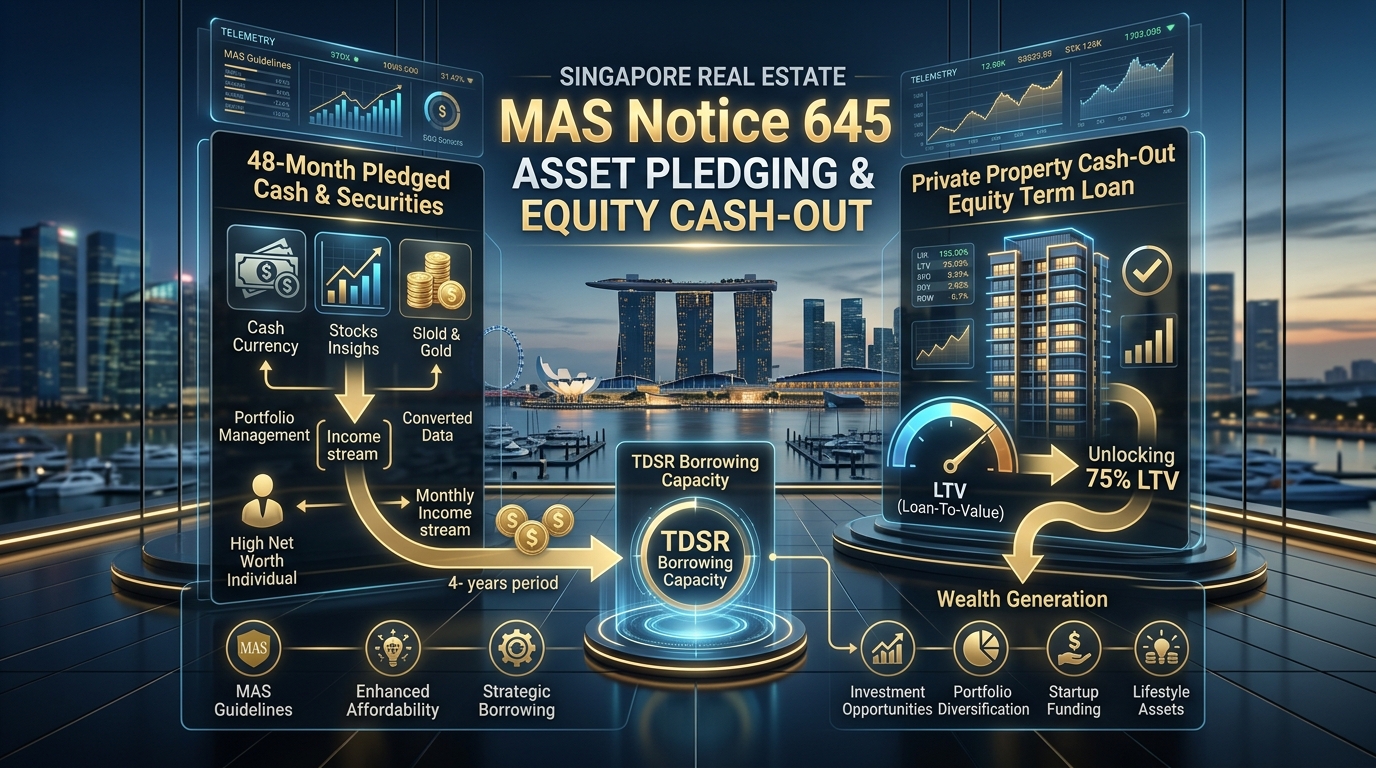
In Singapore's prime residential property market, a frequent financing paradox emerges: affluent business founders, venture-backed entrepreneurs, equity traders, and family office principals with tens of millions in net worth frequently fail standard bank loan approvals.
The culprit is the Total Debt Servicing Ratio (TDSR) framework governed by Monetary Authority of Singapore (MAS) Notices 645 and 1115. TDSR strictly caps a borrower's total monthly debt obligations at 55% of verifiable monthly gross income, stress-tested against a regulatory floor interest rate of 4.0% p.a..
For individuals who draw low or zero fixed statutory salaries—relying instead on annual dividends, capital gains, carried interest, or retained corporate earnings—traditional income verification fails.
Fortunately, MAS regulations provide a powerful institutional mechanism: Asset-Based Lending (ABL) via Eligible Financial Assets (EFAs).
The Two Pathways: Pledged vs Unpledged Assets
Under MAS Notice 645, borrowers can convert liquid capital reserves directly into qualifying monthly income using two statutory approaches:
```mermaid flowchart TD A["Eligible Financial Assets (EFA)<br/>(Cash, Bonds, Equities, Gold)"] --> B{"Choose Method"}
B -->|"Option 1: Pledging<br/>(4-Year Bank Lien)"| C["Haircut: 0% (Cash SGD)<br/>Formula: Value / 48 Months"] C --> D["Higher Income Recognition<br/>S$1,000,000 = S$20,833 / Month"]
B -->|"Option 2: Unpledged<br/>(Show Money / No Lock-In)"| E["Haircut: 70% (Mandatory)<br/>Formula: (Value × 30%) / 48 Months"] E --> F["Zero Capital Lock-In<br/>S$1,000,000 = S$6,250 / Month"] ```
1. Pledged Assets (The 4-Year Collateral Lien)
Under the Pledging route, the borrower agrees to place qualifying liquid assets on fixed deposit with the lending bank under a formal legal charge for a minimum tenure of 48 months (4 years).
- Haircut: 0% for Singapore Dollar (SGD) cash deposits. (30% haircut applies to non-cash eligible assets like equities and bonds).
- Income Formula:
$$\text{Imputed Monthly Income} = \frac{\text{Pledged Asset Value}}{48\text{ months}}$$
- Example:
Pledging S$1,000,000 in SGD fixed deposit generates: $$\frac{\text{SGD }1,000,000}{48\text{ months}} = \text{SGD }20,833\text{ / month}$$
At a 55% TDSR threshold and 4.0% stress test, this S$20,833/month imputed income supports an additional loan capacity of ~S$2.3 million on a 25-year mortgage.
Liquidity Advantage: The funds remain in the borrower's name and continue to earn fixed deposit interest throughout the 4-year lien, which is paid directly to the borrower.
2. Unpledged Assets (Show Money: Zero Lock-In)
For active business operators who need full liquidity and cannot lock up working capital for four years, the Unpledged Assets (Show Money) route provides complete freedom.
The borrower simply proves they possess the liquid assets in verifiable accounts for a minimum seasoning period (typically 1 to 3 consecutive bank statements). Once the loan is disbursed, the funds are completely unencumbered and can be deployed back into business operations.
- Haircut: 70% statutory discount (MAS mandates that only 30% of the asset value can be recognized).
- Income Formula:
$$\text{Imputed Monthly Income} = \frac{\text{Unpledged Asset Value} \times 30\%}{48\text{ months}}$$
- Example:
Showing S$1,000,000 in unpledged cash generates: $$\frac{\text{SGD }1,000,000 \times 0.30}{48\text{ months}} = \text{SGD }6,250\text{ / month}$$
How Much Unpledged Capital is Required?
To bridge common loan deficits via the Unpledged route:
| Desired Imputed Monthly Income | Equivalent Mortgage Headroom | Unpledged Cash Required (70% Haircut) |
|---|---|---|
| S$5,000 / month | ~S$550,000 | S$800,000 |
| S$10,000 / month | ~S$1,100,000 | S$1,600,000 |
| S$20,000 / month | ~S$2,200,000 | S$3,200,000 |
| S$50,000 / month | ~S$5,500,000 | S$8,000,000 |
Eligible Financial Assets: What MAS Recognizes
Not all assets qualify under MAS Notice 645. Here is the statutory asset hierarchy:
<div class="my-8 grid gap-4 sm:grid-cols-2"> <div class="rounded-xl border border-emerald-500/30 bg-emerald-950/10 p-5"> <div class="text-emerald-400 font-bold text-sm mb-2 font-serif uppercase tracking-wider"> ✓ Fully Allowable Assets </div> <ul class="text-xs text-muted-foreground space-y-2"> <li>• <strong>Cash Deposits</strong>: SGD & major currencies (USD, EUR, GBP, AUD, HKD).</li> <li>• <strong>Listed Equities</strong>: Stocks listed on SGX or Tier-1 approved global exchanges (NYSE, NASDAQ, LSE).</li> <li>• <strong>Investment-Grade Bonds</strong>: Sovereign bonds and corporate paper rated BBB- or higher.</li> <li>• <strong>Unit Trusts & CIS</strong>: Collective investment schemes managed by MAS-licensed fund managers.</li> <li>• <strong>Physical Gold & Gold Certificates</strong>: Held with accredited bullion depositories.</li> </ul> </div>
<div class="rounded-xl border border-rose-500/30 bg-rose-950/10 p-5"> <div class="text-rose-400 font-bold text-sm mb-2 font-serif uppercase tracking-wider"> ✕ Disallowed Assets </div> <ul class="text-xs text-muted-foreground space-y-2"> <li>• <strong>Cryptocurrency & Digital Tokens</strong>: Bitcoin, Ethereum, and stablecoins are non-eligible.</li> <li>• <strong>Private Unlisted Company Shares</strong>: Equity in your own non-public business cannot be pledged.</li> <li>• <strong>Overseas Real Estate Equity</strong>: Properties owned in Malaysia, UK, or Australia cannot serve as liquid collateral.</li> <li>• <strong>Jewellery, Watches & Art Collections</strong>: Non-standard personal luxury assets are excluded.</li> </ul> </div> </div>
Combining Earned Income with Asset Pledging: The Hybrid Structure
The most effective strategy for business owners is the Hybrid Mortgage Structure:
- Declare a base salary or average monthly director fees (subject to the standard 30% variable income haircut under MAS rules).
- Bridge the remaining deficit to your target luxury loan quantum by showing or pledging liquid securities.
By structuring the application with specialized mortgage bankers who understand MAS Notice 645 schedules, high-net-worth borrowers can secure maximum 75% Loan-to-Value (LTV) private bank financing with zero disruption to corporate cash flow.
FAQ
What is the difference between pledged and unpledged assets under MAS TDSR rules?
Under MAS Notice 645, pledged assets (cash or approved fixed deposits placed with the lending bank for at least 4 years) are recognized at 100% of their value for debt servicing calculations. Unpledged liquid assets receive a mandatory 30% statutory haircut and are amortized over 48 months to calculate an imputed monthly income stream.
Statutory Source: Monetary Authority of Singapore (MAS) — Notice 645 Property Loan Regulations & TDSR Limits
Can foreign currency fixed deposits be used for asset-based pledging in Singapore?
Yes, most Singapore licensed financial institutions accept major foreign currencies (USD, GBP, EUR, AUD) for asset pledging, but typically apply an additional foreign exchange haircut (generally 10% to 20%) on top of the statutory MAS framework to account for currency volatility.
Statutory Source: Monetary Authority of Singapore (MAS) — Notice 645 Property Loan Regulations & TDSR Limits
Can I unpledge my funds before the statutory 4-year tenure expires?
If you withdraw or unpledge funds before the agreed tenure without providing substitute collateral or demonstrating sufficient earned income to pass the 55% TDSR threshold, the bank is legally required under MAS guidelines to review the facility, demand partial loan redemption, or increase interest margins.
Statutory Source: Monetary Authority of Singapore (MAS) — MAS Notice 645 Property Loan Regulations & TDSR Limits
Primary References & Statutory Authorities
- Monetary Authority of Singapore (MAS) (2026) MAS Notice 645: Computation of Total Debt Servicing Ratio (TDSR) for Property Loans. Singapore: Monetary Authority of Singapore. Available at: https://www.mas.gov.sg
- Monetary Authority of Singapore (MAS) (2026) MAS Notice 1115: Minimum Cash Downpayment and Loan-to-Value (LTV) Limits for Residential Mortgages. Singapore: Monetary Authority of Singapore.
- Association of Banks in Singapore (ABS) (2026) Singapore Overnight Rate Average (SORA): Key Principles and Transition Methodology. Singapore: ABS.
- Inland Revenue Authority of Singapore (IRAS) (2026) Stamp Duties Act 1929: Schedule of Buyer's Stamp Duty (BSD). Singapore: Singapore Statutes Online. Available at: https://sso.agc.gov.sg
Interactive Strategic Tools & Concierge
Check your maximum mortgage ceiling stress-tested against the MAS 4.0% interest rate floor.
Calculate Borrowing Capacity with TDSR Calculator
Frequently Asked Questions
What is the difference between pledged and unpledged assets under MAS TDSR rules?
Under MAS Notice 645, pledged assets (cash or approved fixed deposits placed with the lending bank for at least 4 years) are recognized at 100% of their value for debt servicing calculations. Unpledged liquid assets receive a mandatory 30% statutory haircut and are amortized over 48 months to calculate an imputed monthly income stream. Statutory Source:** [Monetary Authority of Singapore (MAS) — Notice 645 Property Loan Regulations & TDSR Limits](https://www.mas.gov.sg/regulation/explainers/mort
Can foreign currency fixed deposits be used for asset-based pledging in Singapore?
Yes, most Singapore licensed financial institutions accept major foreign currencies (USD, GBP, EUR, AUD) for asset pledging, but typically apply an additional foreign exchange haircut (generally 10% to 20%) on top of the statutory MAS framework to account for currency volatility. Statutory Source:** Monetary Authority of Singapore (MAS) — Notice 645 Property Loan Regulations & TDSR Limits
Can I unpledge my funds before the statutory 4-year tenure expires?
If you withdraw or unpledge funds before the agreed tenure without providing substitute collateral or demonstrating sufficient earned income to pass the 55% TDSR threshold, the bank is legally required under MAS guidelines to review the facility, demand partial loan redemption, or increase interest margins. Statutory Source:** [Monetary Authority of Singapore (MAS) — MAS Notice 645 Property Loan Regulations & TDSR Limits](https://www.mas.gov.sg/regulation/explainers/mortgage-equity-withdrawal-lo
Statutory References & Citations
- Monetary Authority of Singapore (MAS) (2026). Notice 645: Computation of Total Debt Servicing Ratio (TDSR) for Property Loans. Singapore: MAS.
Statutory Disclaimer: This guide is published for strategic, educational, and institutional planning purposes only and does not constitute formal legal, taxation, or financial advice. All property transactions, stamp duty remissions, and financing structures should be formally verified with qualified Singapore legal counsel and certified tax advisors.