 PropAce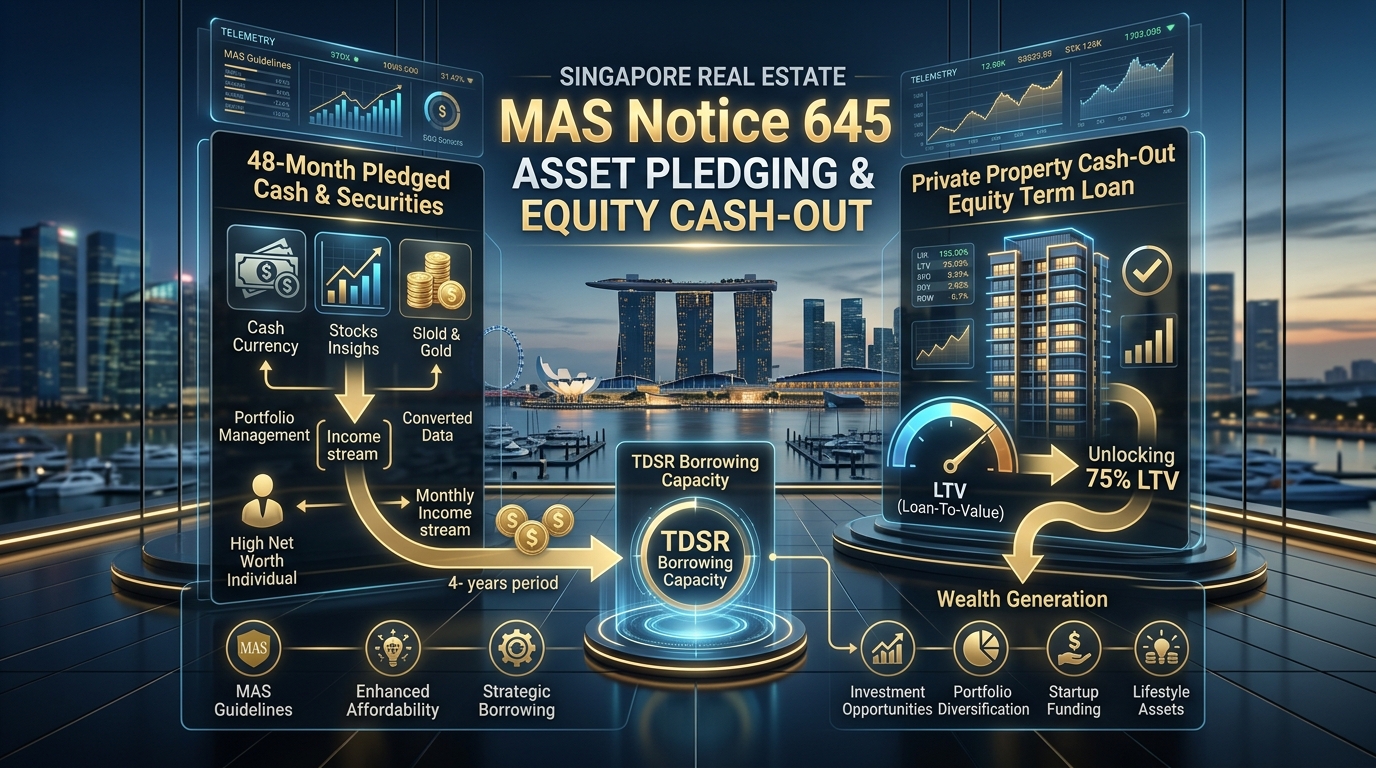
Singapore's strict macroprudential mortgage regulations—anchored by the Total Debt Servicing Ratio (TDSR) framework capping total monthly debt obligations at 55% of gross monthly income—ensure robust household balance sheets. However, for retirees, entrepreneurs, independent investors, and high-net-worth individuals whose wealth is stored in liquid assets or real estate rather than fixed monthly employment salaries, the TDSR can pose an unexpected constraint.
To address this, the Monetary Authority of Singapore (MAS) provides two institutional financial mechanisms:
- MAS Notice 645 Asset Pledging: Converting verifiable liquid assets and investment portfolios into qualifying monthly income over a 48-month statutory horizon to maximize borrowing capacity.
- Private Cash-Out Equity Term Loans: Monetizing accumulated, unrealized capital gains in private residential property into low-cost liquid capital without relinquishing homeownership.
This guide details the statutory calculations, haircut schedules, and wealth preservation strategies for both facilities.
Launch MAS Notice 645 Asset Pledging Engine · Launch Cash-Out Equity Loan Engine
1. MAS Notice 645: Asset Pledging & Unpledging Framework
Under MAS Notice 645 (Residential Property Loans), financial institutions are permitted to recognize eligible liquid financial assets as income when evaluating a borrower's TDSR compliance.
The 48-Month Statutory Income Formula
Liquid assets are not recognized as a lump sum. Instead, their statutory post-haircut value is divided over a 4-year (48-month) amortization horizon:
Recognized Monthly Income = [Eligible Asset Market Value × (1 - Statutory Haircut)] ÷ 48 Months
This imputed income is added directly to the borrower's gross monthly income, substantially expanding borrowing headroom.
The 4-Tier MAS Statutory Haircut Schedule
| Asset Classification | MAS Requirement | Statutory Haircut | Recognized Value |
|---|---|---|---|
| Pledged Liquid Cash | Deposited in fixed deposit with lending bank for a minimum lock-in of 48 continuous months. | 0% | 100% |
| Pledged Securities | SGX/MAS approved equities, statutory bonds, unit trusts, or gold custodian accounts locked for 48 months. | 30% | 70% |
| Unpledged Liquid Cash | Verified cash deposit balances shown in bank statements (minimum 3 months). No lock-in required. | 70% | 30% |
| Unpledged Securities | Verifiable investment portfolios and blue-chip equities with accredited institutions. No lock-in required. | 80% | 20% |
Numerical Impact on Borrowing Headroom
Consider an investor who pledges S$500,000 in liquid cash:
- Eligible Value: S$500,000 (100% recognized)
- Imputed Monthly Income: S$500,000 / 48 months = S$10,417 / month
- Additional Debt Capacity (at 55% TDSR): Up to S$5,729 / month in allowable mortgage servicing
- Mortgage Borrowing Headroom Unlocked: Up to approximately S$1,150,000 in additional loan quantum (at a 4.0% MAS medium-term stress-test rate over a 25-year tenure).
If the same investor prefers not to lock up capital, S$500,000 in unpledged cash yields S$150,000 in qualifying value (30%), generating S$3,125/month in imputed income.
2. Private Cash-Out Equity Term Loans
When a private condominium or landed residential property experiences substantial capital appreciation over time, that wealth remains locked in the property. A Cash-Out Equity Term Loan allows owners to extract this equity in cash at competitive mortgage interest rates (typically 3.2% to 3.8% p.a.), rather than selling the home or resorting to high-cost unsecured credit (8% to 18% p.a.).
The Strict HDB Prohibition
Under Ministry of National Development (MND) and HDB housing regulations, cash-out equity term loans are strictly prohibited on all HDB flats, regardless of whether the flat is fully paid or has significant market value.
Only private residential properties (condominiums, private apartments, cluster housing, and landed properties) are eligible for equity extraction.
The Statutory Equity Loan Formula
MAS banking regulations enforce a strict statutory waterfall. The maximum permissible equity term loan is capped at 75% of the property's current independent market valuation, less all encumbrances and prior retirement claims:
Maximum Equity Loan = (Current Bank Valuation × 75%) - Outstanding Bank Loan - Total CPF Withdrawn & Accrued Interest
Why CPF Monies Must Be Subtracted
The CPF Board maintains a statutory first charge over any residential property where CPF Ordinary Account savings were deployed.
Because cash-out equity loan proceeds are disbursed in unrestricted liquid cash, banking laws prevent borrowers from liquidating equity that legally belongs to their CPF retirement safety net. If you have utilized S$400,000 in CPF OA principal and accrued interest, that entire S$400,000 must be sheltered and deducted before any cash-out equity can be disbursed.
3. Institutional Worked Simulation: Monetizing a Private Property
Consider an executive who purchased a prime condominium 12 years ago that has appreciated substantially:
Property Balance Sheet
- Current Bank Valuation: S$3,000,000
- Statutory 75% LTV Cap: S$2,250,000
- Current Outstanding Bank Mortgage: -S$350,000
- Total CPF Principal Used: -S$220,000
- Total CPF Accrued Interest (2.5% p.a.): -S$55,000
- Estimated Legal & Valuation Expenses: -S$3,500
Equity Loan Calculation
Allowable Equity Loan = S$2,250,000 - S$350,000 - (S$220,000 + S$55,000) = S$1,625,000
- Net Cash Disbursed to Borrower: S$1,621,500
- Monthly Repayment on Equity Loan: Approximately S$7,860 / month (at 3.2% p.a. over a 25-year tenure)
- Retained Homeownership: The borrower retains 100% title ownership, continuing to enjoy capital growth and rental yields.
4. Strategic Applications of Cash-Out Equity
- Portfolio Expansion & Commercial Acquisitions: Deploying extracted cash to fund the downpayment of 0% ABSD commercial offices, medical suites, or shophouses without liquidating equity markets.
- Positive Carry Arbitrage: Deploying capital borrowed at residential mortgage rates (3.2% - 3.8%) into investment-grade corporate bonds or dividend portfolios yielding 5.5% to 7.0%.
- Generational Wealth Planning: Providing liquidity to fund adult children's first home purchases or overseas tertiary education at low mortgage financing rates.
- Debt Optimization: Consolidating higher-cost business overdrafts or credit lines into structured, long-tenure real estate financing.
5. Regulatory Underwriting & Risk Factors
- TDSR Stress Testing Still Applies: The monthly repayment of the cash-out equity loan must fit within the borrower's 55% TDSR limit alongside existing mortgages and credit obligations, assessed at the MAS medium-term stress interest rate (4.0%).
- Loan Tenure Constraints: The tenure of the equity term loan is capped such that the sum of the loan tenure and the borrower's age cannot exceed age 75 (or a maximum of 30 to 35 years).
- No CPF Servicing for Equity Loans: Monthly servicing on cash-out equity term loans must be paid 100% in cash. CPF Ordinary Account funds cannot be used to repay an equity term loan facility.
To model your asset pledging income boosts or calculate your property's cash-out equity potential:
Simulate MAS Notice 645 Asset Pledging · Simulate Private Cash-Out Equity Loan