 PropAce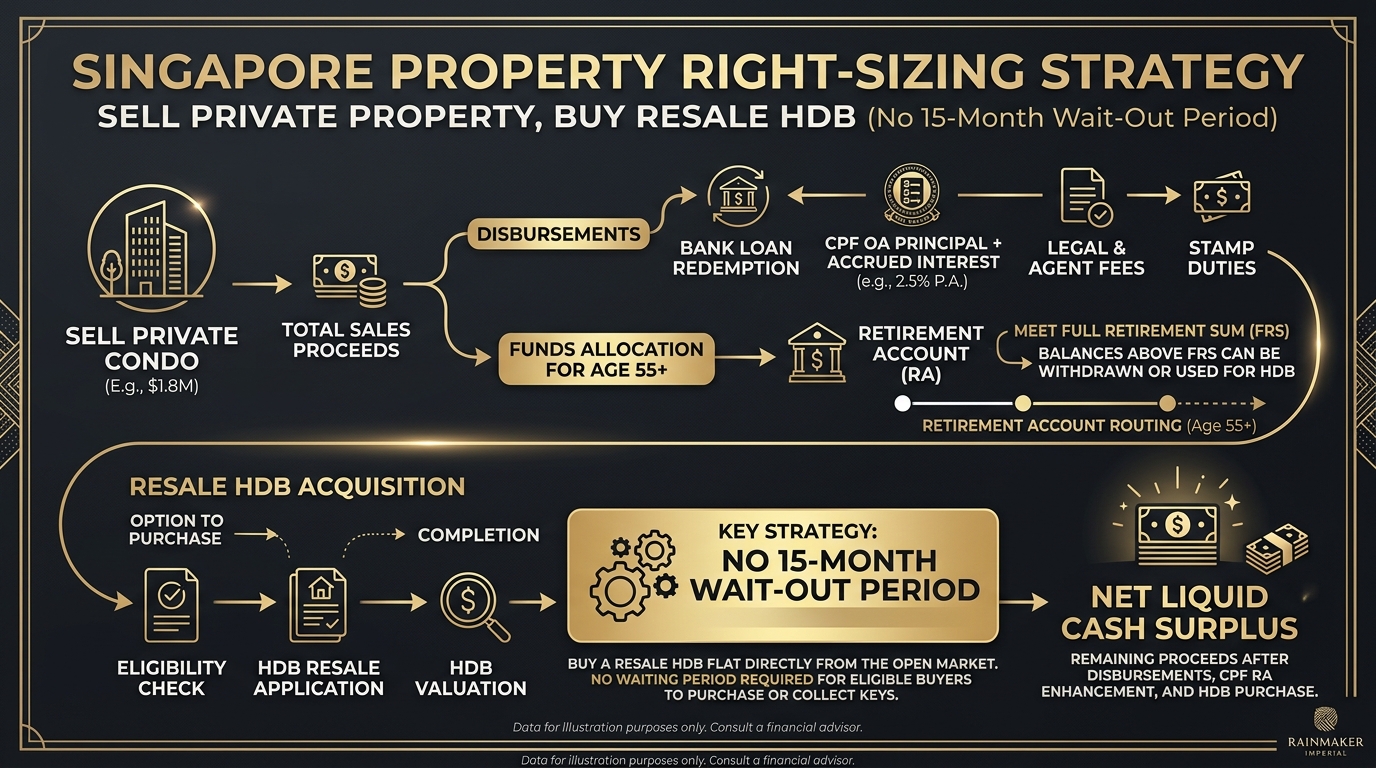
Families whose Build-To-Order (BTO) flats are delayed should not expect a single national waiting-time figure for interim HDB rental flats or Parenthood Provisional Housing Scheme (PPHS) units; the Ministry of National Development's written answer instead describes a case-by-case allocation that turns on estate, flat type and urgency (Ministry of National Development, 2026).
Key takeaways
- MND treats interim housing as a needs-based bridge, not a first-come-first-served queue; waiting times depend on the estates and flat types applicants are willing to accept (Ministry of National Development, 2026).
- Private rents in District 26 rose 15.7% year-on-year to S$4.19 psf per month in 2026-Q2, underlining the financial bite of any BTO delay for families forced into the open market (URA, 2026).
- Islandwide HDB prices stood at S$652 psf in 2026-Q2, exactly level with the previous peak and 57.5% above the cycle trough of S$414 psf (URA, 2026).
- New-launch private homes averaged S$2,303 psf against S$1,594 psf for resale — a roughly 45% premium that makes the choice between interim renting and buying resale a pivotal decision (URA, 2026).
- For families with children, PPHS remains a targeted option, but availability and location preference will determine how long the wait actually lasts (Ministry of National Development, 2026).
What MND's written answer says about interim housing
Allocation is prioritised, not a fixed queue
The written answer addresses a question that has become more urgent as BTO completion dates slip: how long does a family actually wait for temporary accommodation? The ministry's reply avoids giving a single median figure, pointing instead to the variables that shape each applicant's experience. These include the type of interim housing sought — an HDB rental flat versus a PPHS unit — the estates selected, and the household's personal circumstances (Ministry of National Development, 2026). In effect, the waiting time is a function of supply and choice, not a universal counter that starts the day a BTO is delayed.
Two schemes, one bridging purpose
Interim HDB rental flats and PPHS units serve overlapping but distinct functions. Interim rental flats are temporary public housing for households that have booked a BTO flat and need somewhere to live before collection. PPHS is aimed at couples and families with children who are in the same position, often with a stronger emphasis on family-friendly allocation. Both are stopgaps; neither is intended as long-term accommodation. The ministry's answer reinforces that the goal is to keep families housed through the gap between their old home and their new flat, without letting the private rental market become the default fallback (Ministry of National Development, 2026).
Why BTO delays have pushed interim housing up the agenda
The cost of waiting in the open market
BTO delays matter more when the alternative is expensive. Private rental costs have not stood still. In 2026-Q2, District 26 rents climbed 15.7% year-on-year to S$4.19 psf per month, according to URA rental data published via data.gov.sg (URA, 2026). For a family waiting a year or more for a delayed flat, that is not a marginal line item; it is a recurring monthly commitment that can easily rival a mortgage payment. The higher the rent, the more valuable a subsidised interim HDB rental slot becomes.
Resale becomes a real — but costly — alternative
Recent policy changes have widened the path back into HDB resale. The removal of the 15-month wait-out period for eligible private homeowners seeking HDB resale flats gives owners more flexibility, but it does not solve the affordability equation. The same URA caveat data shows islandwide HDB prices at S$652 psf in 2026-Q2, statistically level with the cycle peak and 57.5% above the S$414 psf trough (URA, 2026). That means a family considering pulling out of a delayed BTO and buying resale is not buying at a discount; it is buying into a market that has already re-rated significantly.
The gap between booking and building
There is also a timing mismatch that the written answer implicitly acknowledges. Families can book a BTO flat years before it is ready, and their housing situation can change dramatically in that interval. A couple may have a child, a parent may move in, or an existing lease may expire. Interim housing exists to absorb those changes, but it can only do so if the allocation process is responsive. MND's answer suggests that responsiveness depends on the applicant making realistic choices about where and what to accept (Ministry of National Development, 2026).
The market data behind the interim-housing wait
HDB and private price cycles, side by side
The numbers frame the entire debate. In 2026-Q2, islandwide HDB prices averaged S$652 psf — the same level as the previous peak, and 57.5% above the S$414 psf trough (URA, 2026). Private prices averaged S$2,038 psf, 6.8% below the S$2,186 psf peak but still 33.3% above the S$1,529 psf trough (URA, 2026). In other words, both segments have recovered decisively from their lows, and neither offers much downside cushion for a family that is waiting rather than transacting.
The new-sale premium and segment splits
The transaction record adds another layer. New-launch private homes averaged S$2,303 psf in 2026-Q2, against S$1,594 psf for resale — a roughly 45% premium for buying new (URA, 2026). Across regions, prime-core (CCR) homes averaged S$2,444 psf, city-fringe (RCR) S$2,078 psf, and suburban (OCR) S$1,551 psf (URA, 2026). These figures explain why a family that loses confidence in a BTO timeline may still hesitate to pivot: the alternative is either an expensive new launch or a resale market that has already climbed far above its trough. The interim housing decision is therefore not just about waiting; it is about what waiting does to a household's ultimate purchase power.
A worked breakdown: what a delayed family's numbers look like
Renting privately while the BTO slips
Consider a family with a booked four-room BTO that faces a one-year completion delay and cannot secure an interim HDB rental flat quickly. If they turn to the private rental market in District 26, the 2026-Q2 average rent of S$4.19 psf per month means a notional 1,000 sq ft unit would cost roughly S$4,190 a month before utilities and other expenses (URA, 2026). Over 12 months, that is an outlay of around S$50,280 — a substantial sum that does not build any equity.
The buy-resale alternative, priced in psf
The same family might instead decide to buy a resale flat immediately and give up the BTO. At the islandwide HDB average of S$652 psf, a notional 90 sqm (about 969 sq ft) flat would cost roughly S$632,000 at that rate, though actual prices vary by estate and lease (URA, 2026). The key point is that they would be paying a price that is 57.5% above the cycle trough — and in a market that is no longer discounting for uncertainty (URA, 2026). By contrast, holding on to the BTO booking and waiting for interim housing preserves the option to buy a new flat at a contracted price, but it forces the family to absorb the rent and uncertainty in the interim.
The decision, simplified
The choice comes down to two different risks. Buying resale in the current market means paying up for certainty today. Waiting for the BTO means relying on interim housing, with the possibility that the allocated unit is in a less convenient estate. MND's written answer suggests that families willing to accept such placements can shorten their wait (Ministry of National Development, 2026). For a family with limited mobility or a need to stay near a particular school, however, flexibility may not be a realistic option — which is why the waiting-time framework cannot be reduced to a single number.
How the allocation framework translates into actual waiting times
What determines the wait
Three factors dominate, according to the ministry's reply: the type of interim housing applied for, the applicant's estate preferences, and whether the household has urgent housing needs (Ministry of National Development, 2026). A family that applies for a PPHS unit in a mature estate with high demand is likely to wait longer than one open to flats in a less crowded location. Likewise, applicants who can accept a range of flat types give HDB more options to match them to what is available. The estimated waiting time is therefore not a fixed date; it is a moving target shaped by the applicant's own choices.
What families should do while waiting
The practical implication is to apply early and be explicit about constraints. Families should list all acceptable estates, not just their first choice. They should also inform HDB of any changes in household circumstances, such as the birth of a child or a medical condition, which may improve their priority. MND's written answer points to needs-based allocation, so documentation matters (Ministry of National Development, 2026). At the same time, families should keep monitoring the underlying BTO project's revised completion date — the length of interim housing is ultimately tied to when the new flat is ready.
The bigger picture: supply, delays, and the policy response
More flats are coming, but not overnight
The long-term answer to BTO delays is more supply. Over the next few years, the overall stock of public housing is set to increase, which should ease both the BTO queue and the pressure on interim housing. But supply additions take time to translate into completed flats. In the near term, the government has signalled a willingness to build more and build faster, even as it weighs competing demands for land and infrastructure. For families already caught in a delay, that is cold comfort.
Interim housing as a market stabiliser
There is also a broader market angle. When interim housing is readily accessible, fewer families are forced into expensive private rentals, reducing the demand-side pressure on rents. That makes the allocation framework described in MND's written answer more than a social safety net; it is a quiet but important stabiliser for the broader rental market. The fact that private rents in District 26 have risen 15.7% year-on-year shows what happens when alternatives are scarce (URA, 2026). A smoother interim housing pipeline would not eliminate such pressures, but it would give delayed families a credible alternative to the open market.
FAQ
What is the difference between an interim HDB rental flat and a PPHS flat?
Interim HDB rental flats are temporary public rental units for households that have booked a BTO flat and need accommodation before collection. PPHS flats are a similar bridging option but are targeted at couples and families with children who are waiting for their new home. Both are allocated by HDB on the basis of need, availability, and the applicant's location and flat-type preferences (Ministry of National Development, 2026).
Statutory Source: Housing & Development Board (HDB) — Official Housing Policies & Resale Guidelines
Who qualifies for interim housing after a BTO delay?
Households generally need a valid BTO booking and a demonstrated housing need, such as having sold their previous flat or facing a long wait. Families with children are usually prioritised for PPHS. MND's written answer indicates that each application is assessed on its specific circumstances, so applicants with urgent housing needs should provide full supporting information (Ministry of National Development, 2026).
Statutory Source: Housing & Development Board (HDB) — Official Housing Policies & Resale Guidelines
How long can a family stay in interim housing?
Interim housing is meant to be temporary, and the tenancy is typically tied to the expected completion date of the booked BTO flat. Families are expected to move out once their new flat is ready, although exceptional cases may be considered. The ministry's reply does not suggest open-ended tenure (Ministry of National Development, 2026).
Statutory Source: Housing & Development Board (HDB) — Official Housing Policies & Resale Guidelines
Does accepting interim housing affect BTO eligibility or grants?
No, accepting interim housing does not cancel a BTO booking or change the household's grant eligibility, provided the family continues to meet the eligibility conditions at key collection. Interim rental and PPHS are separate from the ownership of the eventual flat. However, applicants should inform HDB of any change in household composition during the wait.
Statutory Source: Housing & Development Board (HDB) — CPF Housing Grants Framework
What should a family do if no interim unit is available in their preferred estate?
The most effective step is to broaden the range of acceptable estates and flat types. MND's written answer shows that flexibility shortens waiting times (Ministry of National Development, 2026). Families should also monitor HDB's regular offers and update their application if their circumstances become more urgent.
Statutory Source: Housing & Development Board (HDB) — Official Housing Policies & Resale Guidelines
By the numbers
``` HDB PSF momentum by district — QoQ %
D? +8.2% ██████████████████████████ D? +7.6% ████████████████████████ D? +2.9% █████████ D? +2.9% █████████ D? +2.4% ████████ D? +2.2% ███████ D? +1.7% █████ D? +1.7% █████ D? +1.5% █████ D? +0.7% ██ ```
| District | Median PSF | QoQ | YoY | Txns (3mo) |
|---|---|---|---|---|
| D? | $964 | ▲ 8.2% | ▲ 7.5% | 190 |
| D? | $834 | ▲ 7.6% | ▲ 7.9% | 216 |
| D? | $705 | ▲ 2.9% | ▲ 4.9% | 32 |
| D? | $644 | ▲ 2.9% | ▲ 2.9% | 321 |
| D? | $824 | ▲ 2.4% | ▲ 1.2% | 209 |
| D? | $595 | ▲ 2.2% | ▲ 0.8% | 207 |
| D? | $773 | ▲ 1.7% | ▲ 5.9% | 112 |
| D? | $536 | ▲ 1.7% | ▲ 0.8% | 254 |
| D? | $665 | ▲ 1.5% | ▲ 0.3% | 102 |
| D? | $691 | ▲ 0.7% | ▲ 1.0% | 442 |
_Data: PropAce Institutional Advisory analysis of URA/HDB transaction data — rolling 3-month average PSF, HDB, 2026-06..2026-08. Directional; confirm before acting._
Sources
- URA rental data (via data.gov.sg), compiled by PropAce Institutional Advisory— 2026Q2.
- URA caveat data, compiled by PropAce Institutional Advisory— 2026-Q2.
- URA caveat data, compiled by PropAce Institutional Advisory.
References
- Ministry of National Development (2022) Written Answer by Ministry of National Development on estimated waiting time for an interim HDB rental flat or a flat under the Parenthood Provisional Housing Scheme (PPHS) to be allocated to those affected by BTO completion delays.
Interactive Strategic Tools & Concierge
Institutional-grade financial engines for Singapore real estate: stamp duties, borrowing capacity, and cashflow modeling.
Explore All 11 PropAce Financial Calculators
Frequently Asked Questions
What is the difference between an interim HDB rental flat and a PPHS flat?
Interim HDB rental flats are temporary public rental units for households that have booked a BTO flat and need accommodation before collection. PPHS flats are a similar bridging option but are targeted at couples and families with children who are waiting for their new home. Both are allocated by HDB on the basis of need, availability, and the applicant's location and flat-type preferences (Ministry of National Development, 2026). Statutory Source:** [Housing & Development Board (HDB) — Official
Who qualifies for interim housing after a BTO delay?
Households generally need a valid BTO booking and a demonstrated housing need, such as having sold their previous flat or facing a long wait. Families with children are usually prioritised for PPHS. MND's written answer indicates that each application is assessed on its specific circumstances, so applicants with urgent housing needs should provide full supporting information (Ministry of National Development, 2026). Statutory Source:** [Housing & Development Board (HDB) — Official Housing Polici
How long can a family stay in interim housing?
Interim housing is meant to be temporary, and the tenancy is typically tied to the expected completion date of the booked BTO flat. Families are expected to move out once their new flat is ready, although exceptional cases may be considered. The ministry's reply does not suggest open-ended tenure (Ministry of National Development, 2026). Statutory Source:** [Housing & Development Board (HDB) — Official Housing Policies & Resale Guidelines](https://www.hdb.gov.sg/cs/infoweb/residential/buying-a-f
Does accepting interim housing affect BTO eligibility or grants?
No, accepting interim housing does not cancel a BTO booking or change the household's grant eligibility, provided the family continues to meet the eligibility conditions at key collection. Interim rental and PPHS are separate from the ownership of the eventual flat. However, applicants should inform HDB of any change in household composition during the wait. Statutory Source:** [Housing & Development Board (HDB) — CPF Housing Grants Framework](https://www.hdb.gov.sg/cs/infoweb/residential/buying
What should a family do if no interim unit is available in their preferred estate?
The most effective step is to broaden the range of acceptable estates and flat types. MND's written answer shows that flexibility shortens waiting times (Ministry of National Development, 2026). Families should also monitor HDB's regular offers and update their application if their circumstances become more urgent. Statutory Source:** Housing & Development Board (HDB) — Official Housing Policies & Resale Guidelines
Statutory References & Citations
- Housing & Development Board (HDB) (2026). Housing and Development Act (Cap. 129). Singapore: Ministry of National Development.
- Singapore Land Authority (SLA) (2026). Land Titles Act (Cap. 157) & Conveyancing Registration Framework. Singapore: SLA.
Statutory Disclaimer: This guide is published for strategic, educational, and institutional planning purposes only and does not constitute formal legal, taxation, or financial advice. All property transactions, stamp duty remissions, and financing structures should be formally verified with qualified Singapore legal counsel and certified tax advisors.