 PropAce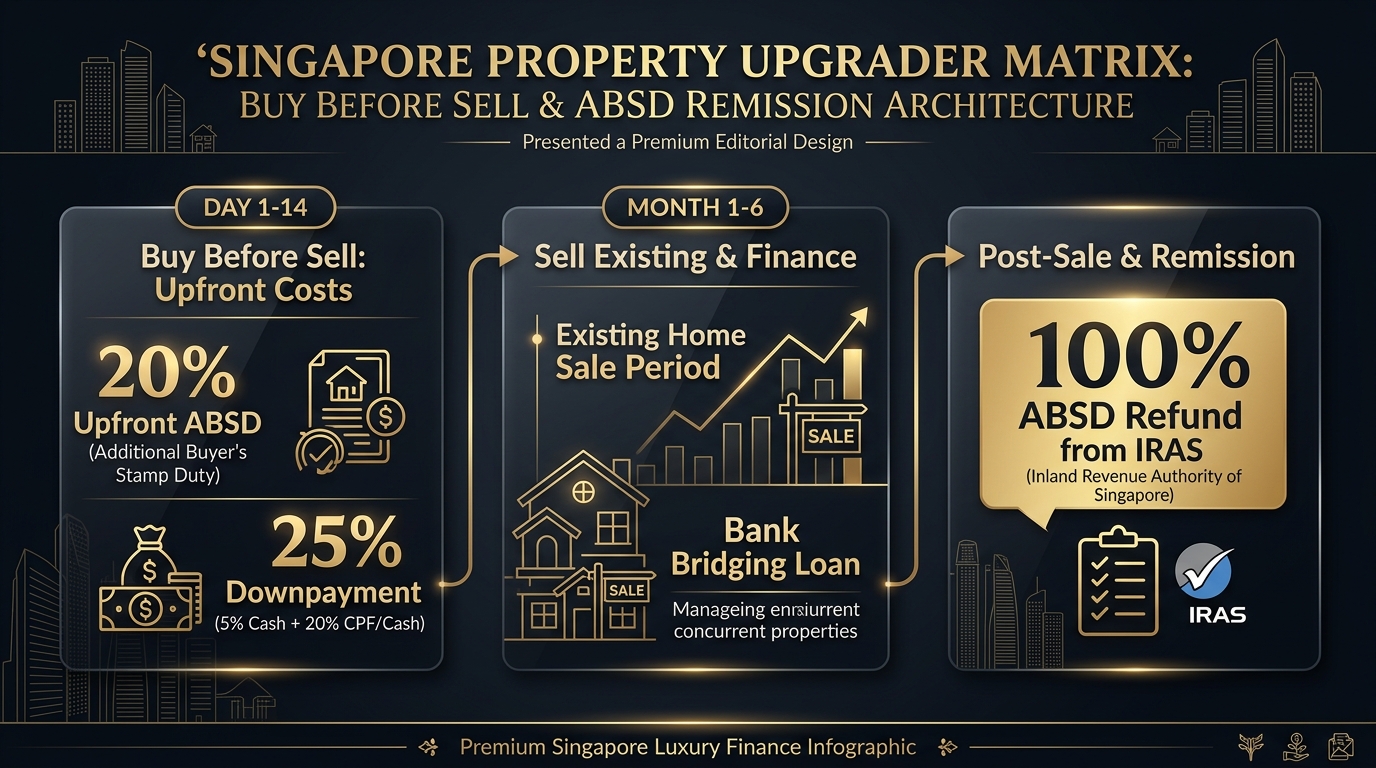
Upgrading from an existing home to a larger condominium or prime family residence is one of the most significant wealth transitions for Singaporean households. Yet homeowners routinely face an agonizing logistical dilemma: Sell First or Buy First?
- Selling first guarantees you avoid upfront stamp duties and frees your capital, but forces your family into temporary interim rental accommodations, double relocation costs, and the risk of being priced out of a rising market.
- Buying first provides a seamless, stress-free move directly from your existing property into your newly renovated home. However, it triggers a mandatory upfront 20% Additional Buyer's Stamp Duty (ABSD) alongside strict banking and CPF utilization boundaries.
For married couples where at least one spouse is a Singapore Citizen, the Inland Revenue Authority of Singapore (IRAS) provides a statutory 100% ABSD Remission.
This guide details the exact statutory conditions, bridging loan mechanics, and CPF liquidity sequencing required to execute a seamless transition without capital shortfall.
Launch Interactive Buy Before Sell Calculator
1. Statutory Eligibility for IRAS ABSD Remission
Under Section 33B of the Stamp Duties Act and IRAS guidelines, a married couple can claim a full refund of the upfront ABSD paid on their replacement property, provided all five statutory criteria are satisfied:
| Statutory Criterion | Regulatory Requirement |
|---|---|
| Citizenship Profile | The matrimonial couple must include at least one Singapore Citizen (SC). Married couples comprising two Singapore Permanent Residents (SPRs) or foreigners do not qualify. |
| Ownership Structure | The replacement residential property must be purchased jointly by both spouses only, or solely by the Singapore Citizen spouse. |
| Property Count at Acquisition | Neither spouse may own any third or subsequent residential property interest on the date of acquiring the replacement home. |
| Disposal Deadline | The first property must be sold within 6 months from: (a) Date of purchase/Option Exercise of completed property, or (b) Date of Temporary Occupation Permit (TOP) or Certificate of Statutory Completion (CSC) for uncompleted properties (BUC), whichever is earlier. |
| Claim Submission Deadline | The formal ABSD remission application must be lodged with IRAS within 6 months from the date of disposal (completion or sale contract date) of the first property. |
Statutory Warning: IRAS strictly enforces the 6-month disposal deadline. Late submissions or delays in finding a buyer for Property 1 will cause the entire upfront ABSD to be permanently forfeited. No discretionary extensions are granted.
2. Upfront Capital Architecture: The Day 1-14 Cash Outlay
When executing a "Buy Before Sell" strategy, the financial commitment is heavily frontloaded:
- Option Fee (5% Cash): Paid upon granting of the Option to Purchase (OTP).
- Exercise Fee (15% Cash/CPF): Paid upon exercising the OTP within the standard 14 to 21-day option validity period.
- Buyer's Stamp Duty (BSD): Calculated on standard tiered residential rates (up to 6% for values exceeding S$3,000,000), payable within 14 days of OTP exercise.
- Upfront 20% ABSD: Even though you intend to sell Property 1, IRAS treats Property 2 as your second residential home on Day 1. The full 20% ABSD must be remitted in cash or CPF within 14 days of exercising the OTP.
Illustrative Upfront Stamp Duty Table (S$2,500,000 Purchase)
For a Singapore Citizen married couple acquiring a S$2,500,000 replacement home:
- Tiered BSD: S$89,600
- Upfront 20% ABSD: S$500,000
- Total Initial Stamp Duty Outlay: S$589,600
All stamp duties must be settled within the 14-day statutory timeline. If CPF Ordinary Account balances are insufficient or pending approval, the shortfall must be covered in liquid cash.
3. The CPF Disconnect & Bridging Loan Architecture
The greatest financial trap for upgraders is assuming that equity and CPF OA funds from Property 1 can be applied directly to complete the purchase of Property 2.
Why CPF Monies Cannot Cross Over Immediately
When you enter a contract to purchase Property 2, your CPF OA funds are still legally locked inside Property 1. Under CPF Board rules:
- Monies used to service Property 1 cannot be released until Property 1 completes legal conveyancing.
- Conveyancing completion typically occurs 10 to 12 weeks after the buyer of Property 1 exercises their Option to Purchase.
- Consequently, if Property 2 completes before Property 1, there is a substantial liquidity gap.
The Banking Bridging Loan Solution
To bridge this gap without liquidating long-term investments, MAS-regulated financial institutions offer Bridging Loans:
- Facility Quantum: Up to the net equity and CPF funds to be refunded from Property 1, or up to the downpayment requirements of Property 2.
- Tenure: Up to a statutory maximum of 6 months.
- Collateral: Backed by the signed and exercised binding sale agreement (OTP) of Property 1.
- Interest Mechanism: Short-term servicing (typically prime lending rate or SORA plus spread), with principal redeemed in a single bullet payment once proceeds from Property 1 are disbursed by your conveyancing lawyer.
4. End-to-End Upgrader Worked Case Study
Consider a Singaporean family upgrading from a fully paid S$1,400,000 HDB flat to an uncompleted private condominium valued at S$2,200,000:
Acquisition Phase (Replacement Property: S$2,200,000)
- Minimum 5% Cash Downpayment: S$110,000
- 20% Balance Downpayment (Cash/CPF): S$440,000
- Tiered Buyer's Stamp Duty (BSD): S$74,600
- Upfront 20% ABSD (Temporary Outlay): S$440,000
- Total Initial Capital Required: S$1,064,600
Disposal Phase & Remission Settlement
- Sale of First Property: Exercised at S$1,400,000 within 3 months of key collection.
- Gross Proceeds Realized: S$1,400,000.
- Lawyer Settles CPF Refund & Disburses Net Cash: Bridging facility redeemed cleanly.
- IRAS Remission Application Lodged: Form submitted within 14 days of legal completion.
- ABSD Refund Credited: IRAS refunds the entire S$440,000 back to the buyers' bank account/CPF accounts.
Final Financial Position
- Net Effective Stamp Duty Paid: S$74,600 (Standard BSD only).
- Net Outlay for Replacement Property: Exactly equivalent to a single-property acquisition.
- Family Experience: Zero interim relocation, zero double handling of furniture, and zero temporary rental costs.
5. Strategic Rules for Upgraders
- Secure In-Principle Approval (IPA) Early: Ensure your lending bank qualifies your household under the Total Debt Servicing Ratio (TDSR) framework, accounting for both the primary mortgage and any bridging facility.
- Time the 6-Month Clock Accurately: For completed resale homes, the 6-month countdown begins on the contract date of the purchase OTP exercise, not completion date. For uncompleted developments, it starts from the official TOP date.
- Verify Joint Tenancy Wording: IRAS remission regulations strictly mandate that the replacement property cannot include third-party owners such as parents, children, or non-spouse relatives.
To model your exact upfront cash outlays, bridging facility requirements, and net refund projections: