 PropAce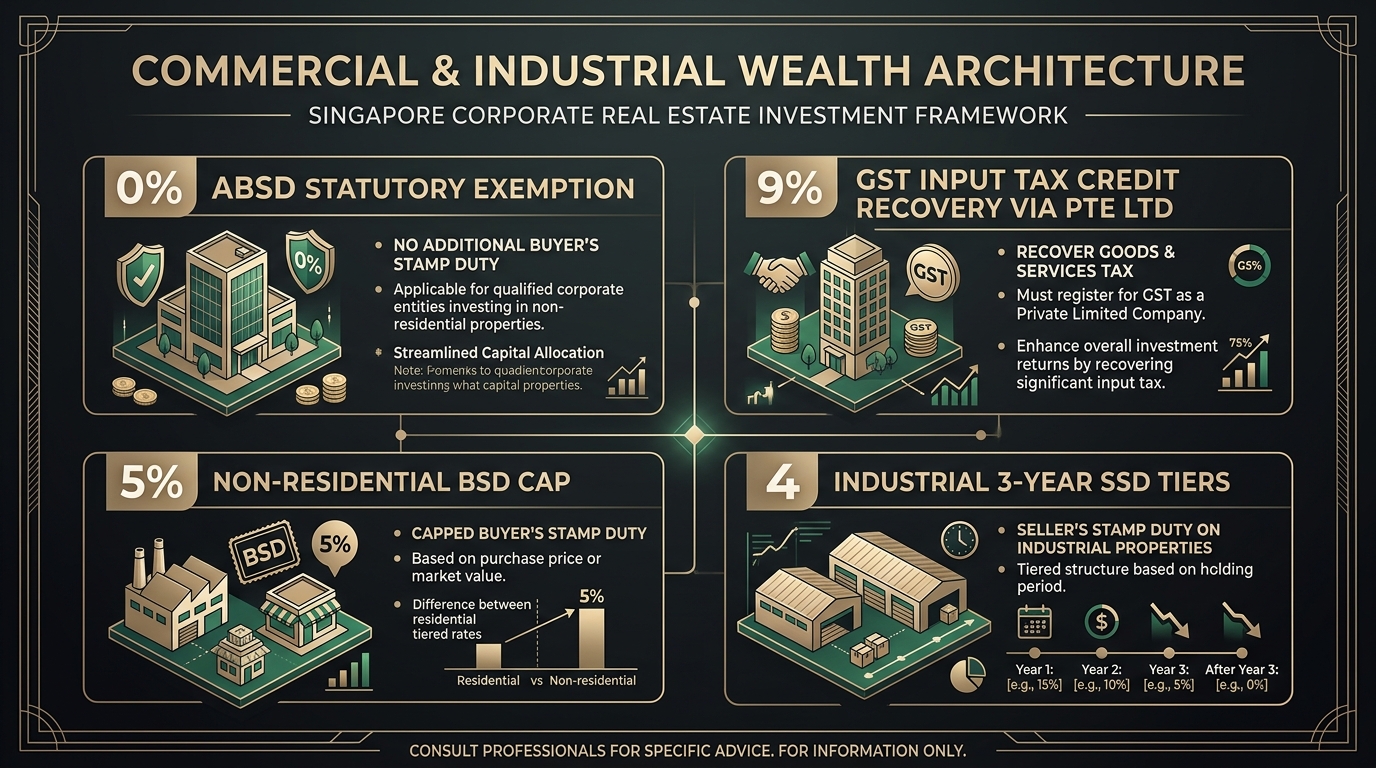
As cooling measures on the Singapore residential market intensified—escalating Additional Buyer's Stamp Duty (ABSD) up to 60% for foreign buyers and 20% to 30% for citizens acquiring multi-property portfolios—institutional capital, family offices, and accredited investors have increasingly diversified into commercial and industrial real estate.
Non-residential real estate operates under an entirely different statutory framework:
- 0% ABSD: Applies universally across all buyers, including foreign nationals, permanent residents, and corporate entities.
- 5% Buyer's Stamp Duty (BSD) Cap: Capped at 5% under IRAS non-residential schedules, compared to 6% for residential acquisitions exceeding S$3,000,000.
- 9% GST Recovery: Full input tax credit refund available when acquiring properties through a GST-registered corporate vehicle.
This guide outlines the statutory regulations, tax mechanisms, and zoning rules governing commercial and industrial property acquisitions in Singapore.
Launch Interactive Commercial & Industrial Engine
1. Statutory Stamp Duty Framework: Residential vs Non-Residential
The core financial advantage of non-residential real estate is the total absence of ABSD, regardless of nationality or existing residential holdings.
| Regulatory Parameter | Residential Property | Commercial & Industrial Property |
|---|---|---|
| Singapore Citizen ABSD (1st / 2nd / 3rd+) | 0% / 20% / 30% | 0% (All Purchases) |
| Permanent Resident ABSD (1st / 2nd / 3rd+) | 5% / 30% / 35% | 0% (All Purchases) |
| Foreign National ABSD | 60% | 0% (All Purchases) |
| Corporate Entity / Trustee ABSD | 65% | 0% (All Purchases) |
| Maximum Buyer's Stamp Duty (BSD) | 6% (Amounts > S$3M) | 5% (Amounts > S$1.5M) |
| CPF Ordinary Account Utilization | Permitted (Within Valuation Limits) | Strictly Prohibited (Cash or Bank Loan only) |
Non-Residential Buyer's Stamp Duty (BSD) Rates
Under IRAS rules, non-residential BSD is structured across progressive tiers:
- First S$180,000: 1%
- Next S$180,000: 2%
- Next S$640,000: 3%
- Next S$500,000: 4%
- Any amount exceeding S$1,500,000: 5%
For an institutional asset valued at S$5,000,000, the total non-residential BSD is S$219,600 (an effective rate of 4.39%), delivering significant transaction fee savings compared to residential acquisitions.
2. The 9% GST Architecture: Corporate Input Tax Recovery
Almost all commercial and industrial real estate transactions by GST-registered sellers attract Singapore's 9% Goods and Services Tax (GST) on the agreed purchase price.
Personal vs Corporate Purchase Impact
- Acquisition by an Individual: If purchased under personal names, the 9% GST is a sunk, non-recoverable capital expense.
- Acquisition via a GST-Registered Pte Ltd: A Singapore Private Limited company registered for GST can claim 100% of the 9% GST back as an Input Tax Credit on its quarterly IRAS Form F5 tax return.
The Cashflow Cycle
- At Completion: The corporate buyer disburses the agreed purchase price plus 9% GST to the vendor's solicitors.
- GST Filing: At the end of the accounting quarter, the company submits its Form F5 filing to IRAS detailing input tax paid.
- IRAS Disbursal: IRAS processes and refunds the full 9% GST quantum directly to the company's bank account within 1 to 2 months of filing.
Liquidity Provision: While 100% recoverable, the 9% GST must be financed upfront at legal completion. Corporate buyers often secure short-term GST bridging facilities from their commercial bank to fund this temporary working capital requirement.
3. Industrial Seller's Stamp Duty (SSD) vs Commercial 0% SSD
Liquidity horizons differ fundamentally between commercial offices/retail spaces and industrial developments.
Commercial Property: 0% SSD
Offices, retail shopping units, medical suites, and commercial shophouses carry 0% Seller's Stamp Duty. Investors are permitted to divest commercial assets at any time post-acquisition without statutory stamp duty penalties.
Industrial Property: 3-Year Tiered SSD
To curb short-term speculative flipping in manufacturing hubs, the Ministry of Finance mandates tiered Seller's Stamp Duty on all industrial properties (B1, B2, and warehouses):
| Holding Period | Statutory Industrial SSD Rate |
|---|---|
| Sold within 1 Year | 15% of actual selling price or market value |
| Sold within 2 Years | 10% of actual selling price or market value |
| Sold within 3 Years | 5% of actual selling price or market value |
| Held more than 3 Years | 0% (Exempt) |
Industrial investors must model their capital holding horizon to ensure disposals occur beyond the 36-month anniversary of purchase.
4. URA Zoning and the 60/40 Industrial Rule
The Urban Redevelopment Authority (URA) enforces strict zoning classifications to protect Singapore's limited industrial land bank for productive manufacturing and economic use.
Zoning Classifications
- Commercial: Offices, retail outlets, banks, F&B establishments. No industrial activities permitted.
- Business 1 (B1): Light industry, software development, data centres, clean manufacturing, research and development. Permissible near residential zones.
- Business 2 (B2): General and heavy manufacturing, warehousing, logistics, transport engineering, metal fabrication. Requires designated environmental buffer zones.
The URA 60/40 Rule
Under URA Master Plan guidelines, every industrial unit must strictly allocate its gross floor area (GFA):
- Minimum 60% Core Industrial Area: Must be used exclusively for core activities such as production, assembly, warehousing, or technical R&D.
- Maximum 40% Ancillary Area: May be deployed for supporting business uses, such as administrative offices, employee rest areas, display showrooms, or meeting rooms.
Letting an industrial unit entirely as a pure commercial office without core industrial usage is an offense under the Planning Act and triggers statutory enforcement by URA.
5. Commercial Financing & Institutional Case Study
Financing non-residential real estate requires distinct underwriting:
- Loan-to-Value (LTV): Up to 80% to 90% for operating businesses acquiring properties for own use; typically 70% to 80% for investment holding vehicles.
- Loan Tenures: Capped at 25 to 30 years (or remaining land lease minus 15 to 20 years).
- TDSR Exemption for Operating Businesses: Corporate operating entities with verified business revenues may be underwritten on Debt Service Coverage Ratios (DSCR) rather than personal Total Debt Servicing Ratio limits.
Institutional Worked Simulation (S$3,500,000 B1 Industrial Unit)
- Purchase Price: S$3,500,000
- Buyer's Stamp Duty (IRAS Tiered Non-Residential): S$144,600
- 9% Upfront GST: S$315,000
- Corporate Bank Loan (80% LTV): S$2,800,000
- Mandatory 20% Cash Equity: S$700,000
- Initial Total Cash Outlay (Before GST Refund): S$1,159,600
- IRAS Form F5 GST Refund (Post-Filing): +S$315,000
- Net Capital Deployed: S$844,600
At a market rental yield of 5.5% (S$16,040 / month) and mortgage servicing of S$12,680 / month (at 3.5% over 25 years), the asset produces S$40,320 in net annual pre-tax cashflow, generating an attractive cash-on-cash return on the net equity deployed.
6. Strategic Advisory Checklist
- Verify Land Tenure: Ensure remaining JTC or private leasehold tenure satisfies your bank's minimum threshold (generally at least 30 years remaining).
- Review JTC Consent & Assignment Rules: Subletting or transferring JTC industrial land properties requires prior approval and adherence to anchor tenant occupancy rules.
- Structure via an SPV: Utilizing a dedicated Singapore Private Limited vehicle allows clear balance-sheet segregation, corporate tax deductions on mortgage interest, and seamless GST input recovery.
To evaluate non-residential stamp duties, GST cashflow timing, and net yield metrics for your investment portfolio: