
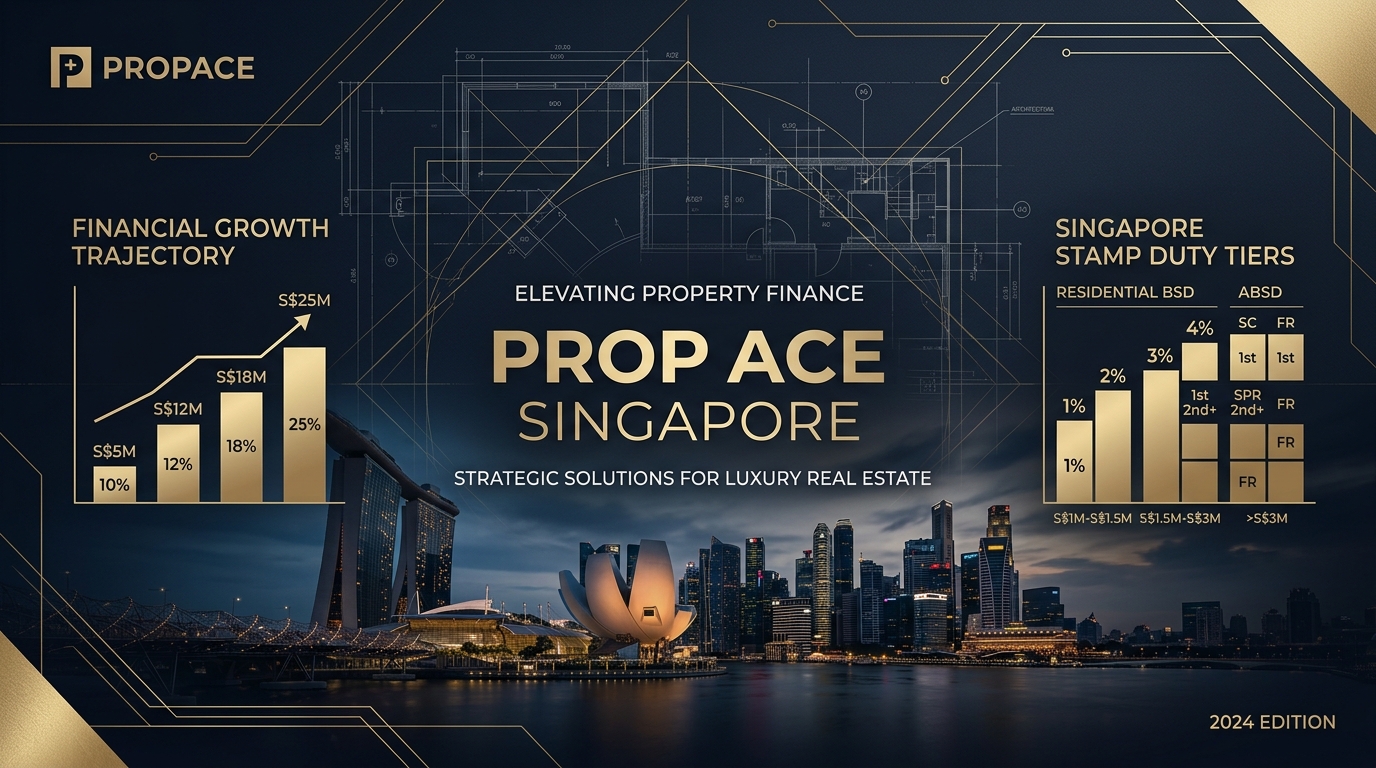
Singapore conserved shophouses represent one of the most prestigious asset classes in Asia-Pacific commercial real estate. Following consecutive rounds of residential cooling measures that elevated foreigner Additional Buyer's Stamp Duty (ABSD) to 60% and citizen second-property ABSD to 20%, institutional capital, family offices, and high-net-worth investors have aggressively rotated capital into pure commercial shophouses to capitalize on 0% ABSD and freehold/999-year land scarcity.
However, underwriting commercial shophouses deviates fundamentally from standard private residential mortgages. In the commercial realm, loan structuring is governed by corporate debt-service coverage, lease tenure decay amortization, and Goods and Services Tax (GST) cash flow cycles rather than individual consumer income ratios.
1. Commercial vs. Residential Financing: Core Regulatory Parameters
| Metric / Rule | Residential Property (MAS Notice 645) | Commercial Shophouse (Commercial Banking Rules) | Strategic Fiduciary Implication |
|---|---|---|---|
| Additional Buyer's Stamp Duty (ABSD) | 0% to 60% (Citizens 2nd: 20%; Foreigners: 60%) | 0% (Completely Exempt) | Substantial upfront capital savings (S$600k saved per S$1M on foreign purchases). |
| Maximum Bank Loan LTV | 75% (for 1st loan facility) | Up to 80% (Commercial Term Facility) | Lower upfront equity downpayment required on approved corporate profiles. |
| Total Debt Servicing Ratio (TDSR) | Strict 55% Cap on borrower monthly salary | Exempt for Qualifying Corporate SPVs | Corporate loans underwrite property Net Operating Income (NOI) via DSCR. |
| Loan Tenure Amortization | Max 30 years (or up to age 65) | Typically 25 to 30 Years (Subject to lease decay) | Capped at remaining lease minus 30 years for 99-year leasehold parcels. |
| Goods & Services Tax (GST) | 0% Exempt (Residential) | 9% Standard-Rated (Commercial) | Requires GST-registered SPV and bank GST bridging loan facility. |
| CPF Funds Eligibility | Ordinary Account (OA) usable | CPF Not Usable (100% Cash/Bank Debt) | Full downpayment and amortization must be settled via commercial cash flows. |
2. Borrowing Entity Architecture: Operating SPV vs. Personal Name
The legal identity of the purchasing entity dictates whether the borrowing facility is evaluated under retail consumer protection guidelines or corporate credit parameters:
The Corporate Special Purpose Vehicle (SPV) Route
Institutional investors almost universally purchase commercial shophouses through a dedicated Private Limited company incorporated in Singapore:
- TDSR Exemption Pathway: If the borrowing entity is an operating business with audited balance sheets or a holding vehicle supported by high-net-worth corporate parent guarantees, banks evaluate loan serviceability on the shophouse's projected Debt Service Coverage Ratio (DSCR) rather than personal debt limits.
- Ring-Fencing Liability: Acquisition debt is tied directly to the SPV asset. While banks require directors' personal guarantees for non-listed entities, exposure is structured with clear legal containment.
- GST Registered Entity: The SPV must register for GST prior to exercising the Option to Purchase (OTP) to reclaim the 9% input tax from the Inland Revenue Authority of Singapore (IRAS).
The Personal Name Acquisition Trap
Purchasing a commercial shophouse in personal names introduces severe borrowing handicaps:
- The borrower's personal 55% TDSR ceiling is triggered, incorporating all existing residential mortgages, car loans, and credit card facilities.
- The 9% GST cannot be claimed as input tax unless the individual operates a registered sole proprietorship or partnership with qualifying taxable turnover.
3. Debt Service Coverage Ratio (DSCR) & Valuation Haircuts
In commercial underwriting, banks benchmark credit approval against the property's operational yield rather than personal payroll payslips:
$$ ext{DSCR} = rac{ ext{Net Operating Income (NOI)}}{ ext{Annual Debt Service (Principal + Interest)}} \ge 1.25 ext{x}$$
The Valuation Spread
Commercial banks appoint independent valuation panels (e.g., Knight Frank, Colliers, CBRE, JLL) to establish the property's Open Market Value (OMV). Because shophouse asking prices frequently price in future redevelopment or change-of-use potential, bank valuations can trail transacted prices by 5% to 12%.
- If an investor agrees to purchase a Telok Ayer shophouse at S$16.0M, but panel valuation returns S$14.8M, the 80% LTV applies strictly to the lower of purchase price or valuation (S$14.8M $ imes$ 80% = S$11.84M).
- The S$1.16M valuation delta ("Cash-Over-Valuation") must be funded in pure cash upfront.
4. Commercial SORA Benchmarks & Interest Rate Hedging (IRS)
Commercial shophouse debt in Singapore is structured primarily as floating-rate corporate facilities pegged to the Singapore Overnight Rate Average (SORA):
Standard Pricing Formula
$$ ext{Effective Commercial Lending Rate} = ext{3M Compounded SORA} + ext{Bank Spread (0.85\% to 1.35\%) p.a.}$$
With 3M SORA holding near 3.12% in late 2026, all-in commercial borrowing rates range between 3.97% and 4.47% p.a.
Corporate Interest Rate Swaps (IRS)
To insulate multi-million-dollar shophouse portfolios against volatility, corporate borrowers borrowing above S$5.0M routinely execute an Interest Rate Swap (IRS) with the lending bank's treasury desk. The borrower exchanges the floating 3M SORA rate for a contractual fixed rate over a 3-year or 5-year tenor, transforming uncertain debt service into predictable cash outflow that protects net rental yield.
5. The 9% GST Bridging Loan Facility Mechanics
Because commercial property transactions are standard-rated supplies under the Goods and Services Tax Act 1993, buyers must remit 9% GST upon completion:
- Option to Purchase (OTP): Buyer's GST-registered SPV exercises the contract.
- Bank Facility Execution: Alongside the 80% term loan, the bank approves a 9% GST Bridging Facility (e.g. S$1.35M on a S$15M acquisition).
- Completion Day: The bank disburses the term loan and the GST bridging facility directly to the vendor's conveyancing solicitors.
- IRAS GST Return (F5): The buyer's appointed corporate tax agent files the quarterly GST return claiming S$1.35M in input tax.
- Reimbursement & Facility Closure: Within 30 to 60 days, IRAS disburses the refund directly to the corporate bank account, automatically retiring the bridging loan and limiting equity capital lockup.
6. Regulatory Due Diligence: The Commercial vs. Mixed-Use Trap
Investors must verify the precise Master Plan zoning and approved URA use before submitting loan applications:
- Pure Commercial Shophouses (Zoned Commercial): 100% exempt from ABSD. Eligible for 80% commercial bank LTV.
- Commercial & Residential Shophouses (Zoned Commercial with Residential at 2nd Storey): IRAS applies ABSD apportioned to the Gross Floor Area (GFA) attributable to residential use. Banks split the credit underwriting between retail and consumer limits.
Fiduciary conveyancing review is required prior to Option exercise to verify title covenants, URA allowable uses, and structural SCDF fire safety approvals.
Interactive Strategic Tools & Concierge
Instant calculation of tiered residential BSD (up to 6%) and profile-based ABSD (0% to 65%).
Calculate Exact Stamp Duties with ABSD/BSD Calculator
Statutory References & Citations
- Inland Revenue Authority of Singapore (IRAS) (2026). Stamp Duties Act 1929. Singapore: Government of Singapore.
- Monetary Authority of Singapore (MAS) (2026). Notice 645: Computation of Total Debt Servicing Ratio (TDSR) for Property Loans. Singapore: MAS.
Statutory Disclaimer: This guide is published for strategic, educational, and institutional planning purposes only and does not constitute formal legal, taxation, or financial advice. All property transactions, stamp duty remissions, and financing structures should be formally verified with qualified Singapore legal counsel and certified tax advisors.