 PropAce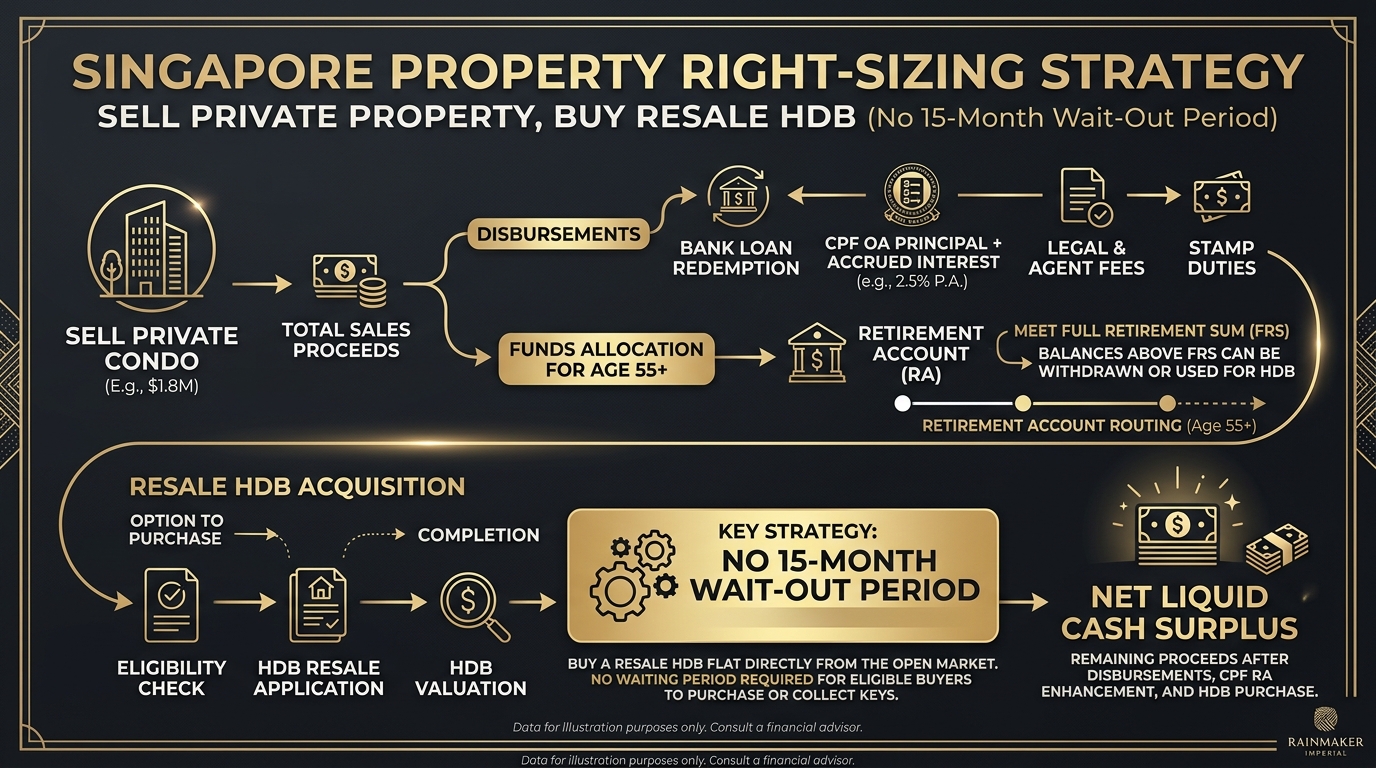
The 2Q2026 flash estimate of the HDB Resale Price Index shows a resale market that has climbed back to its record high, but the more important question for buyers is whether the coming wave of flat supply will finally cool prices over the next 12 to 18 months.
Key takeaways
- The flash Resale Price Index for 2Q2026 points to HDB resale prices holding at their peak, with islandwide HDB prices at S$652 psf (URA caveat data, 2026).
- HDB prices now stand 57.5% above their trough, while private prices remain 6.8% below their peak — a clear difference in cycle positions (URA caveat data, 2026).
- The supply pipeline is turning: about 5,012 private residential units are expected to be completed in 2H2026, and the overall stock of public housing is set to rise over the next three years (Urban Redevelopment Authority, 2026; OrangeTee & ETC, 2026).
- New launches carry a roughly 45% premium over resale, making resale options — both HDB and private — increasingly price-competitive (URA caveat data, 2026).
- Transaction volumes are softening even as prices remain firm; HDB resale transactions fell 7.4% year on year to 12,681 units in H1 2026 (The Business Times, 2026).
The Flash Estimate: A Market at Its Peak
A record, not a breakout
The 2Q2026 flash estimate, published by the Housing & Development Board, is the earliest official read on where HDB resale prices ended the quarter. The headline message is that prices have reached the top of the cycle rather than rolling over.
Islandwide HDB prices averaged S$652 psf in 2026-Q2, unchanged from their previous peak (URA caveat data, 2026). That means the resale market has regained all the ground lost in earlier soft patches and is now consolidating at historical highs. For an owner-occupier market, this is a significant psychological milestone: the fear of buying at the peak is offset by the reality that the peak has already been touched and held.
What the flash estimate tells buyers
The flash estimate matters beyond the headline number. It sets the tone for the official index, influences how sellers price their flats, and shapes the decisions of families weighing a resale purchase against a future Build-To-Order exercise.
This particular release is especially important because it comes alongside HDB's announcement on upcoming flat supply. That pairing is deliberate: the resale price trend cannot be read in isolation from how many new flats are entering the system. If supply expands meaningfully, even a strong resale market will eventually face headwinds.
The Numbers Behind the Headline
HDB and private price cycles have diverged
The most striking feature of the 2026-Q2 data is how differently the public and private markets are positioned in their respective cycles.
Islandwide HDB prices of S$652 psf are exactly at their peak, and remain 57.5% above the trough of S$414 psf (URA caveat data, 2026). By contrast, islandwide private prices of S$2,038 psf sit 6.8% below their peak of S$2,186 psf, even though they are still 33.3% above the trough of S$1,529 psf (URA caveat data, 2026).
In short, the HDB resale market has fully recovered and surpassed its previous high, while the private market is still working its way back. This divergence has practical consequences for upgraders, because it means the gap between the two markets is not simply a function of private prices running away — it is also a function of HDB prices having already run their course.
New-sale premium remains wide
Another key number is the gap between new and resale private homes. New-launch private homes averaged S$2,304 psf in the transaction record, against S$1,594 psf for resale — a premium of roughly 45% (URA caveat data, 2026).
That premium explains why many buyers are being pushed toward the resale market, including HDB resale flats. It also explains why the OCR segment, where HDB flats dominate the landscape, has become a battleground for value-seeking buyers.
Across the private transaction record, prime-core (CCR) homes averaged S$2,444 psf, city-fringe (RCR) homes S$2,078 psf, and suburban (OCR) homes S$1,551 psf (URA caveat data, 2026). For an HDB upgrader, the OCR number is often the relevant comparison point.
Transaction volumes tell a different story
While prices have held at records, volumes have cooled. In H1 2026, HDB resale transactions fell 7.4% year on year to 12,681 units (The Business Times, 2026). The private resale market recorded 7,407 transactions, down 5.1% year on year, while developers sold 4,154 private homes excluding executive condos, down 9.4% from the 4,587 units sold a year earlier (The Business Times, 2026).
Interestingly, EC sales bucked the trend, rising 37.2% year on year to 1,343 units (The Business Times, 2026). That points to continued demand from upgraders who want a private-style home without paying the full new-launch premium.
The combination of firm prices and softer volumes is classic late-cycle behaviour. It suggests that sellers have not yet adjusted their expectations, while buyers are becoming more selective.
The Supply Pipeline: More Flats on the Way
Private completions are about to ramp up
The near-term supply picture is turning. In 2Q2026, only 700 new private residential units, excluding ECs, were completed — a quarterly drop of 23.2% from the 911 units finished in 1Q2026 (Urban Redevelopment Authority, 2026). The first half of 2026 saw 1,611 private residential units completed, well below the 2,329 units recorded in 1H2025 and the 2,123 units in 1H2024 (Urban Redevelopment Authority, 2026).
But the second half is a different story. URA estimates that approximately 5,012 new private residential units will be completed in 2H2026, or around 2,506 units per quarter (Urban Redevelopment Authority, 2026). That is a substantial increase in completed supply, and it will have an immediate effect on the rental market as well as on buyers who have been waiting for more options.
Public housing stock is rising too
The HDB side of the pipeline is also expanding, although the exact BTO numbers are not the focus of this release. Analysts at OrangeTee & ETC note that the overall level of public housing stock is poised to increase over the next three years (OrangeTee & ETC, 2026).
This matters for resale prices because new flats eventually become future resale supply. A family that buys a BTO flat today will not compete in the resale market for several years, but the knowledge that more flats are coming can change bidding behaviour now.
Large launches remain on the horizon
On the private side, Chuan Park is among the largest upcoming launches, with 916 units in District 19, an OCR location, and a target TOP in 2027 (PropAce Institutional Advisorydata, 2026). Projects of this scale will compete directly with HDB upgraders in the suburban segment.
For an HDB owner in the OCR, the choice is no longer simply between staying put and upgrading to a private condo. It is increasingly a choice between a new launch at a premium, a private resale unit, or a newer HDB flat. The widening supply pipeline gives that buyer more room to wait.
The Upgrader's Arithmetic
The interaction between HDB and private prices is best understood through a worked example.
Consider an HDB owner with a flat worth S$700,000 who hopes to upgrade to a S$1.5 million condo. The initial price gap is S$800,000.
Now suppose both properties rise by exactly 10%. The HDB flat appreciates from S$700,000 to S$770,000, a gain of S$70,000. The condo rises from S$1.5 million to S$1.65 million, a gain of S$150,000. The gap has widened from S$800,000 to S$880,000 — even though both markets moved by the same percentage.
This is the core frustration for many upgraders. HDB does not need to underperform for the upgrader to feel priced out; the absolute gap simply grows because the private asset has a larger base.
The arithmetic cuts the other way too. For a S$700,000 HDB flat to match the S$150,000 gain of a S$1.5 million condo that rises by 10%, the HDB flat would need to appreciate by about 21.4%. That is a much larger percentage move, and it is why HDB prices have to do far more than merely keep pace with private prices for an upgrader to stay comfortable.
With new launches averaging S$2,304 psf against S$1,594 psf for resale, the new-sale premium of roughly 45% makes the decision even starker (URA caveat data, 2026). A buyer who chooses a resale unit, whether HDB or private, is effectively deferring that premium.
Policy and Demand: What Is Supporting Prices
The 15-month wait-out period is gone
One of the most significant policy changes supporting HDB resale demand is the removal of the 15-month wait-out period for eligible private homeowners buying HDB resale flats (The Business Times, 2026). This allows private property owners who wish to rightsize into an HDB flat to do so immediately, rather than waiting 15 months after selling their private home.
The policy change broadens the pool of potential HDB buyers, particularly empty-nesters and retirees. It also signals that the government is comfortable with more demand flowing into the resale market, even as it maintains measures to curb speculation.
LTV limits were tightened earlier
In August 2024, the government reduced the maximum loan-to-value ratio for HDB resale flat buyers from 80% to 75% (Housing & Development Board, 2024). This means buyers now need a larger downpayment, which encourages prudent borrowing and tempers aggressive bidding.
The combination of a looser wait-out rule and a tighter LTV limit creates a market where genuine owner-occupiers are supported, but leveraged speculation is not. That is consistent with the price behaviour seen in 2026-Q2: firm but not runaway.
Rental demand confirms the broader picture
HDB rental demand also remained healthy in the quarter. Approved applications to rent out HDB flats grew 4.9% quarter on quarter, from 9,535 units in 1Q2026 to 10,002 units in 2Q2026 (OrangeTee & ETC, 2026). For the full year, HDB rental prices are forecast to rise 1% to 3%, while private rents are expected to grow 2% to 3% (OrangeTee & ETC, 2026).
A strong rental market does not directly set resale prices, but it supports investor confidence and gives owners an alternative to selling. That reduces forced selling pressure and helps keep resale prices firm.
Risk Factors: Divergence, Volumes, and Timing
HDB and private markets can diverge
History shows that HDB resale prices do not always move in step with private prices. In 2005 and 2006, private prices rose by roughly 3.9% and 10% respectively, while HDB resale prices ended about 2.9% below their end-2004 level (Housing & Development Board, 2026). A similar pattern emerged in 2017 and 2018, when HDB resale prices fell by about 2.4% over two years while private prices rose by roughly 9% (Housing & Development Board, 2026).
These episodes are a useful reminder that the HDB market can soften even when the private market is rising. The current situation is the reverse: HDB prices are at a record while private prices remain below their peak. That does not mean a correction is imminent, but it does mean the two markets are facing different pressures.
Falling volumes are the first warning sign
The quieter concern in the 2026 data is volume. HDB resale transactions fell 7.4% year on year in H1 2026 (The Business Times, 2026). When volumes decline while prices hold steady, it often indicates that buyers are resisting asking prices. If that resistance continues, prices will eventually adjust.
The same pattern is visible in the private market, where both new sales and resale volumes are lower year on year (The Business Times, 2026). A market can look firm on price for several quarters while the underlying number of transactions shrinks.
Timing matters more than the headline
For buyers, the key question is whether the supply pipeline will arrive in time to matter. On the private side, the answer is clearly yes: about 5,012 units are expected to complete in 2H2026, which will ease pressure on both the rental and resale markets (Urban Redevelopment Authority, 2026). On the HDB side, the stock of public housing is set to increase over the next three years (OrangeTee & ETC, 2026).
None of this means prices will crash. But it does mean that the conditions that supported record HDB prices may not persist indefinitely. Buyers who can wait for more supply may find themselves with more options and less urgency; sellers who expect the momentum to continue may need to recalibrate.
FAQ
What does the 2Q2026 HDB resale flash estimate show?
The flash estimate points to HDB resale prices holding at their record high, with islandwide HDB prices at S$652 psf in 2026-Q2 (URA caveat data, 2026). It does not show a breakout to new highs, but it does show a market consolidating at the top.
Statutory Source: Housing & Development Board (HDB) — Official Housing Policies & Resale Guidelines
How much supply is expected in the second half of 2026?
URA estimates that about 5,012 new private residential units will be completed in 2H2026, or roughly 2,506 units per quarter (Urban Redevelopment Authority, 2026). On the public housing side, the overall stock of flats is set to increase over the next three years (OrangeTee & ETC, 2026).
Statutory Source: Housing & Development Board (HDB) — Official Housing Policies & Resale Guidelines
Is the gap between HDB and private prices widening?
Yes, in absolute terms. Even when both markets rise by the same percentage, the gap widens because the private property has a larger price base. For example, a S$700,000 HDB flat and a S$1.5 million condo both rising 10% would see the gap grow from S$800,000 to S$880,000.
Statutory Source: Housing & Development Board (HDB) — Official Housing Policies & Resale Guidelines
How did HDB resale transaction volumes move in the first half of 2026?
HDB resale transactions fell 7.4% year on year to 12,681 units in H1 2026 (The Business Times, 2026). This decline in volume, alongside firm prices, suggests buyers are becoming more cautious.
Statutory Source: Housing & Development Board (HDB) — Official Housing Policies & Resale Guidelines
What policy changes are supporting HDB resale demand?
The removal of the 15-month wait-out period for eligible private homeowners buying HDB resale flats has broadened the buyer pool (The Business Times, 2026). Earlier, the government reduced the maximum LTV ratio for HDB resale buyers from 80% to 75%, encouraging more prudent borrowing (Housing & Development Board, 2024).
Statutory Source: Housing & Development Board (HDB) — Resale Flat Eligibility & Wait-Out Requirements
By the numbers
``` Private PSF momentum by district — QoQ %
D11 +28.9% ██████████████████████████ D26 +11.8% ███████████ D25 +9.5% █████████ D12 +7.3% ███████ D08 +5.0% ████ D28 +4.2% ████ D20 +3.4% ███ D02 +3.3% ███ D22 -0.3% ░ D27 -0.7% ░ ```
| District | Median PSF | QoQ | YoY | Txns (3mo) |
|---|---|---|---|---|
| D11 | $2,866 | ▲ 28.9% | ▲ 29.0% | 333 |
| D26 | $2,285 | ▲ 11.8% | ▲ 6.4% | 257 |
| D25 | $1,372 | ▲ 9.5% | ▲ 8.2% | 64 |
| D12 | $1,976 | ▲ 7.3% | ▲ 6.7% | 95 |
| D08 | $2,006 | ▲ 5.0% | ▲ 16.8% | 40 |
| D28 | $1,714 | ▲ 4.2% | ▲ 10.3% | 109 |
| D20 | $2,046 | ▲ 3.4% | ▲ 4.3% | 132 |
| D02 | $2,540 | ▲ 3.3% | ▲ 24.2% | 31 |
| D22 | $1,655 | ▼ 0.3% | ▲ 2.9% | 103 |
| D27 | $1,413 | ▼ 0.7% | ▼ 13.6% | 129 |
_Data: PropAce Institutional Advisory analysis of URA/HDB transaction data — rolling 3-month average PSF, private residential, 2026-06..2026-08. Directional; confirm before acting._
Sources
- URA developer/pipeline data, compiled by PropAce Institutional Advisory.
- URA caveat data, compiled by PropAce Institutional Advisory— 2026-Q2.
- URA caveat data, compiled by PropAce Institutional Advisory.
References
- Housing & Development Board (2026) Flash Estimate of 2nd Quarter 2026 Resale Price Index and Upcoming Flat Supply.
Interactive Strategic Tools & Concierge
Institutional-grade financial engines for Singapore real estate: stamp duties, borrowing capacity, and cashflow modeling.
Explore All 11 PropAce Financial Calculators
Frequently Asked Questions
What does the 2Q2026 HDB resale flash estimate show?
The flash estimate points to HDB resale prices holding at their record high, with islandwide HDB prices at S$652 psf in 2026-Q2 (URA caveat data, 2026). It does not show a breakout to new highs, but it does show a market consolidating at the top. Statutory Source:** Housing & Development Board (HDB) — Official Housing Policies & Resale Guidelines
How much supply is expected in the second half of 2026?
URA estimates that about 5,012 new private residential units will be completed in 2H2026, or roughly 2,506 units per quarter (Urban Redevelopment Authority, 2026). On the public housing side, the overall stock of flats is set to increase over the next three years (OrangeTee & ETC, 2026). Statutory Source:** Housing & Development Board (HDB) — Official Housing Policies & Resale Guidelines
Is the gap between HDB and private prices widening?
Yes, in absolute terms. Even when both markets rise by the same percentage, the gap widens because the private property has a larger price base. For example, a S$700,000 HDB flat and a S$1.5 million condo both rising 10% would see the gap grow from S$800,000 to S$880,000. Statutory Source:** Housing & Development Board (HDB) — Official Housing Policies & Resale Guidelines
How did HDB resale transaction volumes move in the first half of 2026?
HDB resale transactions fell 7.4% year on year to 12,681 units in H1 2026 (The Business Times, 2026). This decline in volume, alongside firm prices, suggests buyers are becoming more cautious. Statutory Source:** Housing & Development Board (HDB) — Official Housing Policies & Resale Guidelines
What policy changes are supporting HDB resale demand?
The removal of the 15-month wait-out period for eligible private homeowners buying HDB resale flats has broadened the buyer pool (The Business Times, 2026). Earlier, the government reduced the maximum LTV ratio for HDB resale buyers from 80% to 75%, encouraging more prudent borrowing (Housing & Development Board, 2024). Statutory Source:** [Housing & Development Board (HDB) — Resale Flat Eligibility & Wait-Out Requirements](https://www.hdb.gov.sg/cs/infoweb/residential/buying-a-flat/resale-flat/
Statutory References & Citations
- Housing & Development Board (HDB) (2026). Housing and Development Act (Cap. 129). Singapore: Ministry of National Development.
- Singapore Land Authority (SLA) (2026). Land Titles Act (Cap. 157) & Conveyancing Registration Framework. Singapore: SLA.
Statutory Disclaimer: This guide is published for strategic, educational, and institutional planning purposes only and does not constitute formal legal, taxation, or financial advice. All property transactions, stamp duty remissions, and financing structures should be formally verified with qualified Singapore legal counsel and certified tax advisors.