 PropAce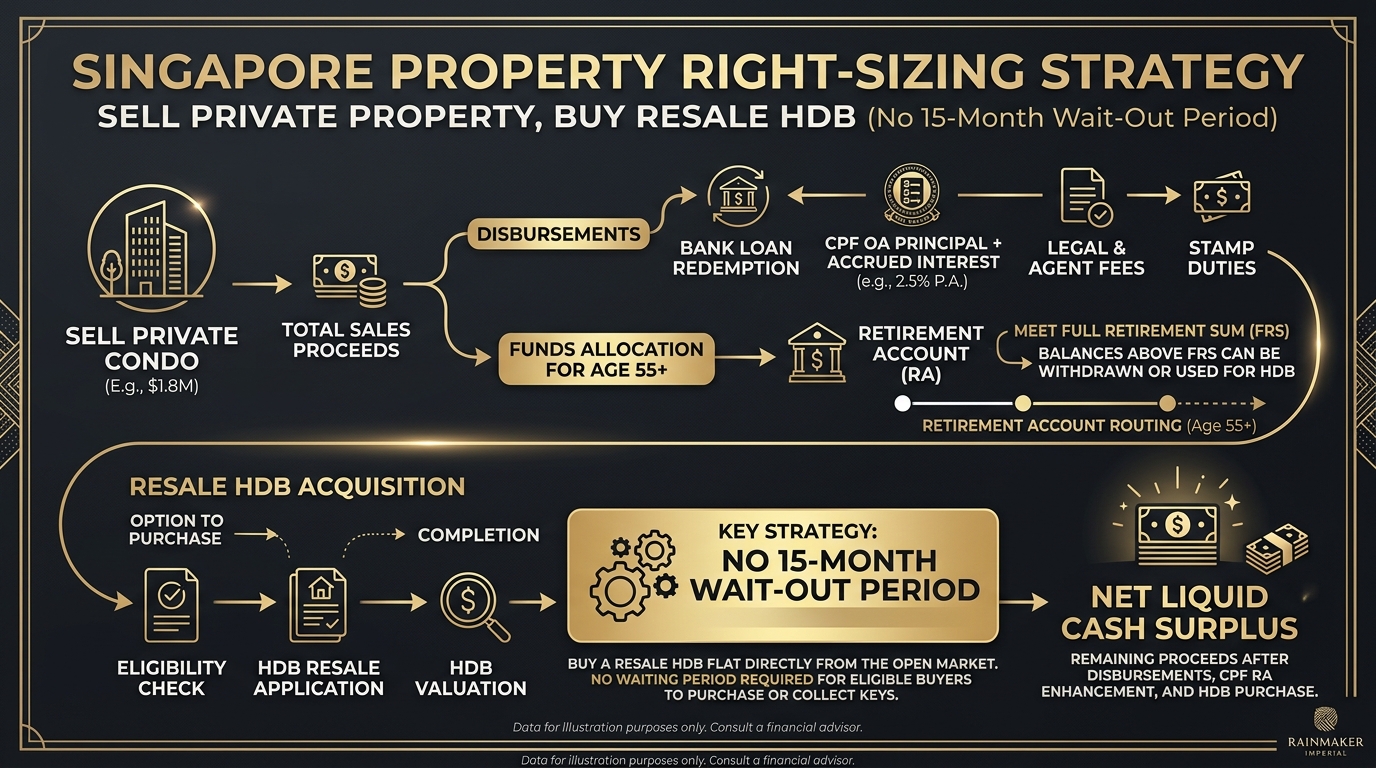
HDB resale prices fell for a second consecutive quarter in 2Q2026, dipping 0.3% quarter-on-quarter, even as private home prices edged up 0.5% — a split that has left upgraders watching the price gap widen (Housing & Development Board, 2026; Urban Redevelopment Authority, 2026).
Key takeaways
- The HDB Resale Price Index declined 0.3% quarter-on-quarter in 2Q2026, the second straight quarterly fall, while private home prices rose for a seventh consecutive quarter (Housing & Development Board, 2026; Urban Redevelopment Authority, 2026).
- Islandwide HDB prices averaged S$652 psf in 2Q2026 — level with their historical peak — while private prices averaged S$2,038 psf, still 6.8% below their peak (PropAce Institutional Advisorydata, 2026).
- New-launch private homes averaged S$2,303 psf versus S$1,594 psf for resale, a premium of roughly 45% (PropAce Institutional Advisorydata, 2026).
- HDB resale volume fell 7.4% year on year to 12,681 transactions in H1 2026, while private resale slipped 5.1% to 7,407 transactions (The Business Times, 2026).
- Historical episodes of HDB-private divergence have tended to correct, but the absolute dollar gap between the two markets can widen even when both rise at the same percentage pace.
A tale of two markets: the 2Q2026 price picture
Public and private housing in Singapore have generally moved in the same broad direction, so when the two price indices pull apart, the divergence invites scrutiny. In the three months to June 2026, the HDB Resale Price Index slipped 0.3% quarter-on-quarter — the second consecutive quarterly decline (Housing & Development Board, 2026; EdgeProp Singapore, 2026). Over the same period, private residential prices rose 0.5% quarter-on-quarter, extending a run of growth that has now lasted seven straight quarters (Urban Redevelopment Authority, 2026; Channel NewsAsia, 2026).
HDB resale: cooling without crashing
The 0.3% fall in the HDB resale index is not dramatic by historical standards, but its significance lies in the trend. After a sharp run-up in previous years, resale prices are now stalling. A second consecutive quarterly decline suggests that buyer demand is moderating, supply is normalising, and the market is no longer being driven by the urgency that characterised earlier cycles.
Crucially, this is not a crash. The index has barely moved below its peak. As PropAce Institutional Advisorydata drawn from URA caveats shows, islandwide HDB prices stood at S$652 psf in 2Q2026, exactly level with their S$652 psf peak (PropAce Institutional Advisorydata, 2026). In other words, the market has paused at its record rather than fallen away from it.
Private homes: slower but still rising
Private home prices, by contrast, continue to climb, though the pace has moderated. The 0.5% quarter-on-quarter increase in 2Q2026 is a slower rate than in some earlier quarters, but it still extends the private market’s growth streak to seven consecutive quarters (Urban Redevelopment Authority, 2026; The Straits Times, 2026).
The result is a widening gap in headline momentum. HDB prices are moving down while private prices are moving up. That divergence feeds a familiar anxiety among HDB upgraders: if my flat is falling in value while the condominium I want keeps rising, how will I bridge the gap?
The data in full: what the indices miss
Islandwide psf and cycle positioning
Looking at the psf figures rather than just the index gives a clearer sense of where the two markets sit in their cycles. PropAce Institutional Advisorydata, based on URA caveats, puts islandwide private home prices at S$2,038 psf in 2Q2026 (PropAce Institutional Advisorydata, 2026). That is 6.8% below the market peak of S$2,186 psf, but still 33.3% above the trough of S$1,529 psf (PropAce Institutional Advisorydata, 2026).
On the HDB side, islandwide resale prices averaged S$652 psf in 2Q2026 (PropAce Institutional Advisorydata, 2026). That is 0.0% above the S$652 psf peak, and 57.5% above the S$414 psf trough (PropAce Institutional Advisorydata, 2026). The contrast is instructive: the private market is still recovering from a cycle that saw prices fall sharply from peak, while the HDB market is sitting at its highest level ever.
New launches versus resale
The caveat data also highlights the cost of buying new. New-launch private homes averaged S$2,303 psf against S$1,594 psf for resale — a premium of roughly 45% (PropAce Institutional Advisorydata, 2026). For an HDB upgrader, that premium matters. Even if the resale private market seems expensive, buying a new launch from a developer costs substantially more per square foot.
Location and price tiers
Location remains the biggest single determinant of price. Across the private transaction record, prime-core CCR homes averaged S$2,444 psf, city-fringe RCR homes averaged S$2,078 psf, and suburban OCR homes averaged S$1,551 psf (PropAce Institutional Advisorydata, 2026). An upgrader who is prepared to look outside the core region can therefore access significantly lower psf prices, though often with trade-offs in size, age, and convenience.
Is this decoupling? Historical perspective
When the two markets diverged before
Divergence between the HDB and private markets is not unprecedented. The HDB Resale Price Index stood at 77.1 at the end of 2004, and by the end of 2006 it remained about 2.9% below that level (Housing & Development Board, 2026). During those same two years, private residential prices rose by around 3.9% in 2005 and a further 10% in 2006 — a cumulative gain of roughly 14% (Urban Redevelopment Authority, 2026).
A similar pattern appeared more recently. HDB resale prices fell by about 1.5% in 2017 and another 0.9% in 2018 (Housing & Development Board, 2026). Private residential prices rose by 1.1% in 2017 and 7.9% in 2018 (Urban Redevelopment Authority, 2026). Over those two years, HDB prices fell by around 2.4% while private prices rose by roughly 9% — a far bigger divergence than what the market has seen so far in 2026.
In both episodes, HDB prices subsequently recovered. The current three-quarter divergence, while notable, fits within a historical pattern of temporary dislocations rather than permanent decoupling.
Why three quarters is early to call
NUS Provost’s Chair Professor of Real Estate Tien Foo Sing has argued that price movements of less than a year should not be mistaken for a structural change (The Straits Times, 2026). Three quarters of divergence, he suggests, is too short a period to conclude that the HDB and private markets have split for good. That is a reasonable caution. Housing cycles are long, and sentiment can shift quickly when supply or policy changes.
Still, the markets do not need to decouple for an upgrader to feel priced out.
The upgrader’s maths: a worked example
A S$700,000 flat versus a S$1.5 million condo
Consider an HDB owner with a flat worth S$700,000 who hopes to upgrade to a condominium worth S$1.5 million. The initial price gap is S$800,000.
Now suppose both properties rise by exactly 10%. The HDB flat appreciates from S$700,000 to S$770,000, a gain of S$70,000. The condominium rises from S$1.5 million to S$1.65 million, a gain of S$150,000. Both markets have moved by precisely the same percentage, yet the absolute gap has widened from S$800,000 to S$880,000.
No decoupling is required for this to happen. Both markets can move in perfect tandem, and the dollar gap still grows because the private property starts from a much higher base.
The HDB appreciation needed to keep pace
Flip the calculation around. If a S$1.5 million condominium rises by 10%, it gains S$150,000 in value. For a S$700,000 HDB flat to gain the same S$150,000, it would need to appreciate by around 21.4%.
This is the arithmetic behind the upgrader’s problem. Even if HDB prices are not falling in real terms, and even if they later recover, the private market only needs to hold steady for the gap to feel insurmountable. The HDB market must do far more than simply track private market growth for an upgrader to close the distance.
Market activity: what the transactions show
Resale volumes
The second quarter data is echoed in transaction volumes. In H1 2026, HDB resale transactions fell 7.4% year on year to 12,681 units, while private residential resale transactions slipped 5.1% to 7,407 (The Business Times, 2026). Lower volumes are consistent with a market in consolidation, where buyers are more cautious and sellers are less willing to accept lower prices.
Developer sales and the launch pipeline
Developers sold 4,154 private homes excluding executive condominiums in H1 2026, down 9.4% from 4,587 units in the same period a year earlier (The Business Times, 2026). Executive condo sales, however, rose 37.2% to 1,343 units (The Business Times, 2026). The contrast suggests that buyers are still willing to commit, but they are gravitating towards more affordable options.
Apac Realty’s chief executive Marcus Chu described the first half of 2026 as a period of consolidation following the strong wave of new launches in late 2025 (The Business Times, 2026). Looking ahead, seven more condo developments and one EC project are expected to launch in 2026 (The Business Times, 2026). ERA projects new-home sales of 8,000 to 9,000 units and secondary market transactions of 13,000 to 14,000 units for the year (The Business Times, 2026).
Rents and the broader housing market
Rental growth remains positive
While sale prices are cooling, rental markets have held up better. Private residential rents rose 0.7% quarter-on-quarter in 2Q2026, with landed property rents up 2.7% (Realion, 2026). HDB rents rose 0.4% quarter-on-quarter, and approved HDB rental applications grew 4.9% quarter-on-quarter from 9,535 units in 1Q2026 to 10,002 units in 2Q2026 (Housing & Development Board, 2026; Realion, 2026).
Rental demand was supported by seasonal factors, including international students renewing or signing new leases before the start of the academic year (Realion, 2026). That seasonal support is one reason rents have remained firm even as sales activity has softened.
Supply and forecasts
Supply is nonetheless expanding. Around 700 private residential units were completed in 2Q2026, with about 2,506 units expected to be completed in each quarter of the second half of 2026 (Realion, 2026). Over the next three years, the overall level of public housing stock is also set to increase, which could add pressure to the HDB rental market (Realion, 2026).
Realion forecasts HDB rental prices will grow 1% to 3% for the whole of 2026, while private rental prices are expected to hold steady at 2% to 3% growth (Realion, 2026). For landlords, the picture is one of modest, stable income rather than strong capital gains.
Outlook: what to watch
Policy support
Policy is one factor that could shift the trajectory. The removal of the 15-month wait-out period for eligible private homeowners rightsizing to HDB resale flats is expected to support consumer confidence and long-term market stability (The Business Times, 2026). That change could also bring more private homeowners into the HDB resale market, providing demand at the upper end.
Fundamentals and risks
Apac Realty’s outlook points to a market underpinned by resilient owner-occupier demand, disciplined supply, and stable economic fundamentals (The Business Times, 2026). Those are supportive conditions for a soft landing rather than a sharp correction.
The central risk for HDB upgraders is not a crash in their own flat’s value, but a continued widening of the absolute gap with the private market. As the worked example shows, even equal percentage growth can leave upgraders further behind. If private prices continue to rise while HDB prices pause, the gap will keep growing.
The bottom line
The 2Q2026 numbers are a reminder that Singapore’s housing market is not monolithic. The HDB resale market is at a cyclical pause, while the private market continues to grind higher. For upgraders, the real challenge is not whether the two markets decouple, but whether the absolute price gap becomes too large to bridge with a single step.
FAQ
How much did HDB resale prices fall in 2Q2026?
HDB resale prices fell by 0.3% quarter-on-quarter in 2Q2026, marking a second consecutive quarterly decline (Housing & Development Board, 2026). On a psf basis, islandwide HDB prices remained level with their historical peak at S$652 psf (PropAce Institutional Advisorydata, 2026).
Statutory Source: Housing & Development Board (HDB) — Official Housing Policies & Resale Guidelines
How did private home prices perform in 2Q2026?
Private home prices rose 0.5% quarter-on-quarter in 2Q2026, extending the run of quarterly growth to seven consecutive quarters (Urban Redevelopment Authority, 2026). Islandwide private prices averaged S$2,038 psf, still 6.8% below their S$2,186 psf peak but 33.3% above the trough (PropAce Institutional Advisorydata, 2026).
Statutory Source: Housing & Development Board (HDB) — Official Housing Policies & Resale Guidelines
Why does the HDB-private price gap matter to upgraders?
Even if both markets rise by the same percentage, the absolute gap widens because the private property starts from a higher base. A S$700,000 flat and a S$1.5 million condo both rising 10% would see the gap grow from S$800,000 to S$880,000. This makes upgrading feel more expensive even when there is no decoupling between the two markets.
Statutory Source: Housing & Development Board (HDB) — Official Housing Policies & Resale Guidelines
Is the recent divergence between HDB and private prices unusual?
No. Similar episodes occurred in 2004–2006 and 2017–2018, when HDB prices fell or stagnated while private prices rose; HDB prices later recovered (Housing & Development Board, 2026; Urban Redevelopment Authority, 2026). Analysts caution against reading three quarters of divergence as a structural change (The Straits Times, 2026).
Statutory Source: Housing & Development Board (HDB) — Official Housing Policies & Resale Guidelines
What is the outlook for HDB rental prices and resale volumes?
HDB rental prices are forecast to grow 1% to 3% for the whole of 2026, while private rents are projected to rise 2% to 3% (Realion, 2026). HDB resale transaction volumes fell 7.4% year on year in H1 2026, and the market is widely seen as consolidating (The Business Times, 2026).
Statutory Source: Housing & Development Board (HDB) — Official Housing Policies & Resale Guidelines
By the numbers
``` Private PSF momentum by district — QoQ %
D11 +29.6% ██████████████████████████ D26 +12.6% ███████████ D25 +7.9% ███████ D12 +7.8% ███████ D02 +5.6% █████ D08 +4.8% ████ D20 +3.2% ███ D28 +1.5% █ D27 +0.1% █ D19 -0.2% ░ ```
| District | Median PSF | QoQ | YoY | Txns (3mo) |
|---|---|---|---|---|
| D11 | $2,882 | ▲ 29.6% | ▲ 29.8% | 320 |
| D26 | $2,297 | ▲ 12.6% | ▲ 6.9% | 247 |
| D25 | $1,352 | ▲ 7.9% | ▲ 6.6% | 57 |
| D12 | $1,984 | ▲ 7.8% | ▲ 7.1% | 85 |
| D02 | $2,596 | ▲ 5.6% | ▲ 26.9% | 28 |
| D08 | $2,002 | ▲ 4.8% | ▲ 16.6% | 35 |
| D20 | $2,041 | ▲ 3.2% | ▲ 4.1% | 122 |
| D28 | $1,670 | ▲ 1.5% | ▲ 7.5% | 99 |
| D27 | $1,425 | ▲ 0.1% | ▼ 12.9% | 115 |
| D19 | $1,758 | ▼ 0.2% | ▲ 5.3% | 440 |
_Data: PropAce Institutional Advisory analysis of URA/HDB transaction data — rolling 3-month average PSF, private residential, 2026-06..2026-08. Directional; confirm before acting._
Sources
- URA caveat data, compiled by PropAce Institutional Advisory— 2026-Q2.
- URA caveat data, compiled by PropAce Institutional Advisory.
References
- Channel NewsAsia (2026) HDB resale prices fall for second consecutive quarter; private home prices edge up 0.5%.
- EdgeProp Singapore (2026) HDB resale prices fall for second consecutive quarter, down 0.3% in 2Q2026.
- The Straits Times (2026) HDB resale prices dip for second straight quarter, private home prices rise at slower pace.
Interactive Strategic Tools & Concierge
Institutional-grade financial engines for Singapore real estate: stamp duties, borrowing capacity, and cashflow modeling.
Explore All 11 PropAce Financial Calculators
Frequently Asked Questions
How much did HDB resale prices fall in 2Q2026?
HDB resale prices fell by 0.3% quarter-on-quarter in 2Q2026, marking a second consecutive quarterly decline (Housing & Development Board, 2026). On a psf basis, islandwide HDB prices remained level with their historical peak at S$652 psf (PropAce Institutional Advisorydata, 2026). Statutory Source:** Housing & Development Board (HDB) — Official Housing Policies & Resale Guidelines
How did private home prices perform in 2Q2026?
Private home prices rose 0.5% quarter-on-quarter in 2Q2026, extending the run of quarterly growth to seven consecutive quarters (Urban Redevelopment Authority, 2026). Islandwide private prices averaged S$2,038 psf, still 6.8% below their S$2,186 psf peak but 33.3% above the trough (PropAce Institutional Advisorydata, 2026). Statutory Source:** Housing & Development Board (HDB) — Official Housing Policies & Resale Guidelines
Why does the HDB-private price gap matter to upgraders?
Even if both markets rise by the same percentage, the absolute gap widens because the private property starts from a higher base. A S$700,000 flat and a S$1.5 million condo both rising 10% would see the gap grow from S$800,000 to S$880,000. This makes upgrading feel more expensive even when there is no decoupling between the two markets. Statutory Source:** [Housing & Development Board (HDB) — Official Housing Policies & Resale Guidelines](https://www.hdb.gov.sg/cs/infoweb/residential/buying-a-f
Is the recent divergence between HDB and private prices unusual?
No. Similar episodes occurred in 2004–2006 and 2017–2018, when HDB prices fell or stagnated while private prices rose; HDB prices later recovered (Housing & Development Board, 2026; Urban Redevelopment Authority, 2026). Analysts caution against reading three quarters of divergence as a structural change (The Straits Times, 2026). Statutory Source:** Housing & Development Board (HDB) — Official Housing Policies & Resale Guidelines
What is the outlook for HDB rental prices and resale volumes?
HDB rental prices are forecast to grow 1% to 3% for the whole of 2026, while private rents are projected to rise 2% to 3% (Realion, 2026). HDB resale transaction volumes fell 7.4% year on year in H1 2026, and the market is widely seen as consolidating (The Business Times, 2026). Statutory Source:** Housing & Development Board (HDB) — Official Housing Policies & Resale Guidelines
Statutory References & Citations
- Housing & Development Board (HDB) (2026). Housing and Development Act (Cap. 129). Singapore: Ministry of National Development.
- Singapore Land Authority (SLA) (2026). Land Titles Act (Cap. 157) & Conveyancing Registration Framework. Singapore: SLA.
Statutory Disclaimer: This guide is published for strategic, educational, and institutional planning purposes only and does not constitute formal legal, taxation, or financial advice. All property transactions, stamp duty remissions, and financing structures should be formally verified with qualified Singapore legal counsel and certified tax advisors.