 PropAce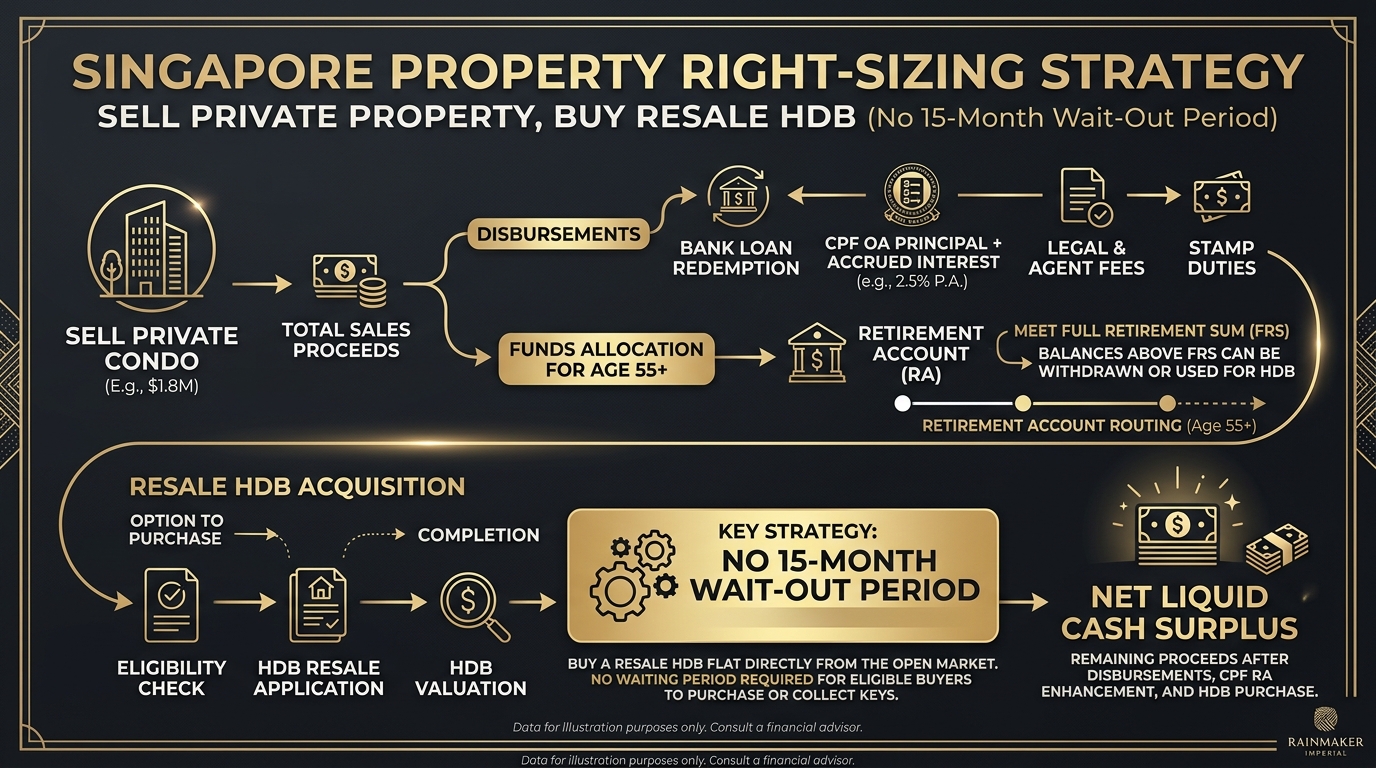
HDB resale prices fell for the first time in seven years in 2026, ending a long upcycle and pushing the question of affordability for upgraders to the centre of the housing debate (Straits Times, 2026).
Key takeaways
- HDB resale prices recorded their first quarterly decline in seven years in 2026, even as private residential prices continued to climb (Straits Times, 2026).
- PropAce Institutional Advisorycaveat data shows islandwide HDB prices at S$652 psf in 2026-Q2 — level with their previous peak — and still 57.5% above the cycle trough (PropAce Institutional Advisorydata, 2026).
- Private home prices averaged S$2,038 psf in the same quarter, 6.8% below their S$2,186 psf peak but 33.3% above the trough (PropAce Institutional Advisorydata, 2026).
- New launches carry a roughly 45% premium over resale, at S$2,303 psf versus S$1,594 psf (PropAce Institutional Advisorydata, 2026).
- Past episodes of public-private divergence eventually rebalanced, but the absolute dollar gap between a flat and a condo can still widen even when both markets rise by the same percentage.
What the first fall in seven years tells us
An end to a long run
The HDB resale market has been one of Singapore’s most consistent asset classes in recent years. That changed in 2026, when the HDB resale price index recorded its first quarterly decline in seven years (Straits Times, 2026). The fall was modest in size, but it was a third consecutive quarterly dip, giving it a significance beyond the headline number.
The contrast with the private market could not be starker. While HDB resale prices slipped, private residential prices kept rising, extending a sustained run of quarterly increases. For a property market that has long moved broadly in tandem between public and private segments, this divergence raised an obvious question: are the two markets starting to decouple?
The short answer is that three quarters of divergence is too little evidence to call a structural break. NUS Provost’s Chair Professor of Real Estate Tien Foo Sing has cautioned that reading too much into such a short stretch of price data could itself create a self-fulfilling frenzy (Straits Times, 2026). The longer answer, however, is that even a temporary divergence carries real consequences for upgraders, because what matters to a buyer is not the percentage movement of an index but the absolute dollar gap between what they own and what they want to own.
A break that was always going to happen
Resale prices cannot rise indefinitely without eventually meeting affordability limits. The Singapore market has seen this pattern before. In the mid-2000s, HDB resale prices stalled and drifted down even as private home prices accelerated. A similar divergence appeared in 2017 and 2018, when HDB resale prices softened while private prices rose.
In both episodes, the gap eventually closed, and HDB resale prices resumed their upward path. That history supports the view that the current dip may be a pause rather than a permanent shift. But history also offers a warning: the recovery came only after the price gap between HDB flats and private homes had already widened. For any household trying to upgrade within a short horizon, that timing can be painful.
The data beneath the headline
Prices at a glance
The headline fall in HDB resale prices should be read against the full cycle, not just the latest quarter. PropAce Institutional Advisorycaveat data shows that islandwide HDB prices averaged S$652 psf in 2026-Q2, which is effectively 0.0% above their S$652 psf peak and 57.5% above the S$414 psf trough (PropAce Institutional Advisorydata, 2026). In other words, the recent decline has shaved off only a small part of a very large upcycle.
The private market, by comparison, is further below its own peak. Islandwide private prices averaged S$2,038 psf in 2026-Q2, sitting 6.8% below the S$2,186 psf peak, yet still 33.3% above the S$1,529 psf trough (PropAce Institutional Advisorydata, 2026). The picture is therefore not one of a public market in decline but of two markets at different points in their cycles: private prices have cooled from a higher high, while HDB prices have only just stopped advancing.
New launches and regional spread
A single average price hides a wide spread within the private market. Across the transaction record, prime-core (CCR) homes have averaged S$2,444 psf, city-fringe (RCR) homes S$2,078 psf, and suburban (OCR) homes S$1,551 psf (PropAce Institutional Advisorydata, 2026). For most HDB upgraders, the relevant target is not the prime core but the city fringe and suburban segments.
The new-launch premium is just as important. New-launch private homes averaged S$2,303 psf against S$1,594 psf for resale — a roughly 45% premium (PropAce Institutional Advisorydata, 2026). That premium explains why many upgraders are drawn to resale condos, which offer more floor area for the same quantum, and why any fall in HDB values is felt most acutely by those who need to maximise their sale proceeds.
A worked example: why percentage moves hide the real cost
The S$700,000 flat and the S$1.5 million condo
Consider an HDB owner with a flat valued at S$700,000 who hopes to upgrade to a S$1.5 million condo. The initial price gap to close is S$800,000.
Now suppose both properties rise by exactly 10%. The HDB flat appreciates from S$700,000 to S$770,000, a gain of S$70,000. The condo rises from S$1.5 million to S$1.65 million, a gain of S$150,000. Both markets have moved by the same percentage, yet the gap between the two properties has grown from S$800,000 to S$880,000.
This is the trap hidden in the decoupling debate. The HDB market does not need to underperform the private market for an upgrader to feel priced out; it only needs to keep pace. Because the starting quantum of a condo is larger, the same percentage gain produces a larger absolute gain. The escalator is moving at the same speed, but the person on the higher floor gets carried higher in dollar terms.
What the HDB needs to do
Flip the calculation and the scale of the challenge becomes clear. If a S$1.5 million condo rises by 10%, it gains S$150,000. For a S$700,000 HDB flat to generate the same S$150,000 gain, it would need to appreciate by around 21.4%.
That is why the HDB market needs to do far more than simply stay in tandem with private prices for upgraders to preserve their purchasing power. A healthy HDB market is necessary, but it is not sufficient. The ratio between flat prices and condo prices matters more than the index direction.
Is this decoupling or just normal rhythm?
What the analysts are watching
Professor Tien Foo Sing has warned that talk of decoupling between the private and HDB resale markets could trigger fear-driven buying (Straits Times, 2026). The logic is straightforward: if buyers believe that private prices will run away from HDB prices, they may rush into the market before they are priced out, pushing prices higher in a self-fulfilling loop.
There is merit in that caution. Property markets are prone to narrative-driven behaviour, and a few quarters of divergence can be mistaken for a permanent trend. The historical record shows that HDB and private prices have moved apart before and then fallen back into step. A patient buyer may be rewarded.
Why the urgency is not entirely irrational
Yet it is also possible for urgency to be based on rational observation. Buyers today have more information than previous generations, and they use it. When a new launch is priced close to the land cost of an adjacent future project, discerning buyers may reasonably conclude that waiting will not deliver a cheaper entry.
Land-bid outcomes are public, and buyers can see when subsequent sites are transacted at significantly higher rates. In some cases, the next comparable development is unlikely to be cheaper, not because prices always rise, but because the cost base has already moved. Under those conditions, early buying is not fear; it is forward pricing.
The risk is that this rational urgency tips into overreach. A buyer who stretches beyond their financial capacity because they fear missing out on the next upcycle is taking on risk that no forecast can justify. The distinction between informed early entry and emotional FOMO is the discipline of the buyer.
What this means for upgraders and buyers
The upgrade path is getting steeper
For HDB upgraders, the most relevant comparison is not between the HDB index and the private index, but between the value of their flat and the price of the private home they intend to buy. That comparison is dominated by the absolute-quantum problem.
A flat valued at S$652 psf is worth a very different amount depending on its size, town, and age. Meanwhile, the city-fringe condos that many upgraders target are priced at S$2,078 psf on average, and suburban condos at S$1,551 psf (PropAce Institutional Advisorydata, 2026). The gap is wide in percentage terms and wider still in dollar terms on larger units.
The S$2,303 psf average for new launches also matters for upgraders considering a brand-new home. Paying the roughly 45% new-sale premium may be justified for buyers who value the unexpired lease, the absence of deferred maintenance, and the option of a deferred payment scheme. For upgraders whose main constraint is the quantum gap, however, a resale condo will often be the more effective bridge.
Policy guardrails are softening the landing
The government has not left the market entirely to its own devices. The removal of the 15-month wait-out period for eligible private homeowners looking to buy HDB resale flats is one example of a policy designed to support demand and market stability (Business Times, 2026). By allowing private homeowners to rightsize back into HDB resale flats without the previous waiting period, the policy widens the pool of potential buyers for HDB flats.
That could help cushion HDB resale prices. But policy cannot change the mathematics of the upgrade gap. A private homeowner selling a condo to buy a flat is the mirror image of an HDB owner trying to buy a condo; the same absolute-quantum issue applies, just in reverse. Removing restrictions helps liquidity, but it does not reset affordability.
Outlook
A pause, not a reversal
The weight of evidence points to a market that is stabilising rather than collapsing. The private residential market continues to be underpinned by resilient owner-occupier demand, disciplined supply, and stable economic fundamentals (Business Times, 2026). HDB resale prices are still at their historical peak in psf terms, which is not the signature of a distressed asset.
Property agencies appear to expect a modest, volume-led market rather than a price boom. Industry projections point to a slower new-home sales environment and a quieter secondary market for the rest of the year. That would be consistent with a market working through affordability constraints rather than one entering a downturn.
The real divide is between buyers
For the market as a whole, the first decline in seven years is a headline. For an HDB upgrader, the more troubling story is the one beneath the headline: private prices have risen for far longer, and the absolute gap between flat values and condo values has widened. Even a market that moves in tandem does not automatically keep the upgrade path open.
The coming quarters will show whether the two markets rebalance as they have done before. But buyers who plan around a single index number, rather than the actual gap they need to close, will be making a mistake — no matter what the next price index says.
FAQ
Why did HDB resale prices fall for the first time in seven years?
HDB resale prices recorded their first quarterly decline in seven years in 2026, following a period of sustained gains that eventually ran into affordability limits (Straits Times, 2026). The fall was small in quarterly terms, but it came after a third consecutive dip in the HDB resale price index.
Statutory Source: Housing & Development Board (HDB) — Official Housing Policies & Resale Guidelines
Is the HDB market decoupling from the private market?
Three quarters of divergence is too short to confirm a structural break, and similar episodes in the past have been followed by a return to tandem movement. Still, the absolute dollar gap between HDB flats and private condos can widen even when both markets rise by the same percentage, which creates real pressure for upgraders.
Statutory Source: Housing & Development Board (HDB) — Official Housing Policies & Resale Guidelines
How do current HDB resale prices compare with the cycle?
Islandwide HDB prices averaged S$652 psf in 2026-Q2, essentially unchanged from their S$652 psf peak and 57.5% above the S$414 psf trough (PropAce Institutional Advisorydata, 2026). The recent decline has therefore only trimmed the top of a long upcycle rather than reversing it.
Statutory Source: Housing & Development Board (HDB) — Official Housing Policies & Resale Guidelines
Should upgraders rush to buy before they are priced out?
Rushing is rarely advisable. Private prices remain 6.8% below their peak, and new launches carry a roughly 45% premium over resale, so there are still choices for buyers who are patient (PropAce Institutional Advisorydata, 2026). The more important exercise is to calculate the absolute gap between a current flat and a target condo, rather than reacting to index movements.
Statutory Source: Housing & Development Board (HDB) — Official Housing Policies & Resale Guidelines
What policy changes are affecting the market?
The removal of the 15-month wait-out period for eligible private homeowners buying HDB resale flats is intended to support demand and market stability (Business Times, 2026). It makes it easier for private owners to rightsize into HDB flats, but it does not change the underlying affordability gap between public and private housing.
Statutory Source: Housing & Development Board (HDB) — Resale Flat Eligibility & Wait-Out Requirements
By the numbers
``` HDB PSF momentum by district — QoQ %
D? +8.2% ██████████████████████████ D? +7.6% ████████████████████████ D? +2.9% █████████ D? +2.9% █████████ D? +2.4% ████████ D? +2.2% ███████ D? +1.7% █████ D? +1.7% █████ D? +1.5% █████ D? +0.7% ██ ```
| District | Median PSF | QoQ | YoY | Txns (3mo) |
|---|---|---|---|---|
| D? | $964 | ▲ 8.2% | ▲ 7.5% | 190 |
| D? | $834 | ▲ 7.6% | ▲ 7.9% | 216 |
| D? | $705 | ▲ 2.9% | ▲ 4.9% | 32 |
| D? | $644 | ▲ 2.9% | ▲ 2.9% | 321 |
| D? | $824 | ▲ 2.4% | ▲ 1.2% | 209 |
| D? | $595 | ▲ 2.2% | ▲ 0.8% | 207 |
| D? | $773 | ▲ 1.7% | ▲ 5.9% | 112 |
| D? | $536 | ▲ 1.7% | ▲ 0.8% | 254 |
| D? | $665 | ▲ 1.5% | ▲ 0.3% | 102 |
| D? | $691 | ▲ 0.7% | ▲ 1.0% | 442 |
_Data: PropAce Institutional Advisory analysis of URA/HDB transaction data — rolling 3-month average PSF, HDB, 2026-06..2026-08. Directional; confirm before acting._
Sources
- URA caveat data, compiled by PropAce Institutional Advisory— 2026-Q2.
- URA caveat data, compiled by PropAce Institutional Advisory.
References
- The Straits Times (2026) HDB resale prices decline for the first time in 7 years.
Interactive Strategic Tools & Concierge
Institutional-grade financial engines for Singapore real estate: stamp duties, borrowing capacity, and cashflow modeling.
Explore All 11 PropAce Financial Calculators
Frequently Asked Questions
Why did HDB resale prices fall for the first time in seven years?
HDB resale prices recorded their first quarterly decline in seven years in 2026, following a period of sustained gains that eventually ran into affordability limits (Straits Times, 2026). The fall was small in quarterly terms, but it came after a third consecutive dip in the HDB resale price index. Statutory Source:** Housing & Development Board (HDB) — Official Housing Policies & Resale Guidelines
Is the HDB market decoupling from the private market?
Three quarters of divergence is too short to confirm a structural break, and similar episodes in the past have been followed by a return to tandem movement. Still, the absolute dollar gap between HDB flats and private condos can widen even when both markets rise by the same percentage, which creates real pressure for upgraders. Statutory Source:** Housing & Development Board (HDB) — Official Housing Policies & Resale Guidelines
How do current HDB resale prices compare with the cycle?
Islandwide HDB prices averaged S$652 psf in 2026-Q2, essentially unchanged from their S$652 psf peak and 57.5% above the S$414 psf trough (PropAce Institutional Advisorydata, 2026). The recent decline has therefore only trimmed the top of a long upcycle rather than reversing it. Statutory Source:** Housing & Development Board (HDB) — Official Housing Policies & Resale Guidelines
Should upgraders rush to buy before they are priced out?
Rushing is rarely advisable. Private prices remain 6.8% below their peak, and new launches carry a roughly 45% premium over resale, so there are still choices for buyers who are patient (PropAce Institutional Advisorydata, 2026). The more important exercise is to calculate the absolute gap between a current flat and a target condo, rather than reacting to index movements. Statutory Source:** [Housing & Development Board (HDB) — Official Housing Policies & Resale Guidelines](https://www.hdb.gov.s
What policy changes are affecting the market?
The removal of the 15-month wait-out period for eligible private homeowners buying HDB resale flats is intended to support demand and market stability (Business Times, 2026). It makes it easier for private owners to rightsize into HDB flats, but it does not change the underlying affordability gap between public and private housing. Statutory Source:** [Housing & Development Board (HDB) — Resale Flat Eligibility & Wait-Out Requirements](https://www.hdb.gov.sg/cs/infoweb/residential/buying-a-flat/
Statutory References & Citations
- Housing & Development Board (HDB) (2026). Housing and Development Act (Cap. 129). Singapore: Ministry of National Development.
- Singapore Land Authority (SLA) (2026). Land Titles Act (Cap. 157) & Conveyancing Registration Framework. Singapore: SLA.
Statutory Disclaimer: This guide is published for strategic, educational, and institutional planning purposes only and does not constitute formal legal, taxation, or financial advice. All property transactions, stamp duty remissions, and financing structures should be formally verified with qualified Singapore legal counsel and certified tax advisors.