 PropAce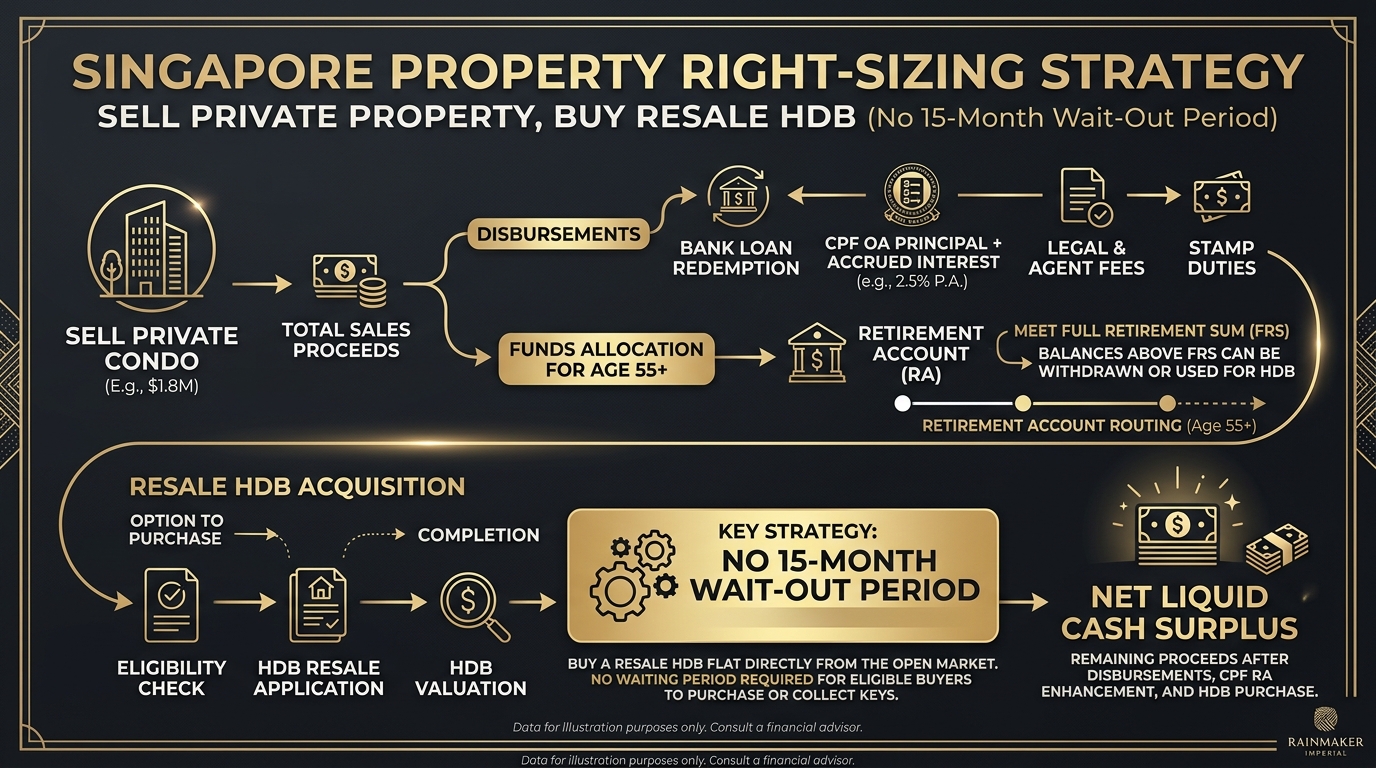
The June 2026 HDB Built-To-Order (BTO) exercise marked a turning point for public housing in Singapore, as it brought the 1,976-unit Berlayar Rise to the new city-fringe Berlayar estate at a moment when islandwide HDB prices were sitting exactly at their record peak of S$652 psf (Stacked Homes, 2026; PropAce Institutional Advisorydata, 2026).
Key takeaways
- The June 2026 BTO exercise was anchored by Berlayar Rise, a 1,976-unit project in the new Berlayar estate, which is planned to eventually contain about 7,000 public homes and 3,000 private homes (Stacked Homes, 2026).
- Islandwide HDB prices stood at S$652 psf in 2026-Q2, unchanged from their peak and 57.5% above the cycle trough of S$414 psf (PropAce Institutional Advisorydata, 2026).
- Private home prices remain 6.8% below their peak, yet new launches still command a roughly 45% premium over resale flats (PropAce Institutional Advisorydata, 2026).
- HDB resale transactions fell 7.4% year-on-year in H1 2026, while EC sales rose 37.2%, signalling a demand shift between housing segments (Business Times, 2026).
- The October 2026 BTO exercise is already lined up with six projects, including Bayshore Road and Toa Payoh Rise, keeping supply pressure on the market (Housing & Development Board, 2026).
A launch that redraws the public–private boundary
The anchor project: Berlayar Rise
The June 2026 exercise was not just another quarterly BTO launch. It included Berlayar Rise, a 1,976-unit development in the new Berlayar neighbourhood, which sits on the city-fringe side of Telok Blangah (Stacked Homes, 2026). This was the second BTO to be launched in Berlayar, following the 880-unit Berlayar Residences that was sold under the October 2025 exercise (Stacked Homes, 2026). The fact that HDB chose to bring such a large project to this location signals the Government’s intent to place public housing in close physical proximity to private housing, rather than confining BTO supply to the suburbs.
Berlayar is not a typical heartland estate. According to the Government, the estate will contain about 7,000 new public housing units alongside 3,000 private homes (Stacked Homes, 2026). That mix is deliberate. It means that BTO applicants are not simply choosing between towns; they are choosing between different forms of housing within the same master-planned district. For the June 2026 exercise, this made Berlayar Rise the most closely watched project of the cycle.
A new model of integrated estate planning
The private side of Berlayar is already taking shape. The first private residential plot in the neighbourhood, at Telok Blangah Road, was awarded to Chinese developer Kingsford Group last November for S$918.3 million, or S$1,326 psf per plot ratio, and could yield about 745 new private homes (Stacked Homes, 2026). A subsequent Government Land Sales (GLS) site at Berlayar Drive drew a single bid of S$1,515 psf per plot ratio from a joint venture between Hong Leong Holdings and GuocoLand — a price that surpasses the previous RCR record of S$1,455 psf per plot ratio by about 4.1% (Stacked Homes, 2026). If the site is awarded, it could yield up to 415 private homes, bringing the total number of confirmed condominium units in Berlayar to approximately 1,160 (Stacked Homes, 2026).
The effect is a live experiment in how public and private housing coexist. Buyers who missed the June 2026 BTO exercise may eventually have the option of buying a private unit in the same estate, but at a very different price point. That price point is precisely the subject of the market data that surrounds this launch.
The state of the market: prices, peaks and premiums
Public housing is at the top of the cycle
The June 2026 BTO exercise took place against a backdrop of record HDB prices. Islandwide HDB prices averaged S$652 psf in 2026-Q2, which is exactly 0.0% above their previous peak of S$652 psf and 57.5% above the cycle trough of S$414 psf (PropAce Institutional Advisorydata, 2026). In other words, the public housing market has fully recovered from its earlier downturn and is now trading at the highest level in its current cycle.
For BTO applicants, this has a double-edged effect. On one hand, resale prices are high, which makes a new BTO flat look relatively attractive as a form of below-market entry into homeownership. On the other hand, high resale prices also raise the benchmark against which future BTO prices are set. BTO pricing is not published for Berlayar Rise in the available data, but the wider resale market provides the context for what applicants are deferring or replacing.
Private prices have room below their peak
The private market tells a slightly different story. Islandwide private home prices averaged S$2,038 psf in 2026-Q2, which is 6.8% below their peak of S$2,186 psf, but still 33.3% above the trough of S$1,529 psf (PropAce Institutional Advisorydata, 2026). This suggests that private prices have cooled from their highs, but have not collapsed. The gap between the private peak and the current level is small enough to be described as consolidation rather than correction.
Within the private market, location matters sharply. Core Central Region (CCR) homes have averaged S$2,444 psf, city-fringe (RCR) homes S$2,078 psf, and suburban (OCR) homes S$1,551 psf (PropAce Institutional Advisorydata, 2026). Berlayar, being in the city-fringe, sits squarely in the RCR band. That is the price cohort against which Berlayar Rise will be judged, even though the BTO itself will be priced by HDB rather than by the private market.
A 45% new-sale premium
One of the most striking figures in the current market is the gap between new and resale private homes. New-launch private homes have averaged S$2,304 psf, against S$1,594 psf for resale — a roughly 45% new-sale premium (PropAce Institutional Advisorydata, 2026). This premium is a reminder that buying a new private launch is not the same as buying a completed home; part of the price pays for the newness, the showflat, and the deferred delivery.
This premium matters for BTO applicants because it frames the opportunity cost of going private. A household that chooses a BTO is effectively opting out of a private market where new units cost more than 45% above resale. When the RCR average is S$2,078 psf, and the HDB resale average is S$652 psf, the financial logic of waiting for a BTO is easy to understand — even if the waiting time is long.
What the numbers say about demand and supply
Resale and new-sale volumes
The demand side of the market is showing signs of consolidation. Developers sold 4,154 private homes, excluding executive condominiums (ECs), in the first half of 2026, down 9.4% from the 4,587 units sold in the year-ago period (Business Times, 2026). EC sales, however, rose 37.2% to 1,343 units in the same period (Business Times, 2026). That divergence suggests that buyers are becoming more price-sensitive, and that the subsidised or hybrid forms of housing are gaining appeal.
The resale market is also cooling. Private residential resale recorded 7,407 transactions in H1 2026, down 5.1% year-on-year, while HDB resale transactions fell 7.4% to 12,681 in the recorded period (Business Times, 2026). For the full year, ERA has projected new-home sales of between 8,000 and 9,000 units, and secondary market transactions of 13,000 to 14,000 units (Business Times, 2026). Seven more condo developments and one EC project are expected to be launched in 2026 (Business Times, 2026).
This is not a market in freefall, but it is a market where volume is moderating. For the June 2026 BTO exercise, that means competition for scarce BTO flats may remain intense, even as the broader private market grows quieter.
October 2026 pipeline
The supply picture is also set to expand. HDB has already lined up the October 2026 BTO exercise, with six projects across the island: Tengah Garden Avenue in Tengah (710 units), Bayshore Walk in Bedok (860 units), Sembawang Drive (1,310 units), Toa Payoh Rise (1,430 units), Yishun Walk (1,580 units), and Bayshore Road in Bedok (1,640 units) (Housing & Development Board, 2026). These projects range from suburban estates to mature-town sites near MRT stations, giving applicants who missed June a broad set of alternatives.
The October list also confirms that HDB is not slowing its launch programme. Toa Payoh Rise, in particular, is a notable addition because mature-town BTO projects are relatively scarce. For those who are prepared to wait, the June 2026 exercise is not the last chance to secure a new flat this year.
What this means for different buyers
First-timer families
For first-timer families, the June 2026 exercise offered the usual advantages of BTO: priority in balloting, grants, and prices that are generally below comparable resale flats. The market context strengthens this case. With islandwide HDB resale prices at S$652 psf and exactly at their peak, a new BTO is one of the few ways to buy into public housing without paying peak resale prices (PropAce Institutional Advisorydata, 2026). However, BTO buyers must also accept a long waiting time and the risk that market conditions will change before completion.
HDB upgraders
The more complex decision is for HDB upgraders who already own a flat. In the areas around Berlayar, this is particularly relevant. Commentary on the June 2026 exercise notes that HDB resale units in Bukit Merah, Queenstown, and nearby city-fringe estates — especially newer units — typically sell at a premium, often above S$1 million (Stacked Homes, 2026). For these owners, the decision to apply for a BTO is not about moving from a low-value asset to a higher-value one; it is about recycling equity into a new home, or choosing to remain in the resale market.
The existence of Berlayar Rise, followed by private launches in the same estate, gives these upgraders an unusual choice: they can stay in the public market or move to a private home in the same neighbourhood. The RCR average price of S$2,078 psf (PropAce Institutional Advisorydata, 2026) tells them what the private option costs. The HDB resale average of S$652 psf (PropAce Institutional Advisorydata, 2026) tells them what their current segment is worth.
Private property downgraders
Another group to watch is private property owners who are rightsizing into HDB flats. The removal of the 15-month wait-out period for eligible private homeowners buying HDB resale flats could “support consumer confidence and long-term market stability” (Business Times, 2026). While this policy applies to the resale market rather than to BTO, it nonetheless affects the broader demand for HDB housing. If more private owners enter the HDB resale market, resale prices could stay firm, which in turn makes BTO applications even more attractive by comparison.
A worked example: the city-fringe upgrader
Consider a household that owns a newer HDB resale flat in Queenstown or Bukit Merah. Based on market commentary around the June 2026 exercise, such a flat could be worth above S$1 million (Stacked Homes, 2026). This puts the household in a strong equity position, but it also creates a decision: sell and buy a private home, or sell and apply for a BTO.
If the household chooses private housing in the RCR, where Berlayar sits, the average price is S$2,078 psf (PropAce Institutional Advisorydata, 2026). By contrast, if they choose to stay in public housing, the islandwide HDB resale average is S$652 psf (PropAce Institutional Advisorydata, 2026). The gap between these figures is enormous, and it explains why many city-fringe HDB owners are reluctant to give up their flats, even when they can afford to upgrade.
For a concrete per-buyer breakdown, the comparison can be made on a per-square-foot basis. A private RCR home at S$2,078 psf (PropAce Institutional Advisorydata, 2026) is more than three times the HDB average of S$652 psf (PropAce Institutional Advisorydata, 2026). A household selling a S$1 million-plus resale flat (Stacked Homes, 2026) would have equity that goes much further in the BTO market than in the private market. The same household, however, would face the opportunity cost of waiting several years for a BTO to be completed. That trade-off between price and time is the central equation of the June 2026 BTO exercise.
The bigger picture: policies and pipeline
Policy support for the market
The policy environment is broadly supportive of housing demand. Besides the removal of the 15-month wait-out period, industry observers expect the market to remain resilient through the rest of 2026, with moderate price growth driven by genuine housing demand (Business Times, 2026). This is not a market that is expected to crash, but it is also not one where prices are racing ahead of incomes. For BTO buyers, this means the urgency to buy is driven more by the fear of missing out than by actual market momentum.
A growing supply of both public and private homes
The supply side is also expanding. Berlayar alone will add about 7,000 public homes and 3,000 private homes over time (Stacked Homes, 2026). The upcoming October 2026 BTO exercise will add another six projects, including major launches at Bayshore Road, Toa Payoh Rise, and Yishun Walk (Housing & Development Board, 2026). On the private front, the Berlayar Drive GLS site could add up to 415 units, and the broader pipeline includes seven more condo developments and one EC project in 2026 (Stacked Homes, 2026; Business Times, 2026).
For the property market as a whole, the June 2026 BTO exercise is therefore not just a sales event. It is a signal that the boundary between public and private housing is being deliberately reorganised. As HDB prices sit at their peak, and private prices hover below theirs, the competition for buyers is intensifying. Berlayar Rise is the most visible symbol of that competition — a 1,976-unit public housing project placed at the heart of a new city-fringe district where private homes are being priced at record levels per plot ratio (Stacked Homes, 2026).
The bottom line for buyers is simple: the June 2026 exercise offered one of the strongest arguments yet for choosing public housing, but it also demanded a long wait. With the October 2026 pipeline already announced, the message from policymakers is equally clear — there will be more supply, and there will be more choice, but the clock will keep ticking for those who hesitate.
FAQ
What was the June 2026 BTO sales exercise?
The June 2026 BTO sales exercise was HDB’s quarterly launch of new flats, and it included the 1,976-unit Berlayar Rise project in the new Berlayar estate (Stacked Homes, 2026). It is significant because it placed a large public housing project in a city-fringe area alongside a planned private housing supply.
Statutory Source: Housing & Development Board (HDB) — Official Housing Policies & Resale Guidelines
How many units were launched at Berlayar Rise?
Berlayar Rise comprises 1,976 units, making it one of the anchor projects of the June 2026 exercise (Stacked Homes, 2026). It follows the earlier 880-unit Berlayar Residences, which was launched in October 2025 in the same estate.
Statutory Source: Housing & Development Board (HDB) — Official Housing Policies & Resale Guidelines
Are HDB prices at a peak?
Yes. Islandwide HDB prices averaged S$652 psf in 2026-Q2, which is exactly 0.0% above the previous peak of S$652 psf and 57.5% above the cycle trough of S$414 psf (PropAce Institutional Advisorydata, 2026). This means public housing prices have fully recovered to record levels.
Statutory Source: Housing & Development Board (HDB) — Official Housing Policies & Resale Guidelines
How does the private market compare with HDB?
Private home prices averaged S$2,038 psf in 2026-Q2, 6.8% below their peak, while new launches averaged S$2,304 psf against S$1,594 psf for resale — a roughly 45% premium (PropAce Institutional Advisorydata, 2026). The gap between the private RCR average of S$2,078 psf and the HDB average of S$652 psf highlights the relative affordability of public housing.
Statutory Source: Housing & Development Board (HDB) — Official Housing Policies & Resale Guidelines
What BTO projects are coming in October 2026?
The October 2026 BTO exercise will include six projects: Tengah Garden Avenue (710 units), Bayshore Walk (860 units), Sembawang Drive (1,310 units), Toa Payoh Rise (1,430 units), Yishun Walk (1,580 units), and Bayshore Road (1,640 units) (Housing & Development Board, 2026). These projects offer a range of suburban and mature-town options for applicants.
Statutory Source: Housing & Development Board (HDB) — Official Housing Policies & Resale Guidelines
By the numbers
``` HDB PSF momentum by district — QoQ %
D? +8.2% ██████████████████████████ D? +7.0% ██████████████████████ D? +2.9% █████████ D? +2.6% ████████ D? +2.4% ████████ D? +2.1% ███████ D? +1.5% █████ D? +1.5% █████ D? +1.3% ████ D? +0.7% ██ ```
| District | Median PSF | QoQ | YoY | Txns (3mo) |
|---|---|---|---|---|
| D? | $964 | ▲ 8.2% | ▲ 7.5% | 195 |
| D? | $829 | ▲ 7.0% | ▲ 7.2% | 228 |
| D? | $705 | ▲ 2.9% | ▲ 4.9% | 32 |
| D? | $597 | ▲ 2.6% | ▲ 1.2% | 215 |
| D? | $641 | ▲ 2.4% | ▲ 2.4% | 342 |
| D? | $822 | ▲ 2.1% | ▲ 1.0% | 214 |
| D? | $535 | ▲ 1.5% | ▲ 0.6% | 266 |
| D? | $665 | ▲ 1.5% | ▲ 0.3% | 105 |
| D? | $770 | ▲ 1.3% | ▲ 5.5% | 119 |
| D? | $691 | ▲ 0.7% | ▲ 1.0% | 455 |
_Data: PropAce Institutional Advisory analysis of URA/HDB transaction data — rolling 3-month average PSF, HDB, 2026-06..2026-08. Directional; confirm before acting._
Sources
- URA caveat data, compiled by PropAce Institutional Advisory— 2026-Q2.
- URA caveat data, compiled by PropAce Institutional Advisory.
References
- Government of Singapore (2026) HDB’S JUNE 2026 BTO SALES EXERCISE.
Interactive Strategic Tools & Concierge
Institutional-grade financial engines for Singapore real estate: stamp duties, borrowing capacity, and cashflow modeling.
Explore All 11 PropAce Financial Calculators
Frequently Asked Questions
What was the June 2026 BTO sales exercise?
The June 2026 BTO sales exercise was HDB’s quarterly launch of new flats, and it included the 1,976-unit Berlayar Rise project in the new Berlayar estate (Stacked Homes, 2026). It is significant because it placed a large public housing project in a city-fringe area alongside a planned private housing supply. Statutory Source:** Housing & Development Board (HDB) — Official Housing Policies & Resale Guidelines
How many units were launched at Berlayar Rise?
Berlayar Rise comprises 1,976 units, making it one of the anchor projects of the June 2026 exercise (Stacked Homes, 2026). It follows the earlier 880-unit Berlayar Residences, which was launched in October 2025 in the same estate. Statutory Source:** Housing & Development Board (HDB) — Official Housing Policies & Resale Guidelines
Are HDB prices at a peak?
Yes. Islandwide HDB prices averaged S$652 psf in 2026-Q2, which is exactly 0.0% above the previous peak of S$652 psf and 57.5% above the cycle trough of S$414 psf (PropAce Institutional Advisorydata, 2026). This means public housing prices have fully recovered to record levels. Statutory Source:** Housing & Development Board (HDB) — Official Housing Policies & Resale Guidelines
How does the private market compare with HDB?
Private home prices averaged S$2,038 psf in 2026-Q2, 6.8% below their peak, while new launches averaged S$2,304 psf against S$1,594 psf for resale — a roughly 45% premium (PropAce Institutional Advisorydata, 2026). The gap between the private RCR average of S$2,078 psf and the HDB average of S$652 psf highlights the relative affordability of public housing. Statutory Source:** [Housing & Development Board (HDB) — Official Housing Policies & Resale Guidelines](https://www.hdb.gov.sg/cs/infoweb/re
What BTO projects are coming in October 2026?
The October 2026 BTO exercise will include six projects: Tengah Garden Avenue (710 units), Bayshore Walk (860 units), Sembawang Drive (1,310 units), Toa Payoh Rise (1,430 units), Yishun Walk (1,580 units), and Bayshore Road (1,640 units) (Housing & Development Board, 2026). These projects offer a range of suburban and mature-town options for applicants. Statutory Source:** [Housing & Development Board (HDB) — Official Housing Policies & Resale Guidelines](https://www.hdb.gov.sg/cs/infoweb/reside
Statutory References & Citations
- Housing & Development Board (HDB) (2026). Housing and Development Act (Cap. 129). Singapore: Ministry of National Development.
- Singapore Land Authority (SLA) (2026). Land Titles Act (Cap. 157) & Conveyancing Registration Framework. Singapore: SLA.
Statutory Disclaimer: This guide is published for strategic, educational, and institutional planning purposes only and does not constitute formal legal, taxation, or financial advice. All property transactions, stamp duty remissions, and financing structures should be formally verified with qualified Singapore legal counsel and certified tax advisors.