 PropAce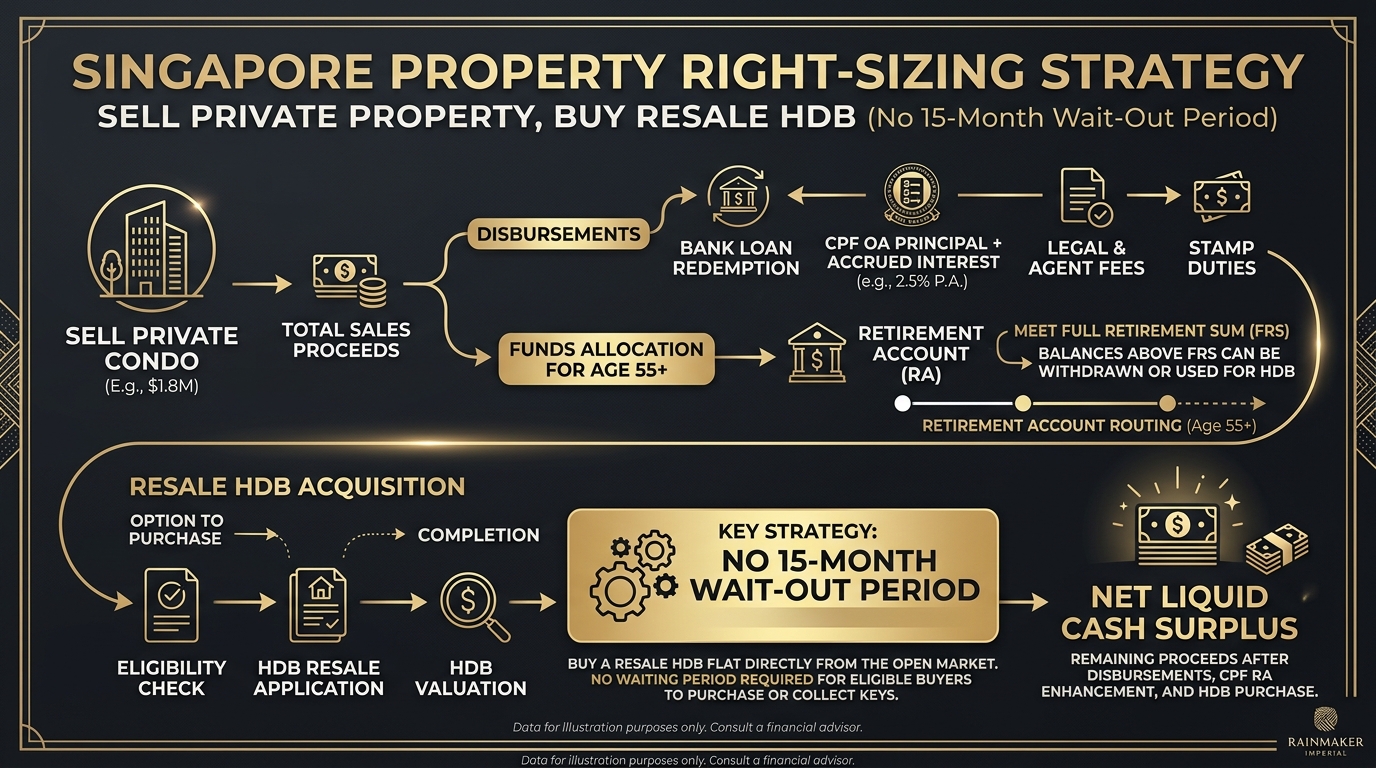
Higher BTO and resale flat demand is expected after the Government raised the monthly household income ceiling from S$14,000 to S$16,000 for Build-To-Order (BTO) flats and from S$16,000 to S$18,000 for Executive Condominiums (ECs), but analysts say the public housing market is on firmer ground and supply can keep pace.
Prime Minister Lawrence Wong announced the changes at the National Day Rally on Aug 23, 2026, alongside plans to make it easier for first-time families with children — or expecting a child — to secure a BTO flat (The Straits Times, 2026). The moves come as the local public housing market is on a stronger footing, with the overall success rate of BTO applications on the rise and the resale market stabilising (The Straits Times, 2026).
Key takeaways
- The monthly household income ceiling for BTO flats rises from S$14,000 to S$16,000; the EC ceiling rises from S$16,000 to S$18,000; the income ceiling for singles is raised by S$1,000.
- The revision follows an established rhythm, with previous adjustments in 2011, 2015 and 2019, typically in S$2,000 increments for families and couples.
- A household earning the new BTO ceiling could potentially borrow up to S$909,372 and buy a flat of up to S$1.212 million, under assumptions used by Realion (OrangeTee & ETC) Group.
- For ECs, a household at the new S$18,000 ceiling could borrow up to S$1.13 million and purchase an EC of up to S$1.508 million — an additional S$168,000, or around 8 to 10 per cent of the median new EC price.
- More middle-income families will gain access to subsidised housing, but lower-income applicants may face tougher balloting odds; analysts say supply can still keep up.
A reset that follows a familiar rhythm
Why the ceiling moved
Christine Sun, chief researcher and strategist at Realion (OrangeTee & ETC) Group, described the revision as timely, noting that previous adjustments occurred approximately every four years — in 2011, 2015 and 2019 (The Straits Times, 2026). She also observed that the latest change is not excessive, and that previous income ceiling revisions for families and couples were made in increments of S$2,000 (The Straits Times, 2026).
The Government’s decision is therefore best read as a periodic policy calibration rather than an abrupt expansion of eligibility. The additional S$2,000 is intended to capture households whose incomes have grown since the last review, bringing them back within the subsidised housing net.
Who stands to benefit
Middle-income families and slightly higher-income couples without children are likely to benefit most, according to Sun, as some may have exceeded the income ceiling needed to purchase subsidised BTO flats (The Straits Times, 2026). Before the revision, some of these families and couples may not have had sufficient cash or CPF savings to buy an HDB resale flat instead (The Straits Times, 2026).
The impact is not limited to BTO applicants. The higher ceilings also improve access to ECs, which sit between public and private housing in price and positioning. This matters for younger households who aspire to own a larger condo-style home but cannot stretch to a private new launch.
What the market data show
HDB prices at their cycle peak
Islandwide HDB prices averaged S$652 psf in 2026-Q2, sitting precisely at their previous S$652 psf peak (PropAce Institutional Advisorydata, 2026). While that leaves no headroom against the historical high, prices remain 57.5 per cent above the S$414 psf trough, underlining the extent of the recovery since the market bottomed out (PropAce Institutional Advisorydata, 2026).
For households re-entering the BTO queue, the affordability question is therefore not just about income eligibility. It is also about the level at which HDB prices have settled after a prolonged upcycle.
Private home prices: below peak, above trough
Private residential prices tell a similar, though slightly cooler, story. Islandwide private prices averaged S$2,038 psf in 2026-Q2, about 6.8 per cent below their S$2,186 psf peak, yet still 33.3 per cent above the S$1,529 psf trough (PropAce Institutional Advisorydata, 2026).
The comparison matters because a meaningful share of BTO applicants are prospective upgraders or right-sizers who track both the HDB and private markets. The data suggest that private prices have eased from their peak, but remain well above pre-cycle levels.
The new-launch premium and market segmentation
Across the private transaction record, new-launch private homes averaged S$2,304 psf against S$1,594 psf for resale — a roughly 45 per cent new-sale premium (PropAce Institutional Advisorydata, 2026). By region, prime-core (CCR) homes averaged S$2,444 psf, city-fringe (RCR) homes S$2,078 psf, and suburban (OCR) homes S$1,551 psf (PropAce Institutional Advisorydata, 2026).
These figures help explain why the BTO and EC ceilings matter. At the margin, more households will now qualify for subsidised options instead of paying private-market prices, particularly in the city-fringe and suburban segments where new-launch pricing has been most competitive.
Recent HDB resale medians
URA transaction data compiled by OTT show that between July and August this year, the median price of a four-room HDB resale flat was S$628,000, while the median price of a five-room flat was S$735,800 (The Straits Times, 2026). Analysts cited these figures as evidence that some families and couples may not have enough cash or CPF to enter the resale market, making access to subsidised BTOs more important (The Straits Times, 2026).
The worked example: what an extra S$2,000 can do
BTO borrowing capacity at S$14,000 and S$16,000
Using an example generated by OTT, assume a Loan-To-Value (LTV) ratio of 75 per cent, a Mortgage Servicing Ratio (MSR) capped at 30 per cent of gross monthly income, a 25-year loan tenure and a 4 per cent stress-test rate.
A borrower with a household income of S$14,000 could take a maximum loan of around S$795,700 and purchase a BTO flat priced at up to S$1.06 million (The Straits Times, 2026). At the new ceiling of S$16,000, the same borrower could take a maximum loan of up to S$909,372 and buy a flat priced up to S$1.212 million (The Straits Times, 2026).
The higher ceiling gives buyers greater purchasing flexibility. According to analysts, it could potentially allow households to access almost any BTO flat on the market, including Prime or Plus flats and high-floor units (The Straits Times, 2026).
A second BTO scenario
A separate example from ERA Singapore uses a 25-year loan tenure, a stress-test interest rate of 3 per cent per annum and no existing debt obligations. Under those assumptions, a BTO buyer with a household income of S$14,000 per month could borrow up to approximately S$885,000, with monthly mortgage payments of about S$4,200 (The Straits Times, 2026).
With the higher income ceiling of S$16,000
By the numbers
``` HDB PSF momentum by district — QoQ %
D? +7.6% ██████████████████████████ D? +7.2% █████████████████████████ D? +2.9% ██████████ D? +2.5% █████████ D? +2.4% ████████ D? +2.4% ████████ D? +1.5% █████ D? +1.3% ████ D? +1.0% ███ D? +0.8% ███ ```
| District | Median PSF | QoQ | YoY | Txns (3mo) |
|---|---|---|---|---|
| D? | $959 | ▲ 7.6% | ▲ 6.9% | 202 |
| D? | $831 | ▲ 7.2% | ▲ 7.5% | 232 |
| D? | $705 | ▲ 2.9% | ▲ 4.9% | 32 |
| D? | $825 | ▲ 2.5% | ▲ 1.4% | 218 |
| D? | $596 | ▲ 2.4% | ▲ 1.0% | 219 |
| D? | $641 | ▲ 2.4% | ▲ 2.4% | 350 |
| D? | $665 | ▲ 1.5% | ▲ 0.3% | 105 |
| D? | $534 | ▲ 1.3% | ▲ 0.4% | 271 |
| D? | $835 | ▲ 1.0% | ▲ 1.0% | 15 |
| D? | $766 | ▲ 0.8% | ▲ 4.9% | 122 |
_Data: PropAce Institutional Advisory analysis of URA/HDB transaction data — rolling 3-month average PSF, HDB, 2026-06..2026-08. Directional; confirm before acting._
Sources
- URA caveat data, compiled by PropAce Institutional Advisory— 2026-Q2.
- URA caveat data, compiled by PropAce Institutional Advisory.
References
- The Straits Times (2026) Higher BTO, resale flat demand expected after income ceiling raised, supply can keep up: Analysts.
FAQ
What are the resale restrictions on Plus and Prime BTO flats compared to Standard flats?
Plus and Prime BTO flats are subject to a 10-year Minimum Occupation Period (MOP) instead of 5 years. Whole-flat renting is permanently barred even after MOP, buyers must return a percentage of the resale price as a subsidy clawback to HDB upon sale, and subsequent resale buyers must meet strict BTO-equivalent eligibility criteria (e.g. S$14,000 income ceiling).
Statutory Source: Housing & Development Board (HDB) — Standard, Plus & Prime Framework
What is the maximum CPF Housing Grant available for BTO buyers in 2026?
Eligible first-timer families can receive up to S$80,000 in Enhanced CPF Housing Grants (EHG), subject to household income tiers (up to S$9,000/month). The grant is credited directly into the applicant's CPF Ordinary Account for downpayment offset.
Statutory Source: Housing & Development Board (HDB) — CPF Housing Grants Framework
Can private property owners apply for a BTO flat immediately after selling?
No. Former private property owners must observe a statutory 30-month wait-out period from the disposal date of their private property before they can apply for a BTO flat from HDB.
Statutory Source: Housing & Development Board (HDB) — Resale Flat Eligibility & Wait-Out Requirements
Interactive Strategic Tools & Concierge
Institutional-grade financial engines for Singapore real estate: stamp duties, borrowing capacity, and cashflow modeling.
Explore All 11 PropAce Financial Calculators
Frequently Asked Questions
What are the resale restrictions on Plus and Prime BTO flats compared to Standard flats?
Plus and Prime BTO flats are subject to a 10-year Minimum Occupation Period (MOP) instead of 5 years. Whole-flat renting is permanently barred even after MOP, buyers must return a percentage of the resale price as a subsidy clawback to HDB upon sale, and subsequent resale buyers must meet strict BTO-equivalent eligibility criteria (e.g. S$14,000 income ceiling). Statutory Source:** [Housing & Development Board (HDB) — Standard, Plus & Prime Framework](https://www.hdb.gov.sg/cs/infoweb/residentia
What is the maximum CPF Housing Grant available for BTO buyers in 2026?
Eligible first-timer families can receive up to S$80,000 in Enhanced CPF Housing Grants (EHG), subject to household income tiers (up to S$9,000/month). The grant is credited directly into the applicant's CPF Ordinary Account for downpayment offset. Statutory Source:** Housing & Development Board (HDB) — CPF Housing Grants Framework
Can private property owners apply for a BTO flat immediately after selling?
No. Former private property owners must observe a statutory 30-month wait-out period from the disposal date of their private property before they can apply for a BTO flat from HDB. Statutory Source:** Housing & Development Board (HDB) — Resale Flat Eligibility & Wait-Out Requirements
Statutory References & Citations
- Housing & Development Board (HDB) (2026). Housing and Development Act (Cap. 129). Singapore: Ministry of National Development.
Statutory Disclaimer: This guide is published for strategic, educational, and institutional planning purposes only and does not constitute formal legal, taxation, or financial advice. All property transactions, stamp duty remissions, and financing structures should be formally verified with qualified Singapore legal counsel and certified tax advisors.