 PropAce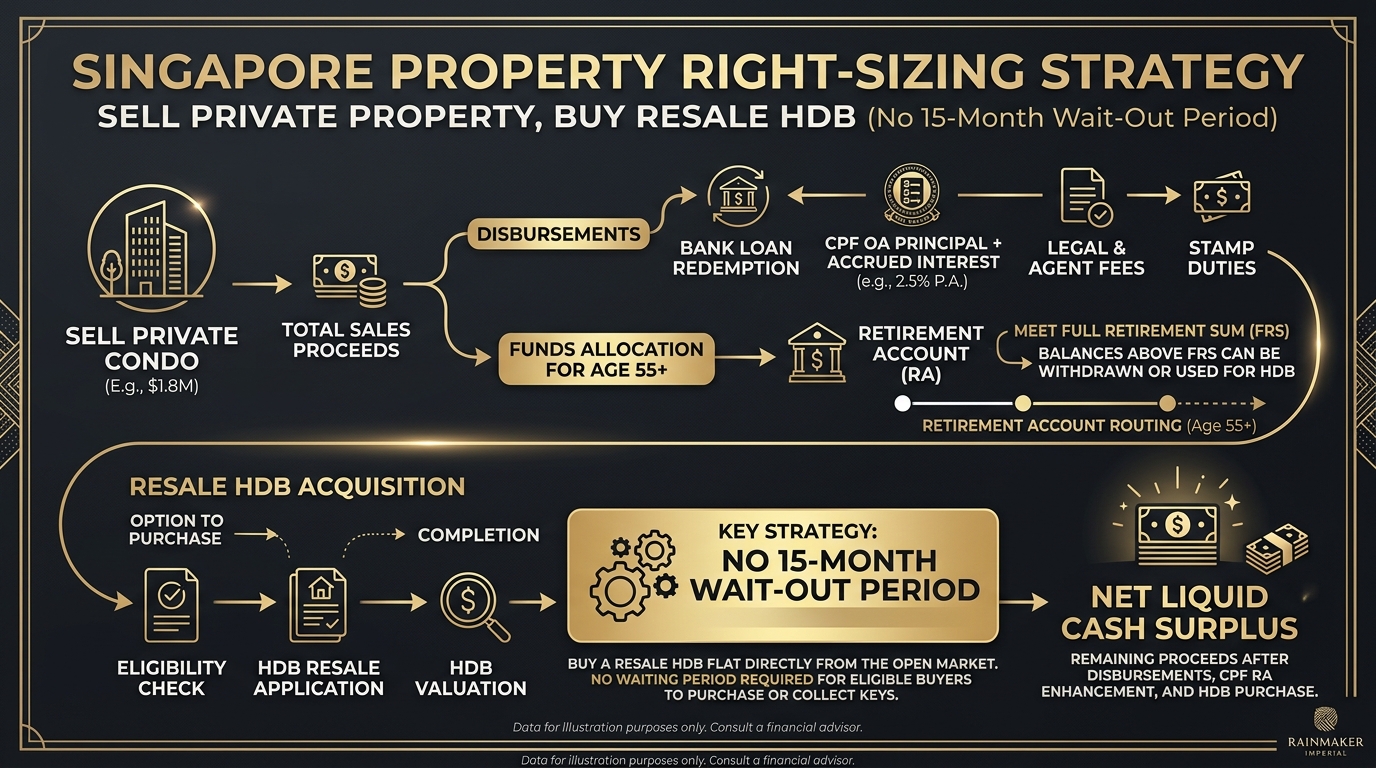
Buying a resale HDB flat in 2026 is a sequence of regulated, date-sensitive steps. Miss one, and you can waste months or lose money. By the end of this guide, you will know exactly how to get from eligibility check to key collection — no guesswork, no missing paperwork, and no expensive surprises.
Key takeaways - Get your HFE letter before viewing any flat; it determines eligibility, grants, and loan options. - Run the budget rules first: MSR, LTV ceilings, CPF limits, and Plus flat income restrictions. - Use official HDB, CPF, and IRAS sources for current figures. - Engage a conveyancing lawyer before you sign anything.
Before you start
This guide is for anyone who can legally buy a resale HDB flat: Singapore Citizens and Singapore Permanent Residents forming an eligible family nucleus, plus single citizens above the age HDB allows. If you are a foreigner, stop here. HDB resale flats are generally not open to you.
Resale is the middle path. You do not wait years for a Build-To-Order flat, but you also do not pay private property prices. The numbers confirm the gap. HDB resale transaction data shows islandwide HDB resale prices stood at S$652 psf in 2026-Q2, effectively 0.0% above their previous peak. That means HDB prices have flattened, not crashed. They still sit 57.5% above the S$414 psf trough. The private market, by comparison, is at S$2,038 psf, 6.8% below its S$2,186 psf peak but 33.3% above the S$1,529 psf trough. If you are looking for a home that is not at record highs, HDB resale is the place to be.
Before you open a single listing, prepare these:
- Your Singpass, to access HDB’s Resale Portal.
- Your CPF statement, to see what you have in Ordinary Account savings.
- Your latest income documents, including payslips, CPF contribution history, and any variable income.
- Details of any property you already own, because that changes everything.
- A marriage certificate or other documents proving your family nucleus, if applicable.
Then get ready for the most important step of all.
Step 1: Get an HDB Flat Eligibility (HFE) letter before you view anything
Do not view flats without this. Do not negotiate a price without this. Do not even message an agent asking for a “quick look” without this.
The HFE letter is the single document that tells you three things: whether you are eligible to buy a resale flat, what CPF housing grants you may qualify for, and whether you can take an HDB concessionary loan. It is issued by HDB and applied for through the HDB Resale Portal under My HDB, using your Singpass.
Where you apply matters. You must go through HDB’s official portal, not a third-party website. The application requires your household income, family nucleus details, and property ownership history. The letter is not instant — HDB needs time to assess. Check the current processing time on the official HDB site, and do not assume a fast turnaround. The moment you decide you are serious about buying, start this application.
The HFE letter also has a validity period. If it expires before you complete your purchase, you will need to reapply. As with the processing time, confirm the current validity window directly on HDB’s site rather than relying on hearsay.
One more eligibility trap: if you currently own private property, you will face the 15-month wait-out period before you can buy a resale HDB flat. This is not a suggestion. It is a hard HDB rule. Count it from the date you dispose of your private property. If you sell in June 2026, you cannot complete an HDB resale purchase until September 2027 at the earliest. Plan your timeline around this.
Step 2: Work out what you can actually afford
The resale HDB price might be S$652 psf islandwide, but that does not mean you can afford any flat you like. Affordability is a function of your income, your cash, your CPF, and the rules.
First, check the Mortgage Servicing Ratio. For HDB flats, your monthly loan repayment cannot exceed 30% of your gross monthly income. This is a hard ceiling. If you earn S$6,000 a month, your maximum monthly mortgage payment is S$1,800, regardless of how much the bank says you can borrow.
Second, understand the Loan-to-Value limit. In August 2024, the government reduced the maximum LTV for HDB concessionary loans from 80% to 75%. That means you need a larger downpayment than buyers enjoyed just a couple of years ago. The exact downpayment mix of cash and CPF depends on whether you take an HDB loan or a bank loan, so check the current HDB and bank loan rules.
Third, run the numbers using the calculators on HDB’s site, CPF’s site, and trusted property portals. These are free, take five minutes, and tell you your maximum property price, your monthly commitment, and your shortfall. Do not skip this because you “know your budget”. The calculators will show you how changing the loan tenure, interest rate, or downpayment mix affects your monthly payments.
Fourth, know your grants. If your household income is S$9,500 or less per month, you may qualify for the Enhanced CPF Housing Grant. This is a meaningful subsidy that can turn a borderline purchase into a comfortable one. There are other resale grants depending on your family status and whether you are buying near your parents; check HDB’s grant page for the current list and amounts.
One further note: ordinary resale flats do not have an income ceiling, but “Plus” flats in the resale market do. The monthly income ceiling for purchasing a Plus flat is S$14,000. If your household income is above that, do not shortlist Plus flats.
Step 3: Search with a shortlist, not a starry eye
Now you can hunt. Use the HDB Resale Portal for official transaction records and current listings, and property portals for convenience. Filter by town, flat type, floor level, remaining lease, and price.
Here is where the data should guide you. New-launch private homes averaged S$2,304 psf against S$1,595 psf for private resale — a roughly 44% new-sale premium. By comparison, islandwide HDB resale prices at S$652 psf are less than half the private resale average. Across private regions, prime-core (CCR) homes averaged S$2,444 psf, city-fringe (RCR) S$2,078 psf, and suburban (OCR) S$1,551 psf. Those are the prices you avoid by choosing HDB resale.
But don’t just chase the cheapest flat in the cheapest town. Build a shortlist of no more than five to eight flats that genuinely fit your commute, your family size, and your budget. Then check the recent transaction prices in the same block and nearby blocks. HDB publishes this data. If the asking price is 20% higher than the last comparable sale, you should know exactly why.
Step 4: Do the due diligence before you fall in love
Every HDB flat looks good at sunset. The problems show up when you check the details.
First, remaining lease. HDB flats do not have freehold tenure. A flat with 60 years left might be cheap, but it can also create problems for CPF usage and bank loans. Ask yourself how long you intend to live there, and check the lease against your loan tenure. If you are older and buying an older flat, the loan may not stretch far enough.
Second, Minimum Occupation Period. The flat must have met its MOP before the owner can sell it to you. If the flat is still within MOP, walk away. The seller cannot legally complete the sale.
Third, physical condition. Visit at different times of day. Check for water stains, cracks, noisy neighbours, afternoon sun, and the actual distance to the nearest MRT station. A map may say 800 metres. Walk it in the rain and you will understand the real cost.
Fourth, the flat’s classification. If it is a Plus flat, you are bound by additional restrictions including the S$14,000 income ceiling and resale conditions. If it is a Prime flat, the restrictions are stricter still. Check the HDB classification before you commit.
Finally, look at the estate itself. A beautiful flat in a dead neighbourhood will still be a beautiful flat, but you will be selling it in an unpopular town. The best flats are in areas where the next buyer will also want to live.
Step 5: Negotiate and get an Option to Purchase (OTP)
When you and the seller agree on a price, the seller issues an Option to Purchase, or OTP. This is the legal document that gives you the exclusive right to buy the flat at that price, for a fixed period.
You will pay an option fee to the seller when the OTP is issued. This fee is capped by HDB — check the current cap on the HDB site, because it changes from time to time. If you do not exercise the OTP, the seller keeps this fee. That is the cost of changing your mind.
The OTP is where everything becomes real. Before you pay even one dollar, make sure your HFE letter is valid, your financing is sorted, and your lawyer or agent has confirmed the terms. Do not rely on verbal promises. The OTP must be in writing, signed by both parties, and dated.
Once the OTP is issued, the clock starts. There are strict deadlines for the next steps, and missing one can cost you the option fee and the flat.
Step 6: Request the HDB valuation
After the OTP is issued, you must request an HDB valuation if you are taking a bank loan or using CPF. Do this through the HDB Resale Portal. HDB will appoint an official valuer to assess the flat’s market value.
The valuation is critical because it determines how much CPF you can use and how much your bank is willing to lend. If the valuation comes in below the agreed price, you may need to top up the difference in cash and CPF. If it comes in above, you are getting a better deal than the valuer thinks.
Do not skip this step or try to substitute a private valuation. HDB only accepts its own valuation for the resale application. The valuation fee is set by HDB, and the turnaround is usually quick, but check the current fee and service standard on the official site.
Step 7: Exercise the OTP and submit the resale application
Within the OTP period, you must exercise the option by paying the option exercise fee to the seller. The OTP then becomes a binding sale and purchase agreement. From this point, backing out is expensive.
The next move is to submit the resale application through the HDB Resale Portal. Both buyer and seller must do this, but the buyer usually drives the process. You will need to upload your HFE letter, the signed OTP, the valuation report, income documents, and any grant-related forms.
There is a non-refundable HDB application fee. Check the current fee on HDB’s fee schedule. The application is the moment HDB checks everything: eligibility, income ceilings, grants, the 15-month wait-out period, and whether the flat can legally be sold.
Expect HDB to process the application, but do not assume you can move in within a week. The application stage to completion can take weeks, sometimes longer. Use the official HDB service standards as your guide, and keep your seller informed.
Step 8: Pay stamp duty, legal fees, and sign the documents
Once HDB approves the resale application, you will be invited to sign the legal documents. This is where the money actually leaves your account.
You will need to pay Buyer’s Stamp Duty. The rates are set by IRAS, not HDB, and they apply to the flat’s purchase price or market value, whichever is higher. If you are a Singapore Citizen buying your first flat, you may not owe Additional Buyer’s Stamp Duty. If you are a PR, ABSD may apply at a different rate. Check the current BSD and ABSD rates directly on IRAS’s site. This is not the time to make assumptions.
You will also need a lawyer. Engage a conveyancing lawyer who specialises in HDB resale. They will handle the title transfer, coordinate with HDB, the bank, and CPF, and make sure you do not get cheated in the fine print. Legal fees vary; ask for a written quote.
If you are using an HDB loan, HDB will handle the disbursement of the loan and CPF. If you are using a bank loan, your lawyer will coordinate the bank’s mortgage and your CPF monies. The day you sign the mortgage, you are committed.
Step 9: Complete the sale and collect your keys
The final step is completion. HDB will set a completion date, usually communicated well in advance. On that day, the balance of the purchase price is paid, the seller transfers ownership, and you receive the keys.
This is not a walk-in day. Ensure all payments are in place before the date. If you are using CPF for part of the purchase, confirm with CPF that funds will be released on time. If you are taking a bank loan, confirm with your lawyer that the bank has issued the funds.
Once the keys are in your hand, the flat is yours. Change the locks before you move in, and arrange your home insurance. Then start the renovation, but only after you have the keys — because if completion is delayed, a contractor standing outside an empty flat is your problem, not HDB’s.
Costs and timeline
Budget for the following costs, and check the current figures on the official HDB, CPF, and IRAS sites:
- Option fee and option exercise fee.
- HDB valuation fee.
- HDB resale application fee.
- Buyer’s Stamp Duty.
- Legal fees.
- Cash and CPF downpayment.
- Monthly mortgage instalments.
- Renovation, moving, and miscellaneous costs.
Timeline-wise, the HFE letter takes time — start it early. The search can take weeks. The OTP and valuation happen within days under HDB deadlines. Then the resale application to completion takes several weeks. A realistic end-to-end journey is a few months, but do not plan a fixed move-out date until HDB confirms the completion date.
Common mistakes to avoid
The first mistake is viewing flats before your HFE letter is issued. You cannot exercise an OTP without it, and some sellers will not even entertain you.
The second is treating CPF like an unlimited piggy bank. CPF usage is subject to withdrawal limits, valuation limits, and loan eligibility. Check with CPF before you commit to a price.
The third is ignoring the lease. An older flat with 50 years left may look cheap, but the banking and CPF implications can be severe.
The fourth is overpaying because of hype. Recent headlines show a 3-room flat in Clementi sold for S$896,000 and a 5-room Pasir Ris flat fetched a record S$1.15 million. Those are outliers, not benchmarks. Use comparables, not headlines.
The fifth is forgetting the 15-month wait-out period if you own private property. You can lose your option fee and your time if HDB rejects you at the application stage.
Finally, do not go without legal advice. HDB resale is a heavily regulated transaction, but the contract still works in your favour only if you read it.
FAQ
Do I need an HFE letter before I view flats?
Yes. Without it you cannot legally exercise an OTP, and most agents and sellers will not take you seriously.
Statutory Source: Housing & Development Board (HDB) — HDB Flat Eligibility (HFE) & Financing Options
What is the 15-month wait-out period for private property owners?
If you currently own or have recently disposed of private property, you must wait 15 months before buying a resale HDB flat, unless HDB grants you an exception.
Statutory Source: Housing & Development Board (HDB) — CPF Housing Grants Framework
Can I use CPF to pay for the downpayment?
Yes, but only within CPF withdrawal rules and HDB valuation limits; you will still need cash for part of the downpayment, stamp duty, and legal fees.
Statutory Source: Central Provident Fund Board (CPF) — Housing Scheme & OA Withdrawal Rules
What happens if the HDB valuation comes in below the agreed purchase price?
You may need to top up the shortfall in cash and CPF, or renegotiate the price with the seller before completion.
Statutory Source: Housing & Development Board (HDB) — Official Housing Policies & Resale Guidelines
Is a resale HDB flat still more affordable than a private home in 2026?
At S$652 psf islandwide in Q2 2026, resale HDB flats are far below private resale prices, which average S$1,595 psf, and a fraction of new launches at S$2,304 psf.
Statutory Source: Housing & Development Board (HDB) — Official Housing Policies & Resale Guidelines
By the numbers
``` HDB PSF momentum by district — QoQ %
D? +8.1% ██████████████████████████ D? +7.2% ███████████████████████ D? +2.9% █████████ D? +2.7% █████████ D? +2.5% ████████ D? +2.4% ████████ D? +2.0% ██████ D? +1.3% ████ D? +1.0% ███ D? +0.8% ███ ```
| District | Median PSF | QoQ | YoY | Txns (3mo) |
|---|---|---|---|---|
| D? | $963 | ▲ 8.1% | ▲ 7.4% | 206 |
| D? | $831 | ▲ 7.2% | ▲ 7.5% | 240 |
| D? | $705 | ▲ 2.9% | ▲ 4.9% | 32 |
| D? | $598 | ▲ 2.7% | ▲ 1.4% | 224 |
| D? | $825 | ▲ 2.5% | ▲ 1.4% | 223 |
| D? | $641 | ▲ 2.4% | ▲ 2.4% | 357 |
| D? | $668 | ▲ 2.0% | ▲ 0.8% | 110 |
| D? | $534 | ▲ 1.3% | ▲ 0.4% | 276 |
| D? | $835 | ▲ 1.0% | ▲ 1.0% | 15 |
| D? | $766 | ▲ 0.8% | ▲ 4.9% | 122 |
_Data: PropAce Institutional Advisory analysis of URA/HDB transaction data — rolling 3-month average PSF, HDB, 2026-06..2026-08. Directional; confirm before acting._
Sources
- URA caveat data, compiled by PropAce Institutional Advisory— 2026-Q2.
- URA caveat data, compiled by PropAce Institutional Advisory.
Interactive Strategic Tools & Concierge
Check your maximum mortgage ceiling stress-tested against the MAS 4.0% interest rate floor.
Calculate Borrowing Capacity with TDSR Calculator
Frequently Asked Questions
Do I need an HFE letter before I view flats?
Yes. Without it you cannot legally exercise an OTP, and most agents and sellers will not take you seriously. Statutory Source:** Housing & Development Board (HDB) — HDB Flat Eligibility (HFE) & Financing Options
What is the 15-month wait-out period for private property owners?
If you currently own or have recently disposed of private property, you must wait 15 months before buying a resale HDB flat, unless HDB grants you an exception. Statutory Source:** Housing & Development Board (HDB) — CPF Housing Grants Framework
Can I use CPF to pay for the downpayment?
Yes, but only within CPF withdrawal rules and HDB valuation limits; you will still need cash for part of the downpayment, stamp duty, and legal fees. Statutory Source:** Central Provident Fund Board (CPF) — Housing Scheme & OA Withdrawal Rules
What happens if the HDB valuation comes in below the agreed purchase price?
You may need to top up the shortfall in cash and CPF, or renegotiate the price with the seller before completion. Statutory Source:** Housing & Development Board (HDB) — Official Housing Policies & Resale Guidelines
Is a resale HDB flat still more affordable than a private home in 2026?
At S$652 psf islandwide in Q2 2026, resale HDB flats are far below private resale prices, which average S$1,595 psf, and a fraction of new launches at S$2,304 psf. Statutory Source:** Housing & Development Board (HDB) — Official Housing Policies & Resale Guidelines
Statutory References & Citations
- Inland Revenue Authority of Singapore (IRAS) (2026). Stamp Duties Act 1929. Singapore: Government of Singapore.
- Monetary Authority of Singapore (MAS) (2026). Notice 645: Computation of Total Debt Servicing Ratio (TDSR) for Property Loans. Singapore: MAS.
- Housing & Development Board (HDB) (2026). Housing and Development Act (Cap. 129). Singapore: Ministry of National Development.
- Singapore Land Authority (SLA) (2026). Land Titles Act (Cap. 157) & Conveyancing Registration Framework. Singapore: SLA.
- Central Provident Fund Board (CPF) (2026). Central Provident Fund (Approved Housing Schemes) Regulations. Singapore: CPF Board.
Statutory Disclaimer: This guide is published for strategic, educational, and institutional planning purposes only and does not constitute formal legal, taxation, or financial advice. All property transactions, stamp duty remissions, and financing structures should be formally verified with qualified Singapore legal counsel and certified tax advisors.