 PropAce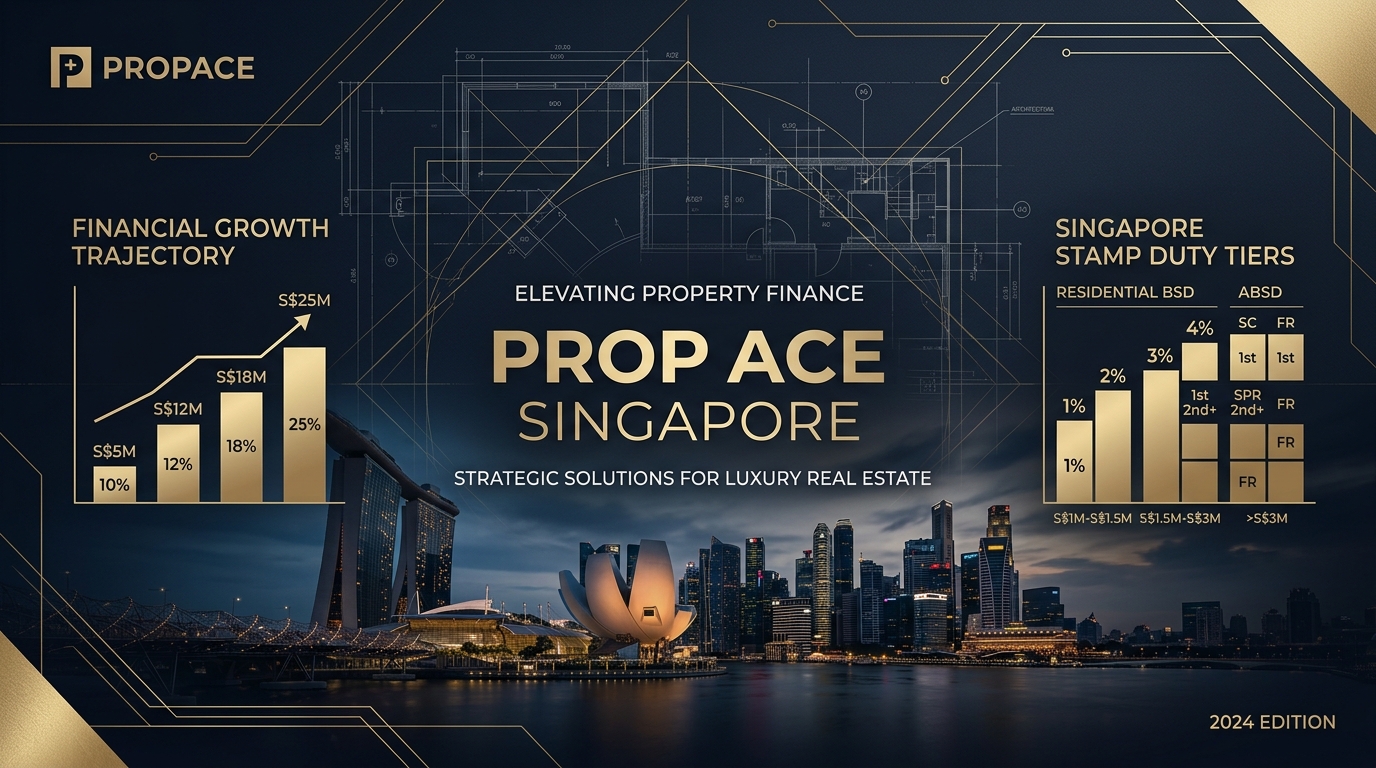
The bottom line for Singapore property investors in 2026 is that financing has become markedly cheaper — some banks are now offering fixed-rate home loans below 2.5% — yet the true cost of an investment purchase now sits in the stamp-duty stack and the four-year Seller's Stamp Duty holding period, not in the monthly repayment (Forbes, 2026; PropAce Institutional Advisorydata, 2026). With private home prices still 6.8% below their peak and rents climbing against a tight supply pipeline, the market is rewarding patient, yield-driven buyers rather than flippers (URA caveat data, 2026). What follows is the current rate environment, the verified market numbers, and a worked example of what a second property actually costs before it earns a cent.
Key takeaways
- Fixed-rate mortgage packages below 2.5% are available, and Singapore home loan rates are expected to trend lower as the US Federal Reserve signals cuts through 2027 (Forbes, 2026).
- Islandwide private prices average S$2,038 psf in 2026-Q2, sitting 6.8% below the S$2,186 psf peak, while HDB prices sit at a record S$652 psf (URA caveat data, 2026).
- Private rents are firm: 22,290 transactions were recorded in 2026-Q2, the rental index rose 0.7% q-o-q, and District 26 rents jumped 15.7% y-o-y to S$4.19 psf per month (URA rental data via data.gov.sg, 2026).
- On PropAce Institutional Advisory's estimated rental-yield analysis, HDB flats in Jurong West lead the market at a 7.25% gross rental yield (PropAce Institutional Advisoryyield estimate, 2026).
- Cooling measures stack against short-hold investors: a Singapore Citizen pays 20% ABSD on a second property, and homes bought on or after 4 July 2025 face SSD of up to 16% within the first year (PropAce Institutional Advisorydata, 2026).
Borrowing Costs Are Falling — But Investment Loans Are Underwritten Differently
The rate picture
After the aggressive tightening cycle of recent years, the financing environment has turned decisively in the borrower's favour. Some banks are already offering fixed-rate mortgages below 2.5%, a level that improves the arithmetic of a leveraged purchase at a stroke (Forbes, 2026). Rate watchers expect the trend to continue: with inflation stabilising and the US Federal Reserve signalling potential cuts between 2025 and 2027, Singapore home loan rates are expected to drift lower still (Forbes, 2026).
Borrowers comparing fixed-rate products should also note the term structure. As in most mortgage markets, shorter-duration fixed packages — the sort of 10-year and 15-year products tracked in benchmark rate analyses — tend to price below longer-dated alternatives (Forbes, 2026). For an investor, that creates a strategic choice: lock in certainty at a low rate for a shorter period, or accept a slightly higher rate for a longer runway. The right answer depends on the holding period, and the holding period has recently been extended by policy (PropAce Institutional Advisorydata, 2026).
How lenders underwrite an investment purchase
A lower headline rate does not mean an easier approval. Lenders routinely price investment-property mortgages at a margin above owner-occupied packages, reflecting the different risk profile of a home that depends on tenants rather than an occupier's salary (Forbes, 2026). More importantly, the quantum of borrowing is constrained by the Total Debt Servicing Ratio (TDSR), which caps a borrower's monthly debt obligations at 55% of gross monthly income (PropAce Institutional Advisorydata, 2026).
For investors, the sting is in the income assessment: only 70% of variable or rental income is counted towards TDSR (PropAce Institutional Advisorydata, 2026). In practice, a landlord cannot simply offset the full expected rent against the mortgage; the bank applies a haircut, then checks the residual against the 55% ceiling. The policy direction is also tightening at the edges — the government reduced the maximum loan-to-value ratio for HDB resale buyers from 80% to 75% in August 2024, and investors should expect the same prudence applied across subsequent housing loans (HDB, 2026).
The Numbers: Where the Singapore Market Actually Stands
Private prices: below the peak, far above the trough
The most important context for any investment decision is the cycle position. Islandwide private residential prices averaged S$2,038 psf in 2026-Q2 — 6.8% below the S$2,186 psf peak — yet remain 33.3% above the S$1,529 psf trough (URA caveat data, 2026). In plain terms, the market has given back a slice of its boom, but not the accumulated gains of the cycle. An investor buying today is not catching a falling knife; they are buying a market that has corrected modestly from its highs while retaining substantial built-up appreciation.
HDB: sitting exactly at the record
The HDB resale market tells a different story. Islandwide HDB prices of S$652 psf in 2026-Q2 sit exactly at their peak — 0.0% above the S$652 psf high — and remain 57.5% above the S$414 psf trough (URA caveat data, 2026). The contrast is striking: private prices have eased from their summit, while HDB resale prices are pinned at an all-time high. This matters for investors because it reframes the yield question: a flat bought at a record price must justify itself through rent, not through further price gains, and HDB rental yields are precisely where the market's best returns are now found (PropAce Institutional Advisoryyield estimate, 2026).
The new-launch premium is an investor trap
The transaction record also exposes a structural gap. New-launch private homes averaged S$2,304 psf against S$1,594 psf for resale — a roughly 45% premium (URA caveat data, 2026). For an owner-occupier chasing a fresh unit, that premium buys modern finishes and deferred maintenance. For an investor, it buys the same rent as a resale unit in the same vicinity, at 45% more cost. Over the past five years, private residential prices have risen 32%, with a 3.9% gain in 2024 alone; investors betting on capital growth have already collected much of that return (URA, 2026).
A tale of three regions
Geography matters as much as timing. Across the private transaction record, prime-core (CCR) homes have averaged S$2,444 psf, city-fringe (RCR) properties S$2,078 psf, and suburban (OCR) homes S$1,551 psf (URA caveat data, 2026). The hierarchy is exactly what the rental market needs: suburban homes at roughly half the per-square-foot cost of prime properties are the natural engine-room of tenancy demand. It is no accident that the market's best yields are found not in the CCR but in mass-market locations where entry prices are lower and rental demand is structural.
The Rental Engine: Tight Supply, Rising Rents, and a Yield Leader
A supply squeeze is supporting rents
Rents are climbing for a simple reason: not enough homes are being finished. In 2026-Q2, only 700 new private residential units (excluding ECs) were completed — a quarterly drop of 23.2% compared with the 911 units finished in 2026-Q1 (URA, 2026). The first half of 2026 saw 1,611 units completed, well down from the 2,329 units in 1H2025 and the 2,123 units in 1H2024 (URA, 2026). With fewer new homes entering the market, existing rental properties have absorbed the demand, and the overall private rental index edged up 0.7% q-o-q even as 22,290 rental transactions were recorded (URA rental data via data.gov.sg, 2026).
The relief valve is coming, but slowly. URA expects approximately 5,012 new private residential units to be completed in 2H2026 — roughly 2,506 units per quarter — which will alleviate some of the pressure on rents (URA, 2026). For an investor timing a purchase, the window of tight supply is now, not eighteen months from now.
Where the rent is rising fastest
The standout rental figure is in District 26, where private rents rose 15.7% year-on-year to S$4.19 psf per month in 2026-Q2 (URA rental data via data.gov.sg, 2026). Even the landed segment is accelerating, with the landed rental index up 2.7% q-o-q in 2026-Q2 against a marginal 0.1% rise in the preceding quarter (URA rental data via data.gov.sg, 2026). These are the pockets of momentum an investor should weigh against the headline averages.
The yield champion: Jurong West HDB
On PropAce Institutional Advisory's estimated rental-yield analysis, HDB flats in Jurong West deliver the highest gross rental yield in the market at 7.25% (PropAce Institutional Advisoryyield estimate, 2026). That figure deserves emphasis because it reframes the investment debate. Against a fixed mortgage rate below 2.5%, a 7.25% gross yield leaves a spread of close to five percentage points before operating costs — a carry that no private condominium in the CCR can match at current prices (Forbes, 2026; PropAce Institutional Advisoryyield estimate, 2026). The yield is gross, not net, and HDB rental demand carries its own profile; but for income-focused investors, the mass-market HDB segment is where the numbers work hardest.
What You Pay Before You Earn a Cent: BSD, ABSD and the Four-Year SSD
The stamp-duty ladder
Before any mortgage payment, an investor must clear the duty stack. Buyer's Stamp Duty (BSD) is progressive, starting at 1% on the first S$180,000, rising through 2% and 3% bands, then to 4% on the portion from S$1,000,001 to S$1,500,000, and 5% on amounts above S$1,500,000 (PropAce Institutional Advisorydata, 2026). Then comes the heavier blow: Additional Buyer's Stamp Duty (ABSD), which applies at 20% for a Singapore Citizen's second residential property, 30% for a third, and 30% for a Permanent Resident's second (PropAce Institutional Advisorydata, 2026). For foreigners, the rate is a flat 60% on all residential purchases, and entities face 65% (PropAce Institutional Advisorydata, 2026).
The seller's trap: a four-year SSD
The exit side is equally punitive. For residential properties acquired on or after 4 July 2025, the Seller's Stamp Duty holding period has been extended to four years, with rates of 16% for a sale within one year, 12% within two, 8% within three, and 4% within four (PropAce Institutional Advisorydata, 2026). Previously, a three-year window applied. The message from policymakers is unambiguous: this is not a flip market. An investor who buys and sells within a year surrenders 16% of the price in SSD alone, on top of the ABSD paid at entry.
What this means for the mortgage decision
Because the exit costs are so high, the mortgage product should be chosen for the long haul. A low introductory rate matters less than a rate that stays manageable across the full SSD window, which is precisely why locking in a sub-2.5% fixed rate for as long as the bank offers it is the rational play for most investors (Forbes, 2026). The duty stack has effectively converted Singapore residential property into a long-hold asset class; the financing must be structured accordingly.
A Worked Example: Buying a Suburban Condo as a Second Property
The purchase and the duties
Consider a Singapore Citizen buying a second property: a 1,000 sq ft resale condominium in the Outside Core Region (OCR) at the S$1,551 psf average, giving a purchase price of S$1,551,000 (URA caveat data, 2026). The BSD works out to S$47,150 — S$1,800 on the first S$180,000, S$3,600 on the next S$180,000, S$19,200 on the next S$640,000, S$20,000 on the next S$500,000, and S$2,550 on the remaining S$51,000 (PropAce Institutional Advisorydata, 2026). Then the ABSD at 20% adds S$310,200 (PropAce Institutional Advisorydata, 2026). Total stamp duties: S$357,350 — roughly 23% of the purchase price, payable upfront before a single dollar of rent is collected.
The per-buyer breakdown
The same unit costs a different buyer dramatically different amounts in duty:
- Singapore Citizen, second property: BSD of S$47,150 plus ABSD of S$310,200, for total duties of S$357,350 (PropAce Institutional Advisorydata, 2026).
- Permanent Resident, second property: BSD of S$47,150 plus ABSD at 30% of S$465,300, for total duties of S$512,450 (PropAce Institutional Advisorydata, 2026).
- Foreigner: BSD of S$47,150 plus ABSD at 60% of S$930,600, for total duties of S$977,750 (PropAce Institutional Advisorydata, 2026).
These are the sums that must be recovered through rental income and long-term appreciation. They dwarf any savings from a quarter-point move in mortgage rates.
The carry and the alternatives
Against that upfront burden, the financing is the easy part. At a fixed rate below 2.5%, the annual interest cost on the mortgage is modest relative to the rent the unit can command — and in a market where District 26 rents are rising at 15.7% y-o-y, income growth is doing some of the heavy lifting (Forbes, 2026; URA rental data via data.gov.sg, 2026). The new-launch alternative makes the resale case even clearer: the same 1,000 sq ft in a new launch at S$2,304 psf would cost S$2,304,000, or roughly S$753,000 more, with no guarantee of proportionally higher rent (URA caveat data, 2026).
For the yield-maximising investor, the Jurong West HDB at 7.25% gross yield offers a faster route to recovering the duty cost than any OCR condo (PropAce Institutional Advisoryyield estimate, 2026). The lower absolute price, combined with the market's strongest gross yield, shortens the payback period on the ABSD — which is precisely why PropAce Institutional Advisory's yield rankings place mass-market HDB ahead of private property.
The Investor's Checklist for 2026
- Match the rate to the holding period. With fixed rates below 2.5% available and further easing signalled through 2027, priority should go to locking in certainty for at least the four-year SSD window (Forbes, 2026; PropAce Institutional Advisorydata, 2026).
- Respect the duty stack as a sunk cost. The 20% ABSD for a Singapore Citizen's second property is gone the moment the contract is signed; only yield and long-run demand can recover it (PropAce Institutional Advisorydata, 2026).
- Buy where the rent is. District 26 rents rose 15.7% y-o-y to S$4.19 psf per month, and Jurong West HDB flats deliver a 7.25% gross yield — the two numbers that matter most for income investors (URA rental data via data.gov.sg, 2026; PropAce Institutional Advisoryyield estimate, 2026).
- Watch the supply pipeline. Roughly 5,012 units completing in 2H2026 will ease rental tightness; buying before that wave hits gives landlords the best negotiating position (URA, 2026).
- Price the exit. With SSD of up to 16% inside the first year and a four-year holding period for acquisitions after 4 July 2025, every purchase should be underwritten as a long hold (PropAce Institutional Advisorydata, 2026).
FAQ
Are investment property mortgage rates higher than owner-occupied rates in Singapore?
Generally, yes — lenders price investment-property loans at a margin above owner-occupied packages and apply the Total Debt Servicing Ratio ceiling of 55%, with only 70% of variable or rental income counted (PropAce Institutional Advisorydata, 2026). Even so, with some banks offering fixed rates below 2.5%, the absolute cost of borrowing has fallen for both types of buyers (Forbes, 2026).
Statutory Source: Monetary Authority of Singapore (MAS) — MAS Notice 645 Property Loan Regulations & TDSR Limits
What is the biggest upfront cost when buying a second property in Singapore?
For a Singapore Citizen, the 20% Additional Buyer's Stamp Duty is by far the largest single cost, followed by Buyer's Stamp Duty of up to 5% on the portion of the price above S$1,500,000 (PropAce Institutional Advisorydata, 2026). On a S$1,551,000 suburban unit, total duties come to roughly S$357,350 — about 23% of the price (PropAce Institutional Advisorydata, 2026).
Statutory Source: Inland Revenue Authority of Singapore (IRAS) — Stamp Duty Rates & Payment Guidelines
How is rental income treated when I apply for an investment property loan?
Only 70% of your assessed rental or variable income is counted towards the Total Debt Servicing Ratio, which caps total monthly debt repayments at 55% of gross monthly income (PropAce Institutional Advisorydata, 2026). In practice, this means the bank will not let you leverage against the full expected rent, and you should underwrite the purchase on your salary income alone.
Statutory Source: Monetary Authority of Singapore (MAS) — MAS Notice 645 Property Loan Regulations & TDSR Limits
Which locations are delivering the strongest rental yields right now?
HDB flats in Jurong West deliver the highest gross rental yield in the market at 7.25%, according to PropAce Institutional Advisory's estimated rental-yield analysis (PropAce Institutional Advisoryyield estimate, 2026). In the private market, District 26 stands out for rental momentum, with rents up 15.7% year-on-year to S$4.19 psf per month in 2026-Q2 (URA rental data via data.gov.sg, 2026).
Statutory Source: Housing & Development Board (HDB) — Official Housing Policies & Resale Guidelines
Is 2026 a good time to buy an investment property in Singapore?
The financing conditions are among the best in years — fixed rates below 2.5% and more easing signalled — while private prices sit 6.8% below their peak and rents remain firm (Forbes, 2026; URA caveat data, 2026). But the 20% ABSD and the four-year SSD holding period mean this is a long-hold, yield-driven market, not a flipping market (PropAce Institutional Advisorydata, 2026).
Statutory Source: Inland Revenue Authority of Singapore (IRAS) — Stamp Duty Rates & Payment Guidelines
By the numbers
``` Private PSF momentum by district — QoQ %
D11 +28.9% ██████████████████████████ D26 +11.8% ███████████ D25 +9.5% █████████ D12 +7.3% ███████ D08 +5.0% ████ D28 +4.2% ████ D20 +3.4% ███ D02 +3.3% ███ D22 -0.3% ░ D27 -0.7% ░ ```
| District | Median PSF | QoQ | YoY | Txns (3mo) |
|---|---|---|---|---|
| D11 | $2,866 | ▲ 28.9% | ▲ 29.0% | 333 |
| D26 | $2,285 | ▲ 11.8% | ▲ 6.4% | 257 |
| D25 | $1,372 | ▲ 9.5% | ▲ 8.2% | 64 |
| D12 | $1,976 | ▲ 7.3% | ▲ 6.7% | 95 |
| D08 | $2,006 | ▲ 5.0% | ▲ 16.8% | 40 |
| D28 | $1,714 | ▲ 4.2% | ▲ 10.3% | 109 |
| D20 | $2,046 | ▲ 3.4% | ▲ 4.3% | 132 |
| D02 | $2,540 | ▲ 3.3% | ▲ 24.2% | 31 |
| D22 | $1,655 | ▼ 0.3% | ▲ 2.9% | 103 |
| D27 | $1,413 | ▼ 0.7% | ▼ 13.6% | 129 |
_Data: PropAce Institutional Advisory analysis of URA/HDB transaction data — rolling 3-month average PSF, private residential, 2026-06..2026-08. Directional; confirm before acting._
Sources
- URA rental data (via data.gov.sg), compiled by PropAce Institutional Advisory— 2026Q2.
- PropAce Institutional Advisoryyield estimate (URA/HDB data), compiled by PropAce Institutional Advisory.
- URA caveat data, compiled by PropAce Institutional Advisory— 2026-Q2.
- URA caveat data, compiled by PropAce Institutional Advisory.
References
- Forbes (2026) Current 10-Year Mortgage Rates.
- Forbes (2026) Current 15-Year Mortgage Rates.
- Forbes (2026) Current Investment Property Mortgage Rates.
Interactive Strategic Tools & Concierge
Instant calculation of tiered residential BSD (up to 6%) and profile-based ABSD (0% to 65%).
Calculate Exact Stamp Duties with ABSD/BSD Calculator
Frequently Asked Questions
Are investment property mortgage rates higher than owner-occupied rates in Singapore?
Generally, yes — lenders price investment-property loans at a margin above owner-occupied packages and apply the Total Debt Servicing Ratio ceiling of 55%, with only 70% of variable or rental income counted (PropAce Institutional Advisorydata, 2026). Even so, with some banks offering fixed rates below 2.5%, the absolute cost of borrowing has fallen for both types of buyers (Forbes, 2026). Statutory Source:** [Monetary Authority of Singapore (MAS) — MAS Notice 645 Property Loan Regulations & TDSR
What is the biggest upfront cost when buying a second property in Singapore?
For a Singapore Citizen, the 20% Additional Buyer's Stamp Duty is by far the largest single cost, followed by Buyer's Stamp Duty of up to 5% on the portion of the price above S$1,500,000 (PropAce Institutional Advisorydata, 2026). On a S$1,551,000 suburban unit, total duties come to roughly S$357,350 — about 23% of the price (PropAce Institutional Advisorydata, 2026). Statutory Source:** [Inland Revenue Authority of Singapore (IRAS) — Stamp Duty Rates & Payment Guidelines](https://www.iras.gov.s
How is rental income treated when I apply for an investment property loan?
Only 70% of your assessed rental or variable income is counted towards the Total Debt Servicing Ratio, which caps total monthly debt repayments at 55% of gross monthly income (PropAce Institutional Advisorydata, 2026). In practice, this means the bank will not let you leverage against the full expected rent, and you should underwrite the purchase on your salary income alone. Statutory Source:** [Monetary Authority of Singapore (MAS) — MAS Notice 645 Property Loan Regulations & TDSR Limits](https
Which locations are delivering the strongest rental yields right now?
HDB flats in Jurong West deliver the highest gross rental yield in the market at 7.25%, according to PropAce Institutional Advisory's estimated rental-yield analysis (PropAce Institutional Advisoryyield estimate, 2026). In the private market, District 26 stands out for rental momentum, with rents up 15.7% year-on-year to S$4.19 psf per month in 2026-Q2 (URA rental data via data.gov.sg, 2026). Statutory Source:** [Housing & Development Board (HDB) — Official Housing Policies & Resale Guidelines](
Is 2026 a good time to buy an investment property in Singapore?
The financing conditions are among the best in years — fixed rates below 2.5% and more easing signalled — while private prices sit 6.8% below their peak and rents remain firm (Forbes, 2026; URA caveat data, 2026). But the 20% ABSD and the four-year SSD holding period mean this is a long-hold, yield-driven market, not a flipping market (PropAce Institutional Advisorydata, 2026). Statutory Source:** [Inland Revenue Authority of Singapore (IRAS) — Stamp Duty Rates & Payment Guidelines](https://www.
Statutory References & Citations
- Inland Revenue Authority of Singapore (IRAS) (2026). Stamp Duties Act 1929. Singapore: Government of Singapore.
- Monetary Authority of Singapore (MAS) (2026). Notice 645: Computation of Total Debt Servicing Ratio (TDSR) for Property Loans. Singapore: MAS.
- Housing & Development Board (HDB) (2026). Housing and Development Act (Cap. 129). Singapore: Ministry of National Development.
- Singapore Land Authority (SLA) (2026). Land Titles Act (Cap. 157) & Conveyancing Registration Framework. Singapore: SLA.
Statutory Disclaimer: This guide is published for strategic, educational, and institutional planning purposes only and does not constitute formal legal, taxation, or financial advice. All property transactions, stamp duty remissions, and financing structures should be formally verified with qualified Singapore legal counsel and certified tax advisors.