
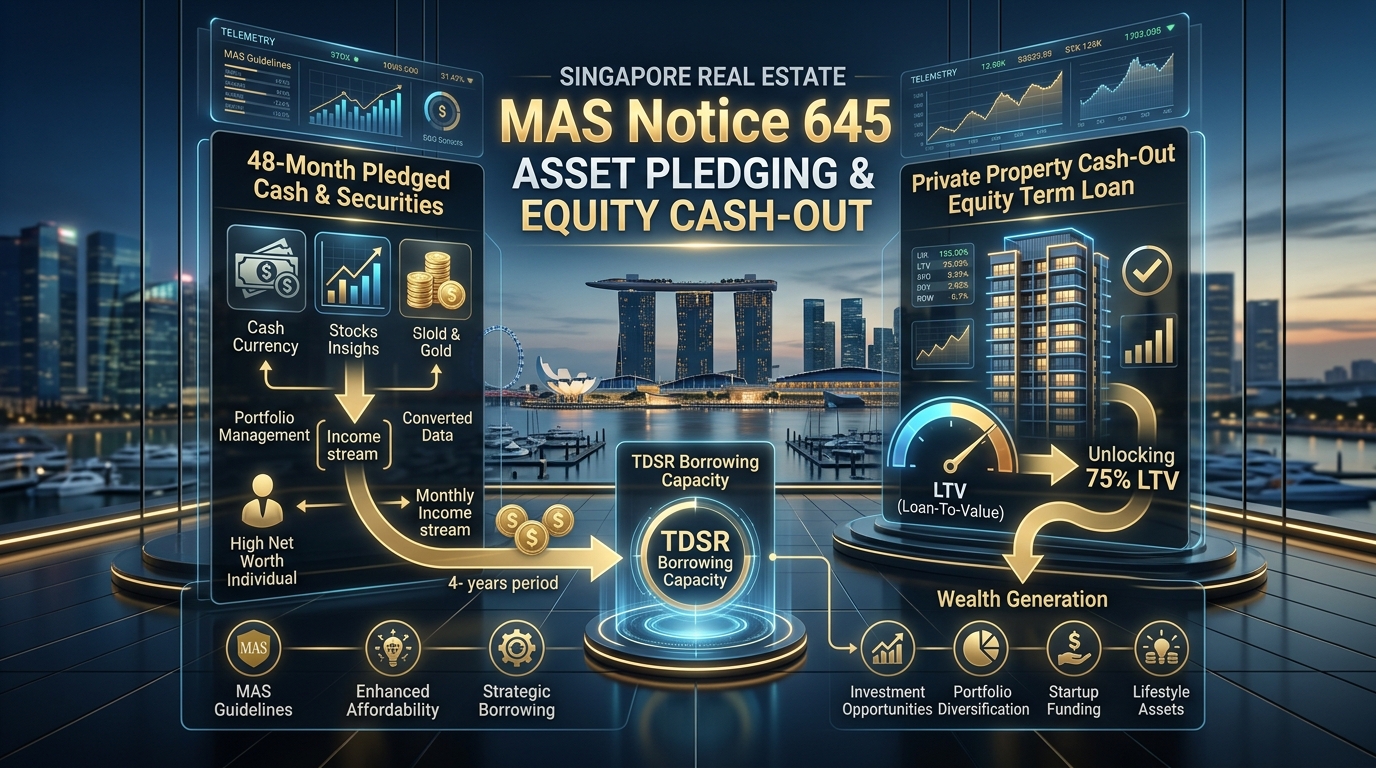
Executive Summary: Qualifying for Multi-Million Mortgages Without a Monthly Salary
In Singapore's private banking and luxury residential sectors, a frequent structural paradox arises: an accredited investor, business founder, or self-funded retiree possesses tens of millions in liquid securities and cash, yet is technically disqualified from securing a residential bank mortgage under the Monetary Authority of Singapore (MAS) Total Debt Servicing Ratio (TDSR) framework.
Because MAS Notice 645 enforces a strict 55% TDSR ceiling based on verifiable monthly earned income, individuals with lumpy dividends, foreign business distributions, or zero monthly CPF contributions cannot pass standard income stress tests.
To bridge this liquidity gap without liquidating investment portfolios, the Monetary Authority of Singapore established a statutory asset-conversion mechanism under MAS Notice 645 (and Notice 632): Asset Pledging vs Asset Unpledging.
By amortizing eligible liquid financial assets over a statutory 48-month schedule, banks are legally authorized to convert capital reserves into "deemed monthly income" for TDSR computation. This dossier outlines the mathematical mechanics, statutory haircuts, asset custody protocols, and bank negotiation playbooks governing asset-based lending in Singapore.
1. Statutory Haircut Architecture: Pledged (30%) vs Unpledged (70%)
Under MAS Notice 645, eligible financial assets are segregated into two distinct regulatory pathways:
`` MAS Notice 645 Asset Amortization Pathways (Over 48 Months): ┌───────────────────────────────────────┬───────────────────────────────────────┐ │ PATHWAY A: PLEDGED ASSETS │ PATHWAY B: UNPLEDGED ASSETS │ ├───────────────────────────────────────┼───────────────────────────────────────┤ │ • 30% Statutory Haircut │ • 70% Statutory Haircut │ │ • Assets legally locked for 48 months │ • Assets freely tradable/accessible │ │ • Deemed Income: (Asset × 0.70) / 48 │ • Deemed Income: (Asset × 0.30) / 48 │ └───────────────────────────────────────┴───────────────────────────────────────┘ ``
The Statutory Amortization Formulas
The MAS rules mandate that asset values are discounted by statutory haircuts and divided strictly across 48 months (4 years):
$$ \begin{aligned} \text{Deemed Monthly Income}_{\text{pledged}} &= \frac{\text{Eligible Asset Value} \times (1 - 0.30)}{48 \text{ months}} \\ &= \frac{\text{Asset} \times 0.70}{48} \end{aligned} $$
$$ \begin{aligned} \text{Deemed Monthly Income}_{\text{unpledged}} &= \frac{\text{Eligible Asset Value} \times (1 - 0.70)}{48 \text{ months}} \\ &= \frac{\text{Asset} \times 0.30}{48} \end{aligned} $$
Comparative Deemed Monthly Income Yield
Let us examine the deemed income generated from a S$2,000,000 liquid portfolio under both statutory pathways:
| Parameter | Pathway A: Pledged (4-Year Lock) | Pathway B: Unpledged (Show Funds) |
|---|---|---|
| Gross Portfolio Value | S$2,000,000 | S$2,000,000 |
| Statutory MAS Haircut | 30% (-S$600,000) | 70% (-S$1,400,000) |
| Recognized Collateral Base | S$1,400,000 | S$600,000 |
| Statutory Division Factor | 48 Months | 48 Months |
| Recognized Deemed Monthly Income | S$29,166 / month | S$12,500 / month |
| Maximum 55% TDSR Monthly Debt Room | S$16,041 / month | S$6,875 / month |
| Max Loan Supported @ 4.0% (25-Yr Tenure) | ~S$3,030,000 | ~S$1,300,000 |
Key Takeaway: Pledging the portfolio increases recognized borrowing capacity by 2.33x compared to unpledging the same asset base ($0.70 / 0.30 = 2.333$).
2. Eligible Financial Assets: What MAS Recognizes
Not all wealth is eligible under MAS Notice 645. Banks are legally prohibited from recognizing physical real estate equity, luxury watches, private equity shares, or cryptocurrencies as eligible assets for TDSR conversion.
Statutory Asset Eligibility Schedule
- Tier 1 (Cash & Sovereign Debt):
- Singapore Dollar (SGD) and major foreign currency (USD, EUR, GBP, AUD) cash deposits held with a licensed bank in Singapore.
- Singapore Government Securities (SGS bonds, Treasury Bills, MAS Bills).
- Tier 2 (Listed Equities & Liquid Debt Instruments):
- Stocks listed on the Singapore Exchange (SGX) or major approved foreign exchanges (NYSE, NASDAQ, LSE, HKEX).
- Investment-grade corporate bonds with daily liquidity and mark-to-market pricing.
- Tier 3 (Collective Investment Schemes):
- Authorized unit trusts and mutual funds registered with MAS.
- Physical gold held in licensed custodial vaults (accepted by select private banks with additional internal haircuts).
3. Operational Mechanics: Pledging vs Show-Funds Protocol
The Pledging Execution Flow (Pathway A)
- Legal Memorandum of Charge: The borrower executes a formal deed of charge or pledge agreement with the mortgage lending bank.
- Custodial Lock: The S$2.0M portfolio is transferred into a designated pledge account maintained with the lender. The capital cannot be withdrawn for 48 continuous months.
- Trading Within the Pledge: Most institutional lenders allow the borrower to trade within the pledge account (e.g. rotating between cash, SGS bills, and blue-chip equities), provided the net liquidated portfolio value never breaches the statutory collateral floor.
- Gradual Unwinding: If the borrower subsequently secures verifiable employment income or reaches a lower loan principal balance through scheduled repayments, the bank can review and early-release the pledge upon application.
The Unpledging / "Show Funds" Flow (Pathway B)
- Proof of Ownership: The borrower presents formal bank statements demonstrating that the assets have been seasoned in an account under their own legal name for at least 30 to 90 consecutive days.
- No Encumbrance Letter: The borrower confirms that the funds are free from existing liens, commercial debentures, or litigation claims.
- Zero Lock-In: Upon loan disbursement, the borrower retains 100% legal freedom to deploy, invest, or transfer the unpledged capital without notifying the mortgage department.
4. Case Study: Retiree Acquiring a S$3.5M Prime Condo in District 10
- Borrower Profile: Uncle Peter (age 56), retired civil engineering contractor with zero earned monthly salary.
- Target Property: 3-Bedroom Freehold Condo in Bukit Timah asking S$3,500,000.
- Available Liquidity: S$1,500,000 cash savings + S$1,000,000 in SGX blue chips (Total: S$2,500,000 liquid capital).
- Financing Strategy:
- Downpayment (25% for 1st Loan): S$875,000 cash.
- Buyer's Stamp Duty (BSD): S$155,600 cash.
- Remaining Capital: S$1,469,400.
- Uncle Peter wishes to borrow the maximum 75% LTV ($S\$2,625,000$) over a 9-year tenure (capped at age 65).
The TDSR Mathematical Breakdown
To borrow $S\$2,625,000$ over 9 years at the MAS 4.0% stress test rate: $$ \text{Monthly Installment at 4.0%} = S\$29,010/\text{month} $$ To satisfy 55% TDSR, Uncle Peter requires a deemed monthly income of: $$ \text{Required Deemed Income} = \frac{S\$29,010}{0.55} = \mathbf{S\$52,745/\text{month}} $$
Under Pathway B (Unpledged), his remaining S$1,469,400 would only generate: $$ \text{Unpledged Income} = \frac{S\$1,469,400 \times 0.30}{48} = S\$9,183/\text{month} \quad (\text{FAILS TDSR}) $$
Under Pathway A (Pledged), Uncle Peter pledges S$1,200,000 into a 4-year structured fixed deposit yielding: $$ \text{Pledged Income} = \frac{S\$1,200,000 \times 0.70}{48} = S\$17,500/\text{month} $$ By combining a S$1.2M pledge with an additional S$400,000 equity top-up (lowering the loan to S$2.225M), the monthly stress repayment drops to S$24,580, which perfectly balances his TDSR profile!
5. Strategic Takeaways for Private Wealth Clients
- Evaluate Opportunity Cost of Capital: Before agreeing to a 48-month legal pledge, evaluate whether locking up your capital at bank deposit rates causes an unacceptable drag on investment returns compared to paying a larger cash downpayment.
- Season Assets Early: Never attempt to transfer funds into Singapore 3 days before Option exercise. MAS anti-money laundering (AML) and source-of-wealth compliance require 30 to 90 days of clear, audited provenance.
- PropAce Private Wealth Concierge: For customized asset-pledging debt structuring and bespoke mortgage underwriting with Singapore Tier-1 private banks, contact our advisory desk.
Interactive Strategic Tools & Concierge
Check your maximum mortgage ceiling stress-tested against the MAS 4.0% interest rate floor.
Calculate Borrowing Capacity with TDSR Calculator
Statutory References & Citations
- Monetary Authority of Singapore (MAS) (2026). Notice 645: Computation of Total Debt Servicing Ratio (TDSR) for Property Loans. Singapore: MAS.
- Central Provident Fund Board (CPF) (2026). Central Provident Fund (Approved Housing Schemes) Regulations. Singapore: CPF Board.
Statutory Disclaimer: This guide is published for strategic, educational, and institutional planning purposes only and does not constitute formal legal, taxation, or financial advice. All property transactions, stamp duty remissions, and financing structures should be formally verified with qualified Singapore legal counsel and certified tax advisors.