 PropAce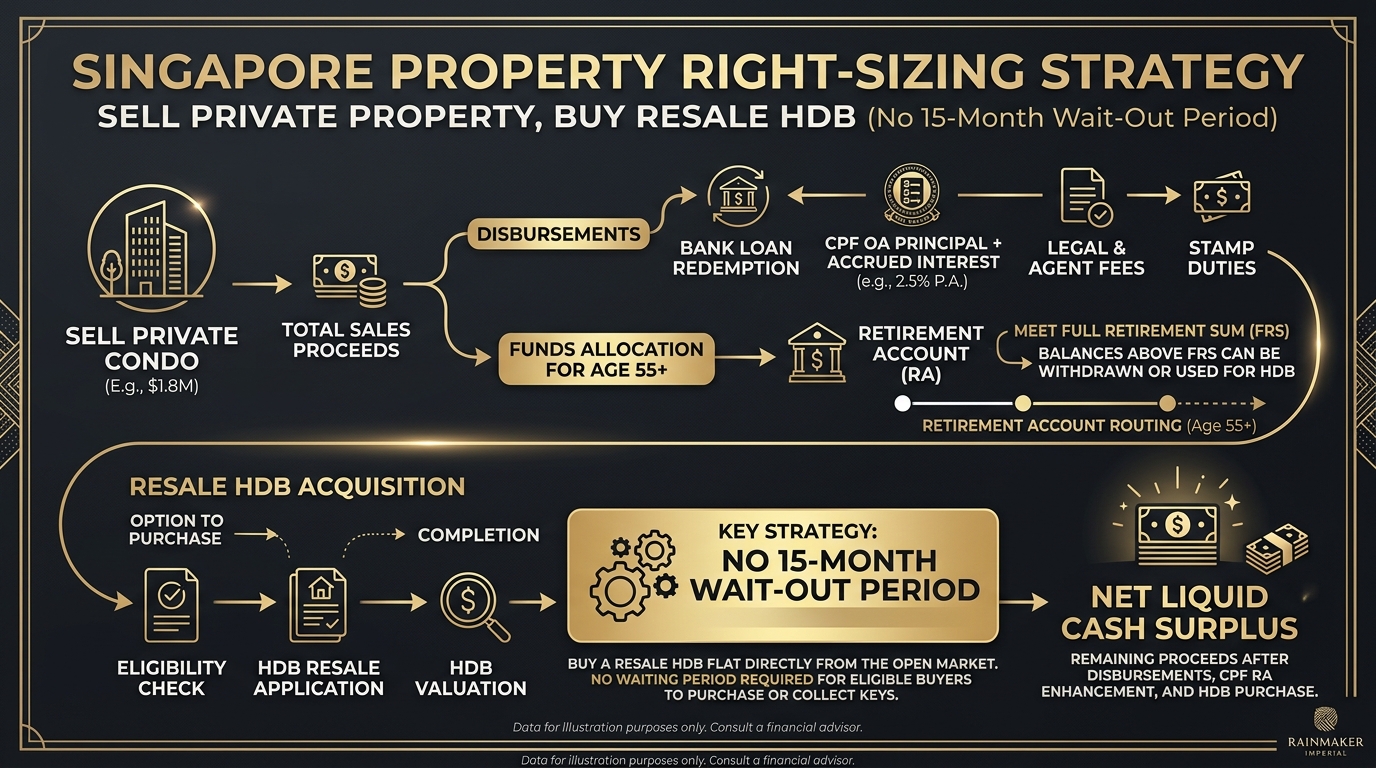
The 15-month wait-out period is gone, and Singapore's million-dollar HDB flat segment suddenly has a new pool of buyers: private property owners who no longer have to sit on the sidelines for more than a year. The policy change, which took effect on 28 July, has already jolted interest at the top end of the HDB resale market (Stacked Homes, 2026; PropertyGuru, 2026). But the surge is not a broad price boom. The wider HDB resale market is cooling, supply is growing, and the million-dollar flat is a specific, high-stakes corner of the market with its own logic.
Key takeaways
- Private property owners who have sold their private home can now buy HDB resale flats without serving the 15-month wait-out, and interest in million-dollar HDB flats has surged (PropertyGuru, 2026).
- Islandwide HDB resale prices sat at S$652 psf in 2026-Q2, unchanged in psf terms from their 2025-Q4 peak, but still 57.5% above the cyclical trough (PropAce Institutional Advisorydata, 2026).
- Private market prices remain below their peak: S$2,038 psf islandwide, 6.8% below the high, while new launches carried a roughly 44% premium over resale (URA caveat data, 2026).
- A wave of newly MOP-ed flats is coming: an estimated 18,425 flats from 22 BTO projects could reach MOP in 2026, giving buyers more alternatives and putting pressure on sellers (Stacked Homes, 2026).
- HDB resale prices recorded two straight quarterly declines in 1Q2026 and 2Q2026, the first consecutive falls since 2019 (Stacked Homes, 2026).
The policy shift that reopened the market
What the wait-out period did
The wait-out period was aimed squarely at private property owners. If you sold a private home and wanted to buy a resale HDB flat, you had to wait 15 months before completing the purchase. The rule was designed to cool speculative down-trading and keep HDB flats for owner-occupiers rather than private-property users cashing out quickly (PropertyGuru, 2026).
It created a real planning problem for households who needed to rightsize. A retiree in a condo could sell but then could not promptly move into a smaller HDB flat; they had to rent or find temporary accommodation. The same applied to families who wanted to move closer to parents or to a specific school. The wait was not just a cooling measure. It was a logistical barrier.
The rule falls
On 28 July 2026, the wait-out period was removed (Stacked Homes, 2026). A private property owner who has already sold their private home can now buy an HDB resale flat immediately. An owner who has not sold, or who wants to keep the private home, must still comply with HDB's disposal rules; the removal of the wait-out does not waive those requirements. The policy swing was quickly visible at the top of the market. Property portals and agents reported a surge in interest in million-dollar HDB flats, the segment most likely to appeal to former private-home owners (PropertyGuru, 2026).
Why million-dollar flats? Because the private-owner cohort usually wants size, location and quality. A standard four-room flat in a new estate is not enough for many of them. A large flat in a mature estate near an MRT station, with a decent remaining lease and a floor area that works like a condominium, is far more likely to cross the million-dollar line. These flats were always rare. The rule change made them accessible to a new group of buyers who can pay.
The data: a market at two speeds
The most important context is that this surge is happening while the broad HDB price gauge is flat. You do not need a runaway HDB market to produce million-dollar transactions. The two-speed pattern is in the numbers.
HDB: flat at the top
The islandwide average HDB resale price was S$652 psf in 2026-Q2, unchanged from the 2025-Q4 peak in psf terms (PropAce Institutional Advisorydata, 2026). That is not a roaring market. The same average still sat 57.5% above the cyclical trough of S$414 psf (PropAce Institutional Advisorydata, 2026). So the average flat has reclaimed all of its losses and more, but it is not setting fresh highs in aggregate.
The HDB resale price index is a separate, mix-adjusted measure, and it has moved the other way. Prices slipped 0.1% q-o-q in 1Q2026 and fell another 0.3% q-o-q in 2Q2026, the first consecutive quarterly declines since 2019 (Stacked Homes, 2026). The flat average psf and the falling index can coexist because the average per-square-foot figure is sensitive to the mix of flats sold, while the index adjusts for that mix. For buyers outside the million-dollar segment, this looks like relief. For sellers in ordinary estates, it looks like competition.
Private: below peak but still expensive
The private market has a different shape. Islandwide private prices averaged S$2,038 psf in 2026-Q2, 6.8% below the S$2,186 psf peak but still 33.3% above the S$1,529 psf trough (URA caveat data, 2026). Private property has corrected from its high, but not enough to make a typical condo feel affordable for an HDB upgrader.
The gap between new and resale private homes makes this worse. New launches averaged S$2,304 psf against S$1,595 psf for resale, a roughly 44% premium (URA caveat data, 2026). That means a buyer choosing a new launch is paying almost half as much again, per square foot, relative to an existing condo. It also means a resale HDB flat, even at a million dollars, is a relative alternative.
Geography matters as much as price. Private homes in the core central region averaged S$2,444 psf; city-fringe homes S$2,078 psf; and suburban homes S$1,551 psf (URA caveat data, 2026). The spread tells you who is most likely to walk into a million-dollar HDB flat. A CCR owner sells at S$2,444 psf and can buy a large HDB flat at a much lower psf, banking cash. An OCR owner at S$1,551 psf has a smaller incentive, unless the private home is too large, too old, or too far from amenities.
The supply wave: more newly MOP flats change the math
A bumper crop of flats
The million-dollar surge is colliding with a supply pipeline. An estimated 18,425 flats from 22 BTO projects completed in 2021 could reach their Minimum Occupation Period in 2026 (Stacked Homes, 2026). Not all will be sold, but enough will enter the resale market to change its texture.
The effect is already visible. Flats with at least 94 years remaining on their leases, a useful proxy for newly MOP-ed homes, accounted for 5.9% of resale transactions in 2Q2026, up 4.5 percentage points from 1Q2026 (Stacked Homes, 2026). The first batch of these units is now being listed and sold.
Where supply is concentrated
The incoming supply is not evenly spread. In Punggol, the four Northshore projects alone hold 2,883 flats, and they will hit MOP within months of each other (Stacked Homes, 2026). That gives buyers in that area multiple close substitutes: same age, same waterfront district, similar layouts. Sellers there face direct competition.
At the other extreme, Alkaff Oasis has 1,594 units but only 165 five-room flats (Stacked Homes, 2026). Buyers looking for a recently MOP-ed large flat in certain mature estates will still have thin pickings. This helps explain why million-dollar flats can keep appearing while the broad market stalls. The supply wave is real, but it is concentrated in locations and flat types that are not the same as the million-dollar segment.
Who is buying million-dollar HDB flats now
The obvious new buyer is the private owner. The wait-out removal gives them the freedom to move without a gap. But they are not all the same.
A private homeowner from a CCR condo at S$2,444 psf might sell a two-bedder, buy a large HDB flat, and pocket a significant cash balance (URA caveat data, 2026). For this buyer, the million-dollar HDB flat is a form of downsizing with a lifestyle twist: it may be newer, bigger, or better located than a tiny condo.
A private homeowner from an OCR condo at S$1,551 psf is in a different position. Their sale proceeds are smaller, and buying a million-dollar HDB flat may not free up cash at all. For them, the move is about location, lease, or the absence of ongoing condo costs, not about banking a windfall.
There is also a second group: existing HDB owners who want to upgrade within the public housing system. A flat owner who bought years ago may be sitting on gains that track the HDB price cycle. The islandwide average is 57.5% above its trough, which means many owners have built substantial equity (PropAce Institutional Advisorydata, 2026). Some can now stretch into a million-dollar flat, especially if they are selling a larger flat and buying at the top of the market.
The policy change did not create this demand out of nowhere. It removed the 15-month delay that made such moves impractical for private owners. When the waiting time disappears, a plan that looked impossible becomes executable.
Worked example: the upgrader's widening gap
Million-dollar HDB flats do not solve the upgrader problem. The arithmetic of upgrading is unforgiving, and it is worth walking through.
Take an HDB owner with a flat worth S$700,000 who hopes to upgrade to a S$1.5 million condo (Stacked Homes, 2026). The gap is S$800,000. Now suppose both prices rise by exactly 10%. The HDB flat appreciates to S$770,000, a gain of S$70,000. The condo rises to S$1.65 million, a gain of S$150,000. The gap has widened to S$880,000, even though both markets moved by the same percentage.
This is the key insight. You do not need a fall in HDB prices, or a private market boom, for an upgrader to feel priced out. Same-percentage growth in both markets produces a larger absolute gap. For an HDB flat to match the S$150,000 gain of a S$1.5 million condo, it would need to rise by roughly 21.4% (Stacked Homes, 2026).
Now consider the reverse direction. A private condo owner who moves into a S$1 million HDB flat is reducing absolute exposure. If the private condo is worth S$1.5 million and the HDB flat is S$1 million, the owner releases S$500,000 in capital, less transaction costs. These are the balances that make million-dollar HDB flats attractive, not the per-square-foot price.
The lesson for HDB owners is not to assume that a million-dollar flat is just a step up. It can also be a step down for someone who once owned private property. The competition at the top end is not only from fellow HDB upgraders; it is increasingly from ex-condo owners who see a million-dollar HDB flat as a cheaper, larger, or more liquid form of housing.
What it means for buyers, sellers, and the rest of 2026
Buyers: more choices, less panic
The combination of the wait-out removal and the MOP wave is unusual. On one hand, a new group of buyers has been released into the market. On the other, a large supply of newly eligible HDB flats is coming. For most buyers, the supply side will matter more than the million-dollar headlines.
If you are looking for an ordinary four-room flat, the 18,425 flats reaching MOP in 2026 mean more options over the next few quarters (Stacked Homes, 2026). The two consecutive quarterly declines in the HDB resale price index suggest the market has lost momentum (Stacked Homes, 2026). There is no longer a pressing need to rush.
The MOP effect may also last longer than one year. Not every flat becomes available immediately after hitting MOP. Some owners wait to gauge demand, some need time to secure a replacement home, and some simply prefer to list closer to the end of 2026 or into 2027 (Stacked Homes, 2026). That means the competition for sellers could linger.
Sellers: don't bake in a million-dollar price
The surge in interest is not a blank cheque. The million-dollar segment is narrow, and the buyers who can pay that price are selective. A private owner moving into an HDB flat is usually accepting a different ownership structure: a 99-year lease, a less uniform product, and restrictions on future purchases. They will pay for the right flat, but not for an ordinary one.
Sellers with large flats in mature, well-connected estates have the best chances. Sellers in Punggol's Northshore cluster, where 2,883 new flats are MOP-ing together, face direct competition (Stacked Homes, 2026). The guidance is simple: benchmark against the specific transaction data for your block, not the million-dollar listings in your town.
FAQ
What exactly was the 15-month wait-out period?
It was a cooling measure that required eligible private property owners to wait 15 months after selling their private home before buying a resale HDB flat. The rule was removed on 28 July 2026, so eligible owners can now buy a resale flat without the waiting period (Stacked Homes, 2026; PropertyGuru, 2026).
Statutory Source: Housing & Development Board (HDB) — Resale Flat Eligibility & Wait-Out Requirements
Why did interest in million-dollar HDB flats surge after the rule was removed?
The wait-out period made it impractical for private property owners to rightsize into an HDB flat, especially older owners who needed to move quickly. Once the 15-month delay disappeared, this group began looking at large, well-located HDB flats, and the million-dollar segment drew immediate attention (PropertyGuru, 2026).
Statutory Source: Housing & Development Board (HDB) — Resale Flat Eligibility & Wait-Out Requirements
Does the surge mean HDB resale prices are rising again?
No. The broad HDB resale price index fell 0.1% in 1Q2026 and 0.3% in 2Q2026, and the islandwide average price sat at S$652 psf in 2026-Q2, flattish against its 2025-Q4 peak (PropAce Institutional Advisorydata, 2026). The surge is specific to the million-dollar segment, not the entire market.
Statutory Source: Housing & Development Board (HDB) — Resale Flat Eligibility & Wait-Out Requirements
Which HDB flats are most likely to cross the million-dollar mark?
Large flats in mature estates, and newly MOP-ed flats in locations with limited five-room supply, are the likely candidates. Newer BTO projects in areas like Punggol's Northshore have many units coming on stream, which intensifies competition instead of pushing prices up (Stacked Homes, 2026).
Statutory Source: Housing & Development Board (HDB) — Resale Flat Eligibility & Wait-Out Requirements
Are HDB resale prices expected to keep falling?
The two consecutive quarterly declines suggest the post-Covid upswing is over, but the data does not point to a sharp drop. HDB resale prices are still 57.5% above the cyclical trough, so owners hold substantial equity (PropAce Institutional Advisorydata, 2026). The more likely path is a period of flat-to-modest price movement, with the million-dollar segment behaving differently from the rest.
Statutory Source: Housing & Development Board (HDB) — Resale Flat Eligibility & Wait-Out Requirements
By the numbers
``` HDB PSF momentum by district — QoQ %
D? +8.1% ██████████████████████████ D? +7.2% ███████████████████████ D? +2.9% █████████ D? +2.7% █████████ D? +2.5% ████████ D? +2.4% ████████ D? +2.0% ██████ D? +1.3% ████ D? +1.0% ███ D? +0.8% ███ ```
| District | Median PSF | QoQ | YoY | Txns (3mo) |
|---|---|---|---|---|
| D? | $963 | ▲ 8.1% | ▲ 7.4% | 206 |
| D? | $831 | ▲ 7.2% | ▲ 7.5% | 240 |
| D? | $705 | ▲ 2.9% | ▲ 4.9% | 32 |
| D? | $598 | ▲ 2.7% | ▲ 1.4% | 224 |
| D? | $825 | ▲ 2.5% | ▲ 1.4% | 223 |
| D? | $641 | ▲ 2.4% | ▲ 2.4% | 357 |
| D? | $668 | ▲ 2.0% | ▲ 0.8% | 110 |
| D? | $534 | ▲ 1.3% | ▲ 0.4% | 276 |
| D? | $835 | ▲ 1.0% | ▲ 1.0% | 15 |
| D? | $766 | ▲ 0.8% | ▲ 4.9% | 122 |
_Data: PropAce Institutional Advisory analysis of URA/HDB transaction data — rolling 3-month average PSF, HDB, 2026-06..2026-08. Directional; confirm before acting._
Sources
- URA caveat data, compiled by PropAce Institutional Advisory— 2026-Q2.
- URA caveat data, compiled by PropAce Institutional Advisory.
References
- PropertyGuru (2026) With the 15-month wait-out period gone, interest in million-dollar HDB flats surged.
Interactive Strategic Tools & Concierge
Simulate bridging loan carrying costs, 6-month disposal deadlines, and 100% IRAS ABSD refunds.
Launch Interactive Buy Before Sell Calculator
Frequently Asked Questions
What exactly was the 15-month wait-out period?
It was a cooling measure that required eligible private property owners to wait 15 months after selling their private home before buying a resale HDB flat. The rule was removed on 28 July 2026, so eligible owners can now buy a resale flat without the waiting period (Stacked Homes, 2026; PropertyGuru, 2026). Statutory Source:** Housing & Development Board (HDB) — Resale Flat Eligibility & Wait-Out Requirements
Why did interest in million-dollar HDB flats surge after the rule was removed?
The wait-out period made it impractical for private property owners to rightsize into an HDB flat, especially older owners who needed to move quickly. Once the 15-month delay disappeared, this group began looking at large, well-located HDB flats, and the million-dollar segment drew immediate attention (PropertyGuru, 2026). Statutory Source:** [Housing & Development Board (HDB) — Resale Flat Eligibility & Wait-Out Requirements](https://www.hdb.gov.sg/cs/infoweb/residential/buying-a-flat/resale-fl
Does the surge mean HDB resale prices are rising again?
No. The broad HDB resale price index fell 0.1% in 1Q2026 and 0.3% in 2Q2026, and the islandwide average price sat at S$652 psf in 2026-Q2, flattish against its 2025-Q4 peak (PropAce Institutional Advisorydata, 2026). The surge is specific to the million-dollar segment, not the entire market. Statutory Source:** Housing & Development Board (HDB) — Resale Flat Eligibility & Wait-Out Requirements
Which HDB flats are most likely to cross the million-dollar mark?
Large flats in mature estates, and newly MOP-ed flats in locations with limited five-room supply, are the likely candidates. Newer BTO projects in areas like Punggol's Northshore have many units coming on stream, which intensifies competition instead of pushing prices up (Stacked Homes, 2026). Statutory Source:** Housing & Development Board (HDB) — Resale Flat Eligibility & Wait-Out Requirements
Are HDB resale prices expected to keep falling?
The two consecutive quarterly declines suggest the post-Covid upswing is over, but the data does not point to a sharp drop. HDB resale prices are still 57.5% above the cyclical trough, so owners hold substantial equity (PropAce Institutional Advisorydata, 2026). The more likely path is a period of flat-to-modest price movement, with the million-dollar segment behaving differently from the rest. Statutory Source:** [Housing & Development Board (HDB) — Resale Flat Eligibility & Wait-Out Requiremen
Statutory References & Citations
- Housing & Development Board (HDB) (2026). Housing and Development Act (Cap. 129). Singapore: Ministry of National Development.
- Singapore Land Authority (SLA) (2026). Land Titles Act (Cap. 157) & Conveyancing Registration Framework. Singapore: SLA.
Statutory Disclaimer: This guide is published for strategic, educational, and institutional planning purposes only and does not constitute formal legal, taxation, or financial advice. All property transactions, stamp duty remissions, and financing structures should be formally verified with qualified Singapore legal counsel and certified tax advisors.