 PropAce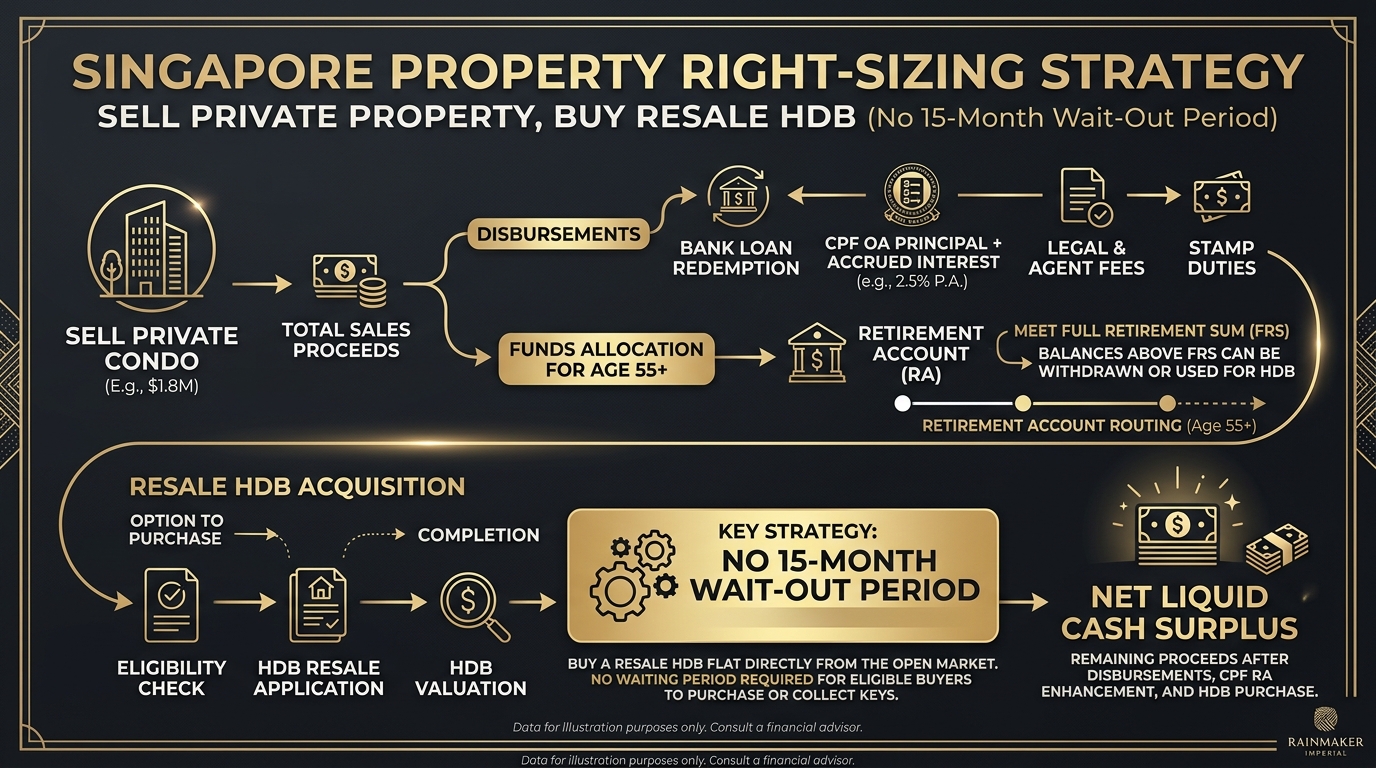
The 15-month wait-out period that forced eligible private property owners to delay an HDB resale purchase has been scrapped, effective 28 July 2026 (Stacked Homes, 2026).
Key takeaways
- The 15-month wait-out is gone for eligible private homeowners moving to HDB resale flats, as announced by Chee Hong Tat (Mothership, 2026).
- The removal covers resale flats of any size, not just smaller units (Stacked Homes, 2026).
- Private market prices sit 6.8% below their peak, while HDB resale prices sit exactly at theirs — the two markets are at very different points in the cycle (URA caveat data, 2026).
- Islandwide private prices averaged S$2,038 psf in Q2 2026, against S$652 psf for HDB resale flats (URA caveat data, 2026).
- The policy makes rightsizing faster, but it does not make the HDB entry price cheaper.
The 15-month rule is dead
For anyone who has tried to sell a condo and buy an HDB flat, the wait-out was the most frustrating part of the process. Sell first. Wait 15 months. Then start looking at HDB resale flats. In that time, prices could move, mortgage rates could change, and you could end up renting in between.
That sequence is no longer mandatory. Chee Hong Tat announced the removal of the 15-month wait-out period for private property owners buying HDB flats (Mothership, 2026). The change took effect on 28 July 2026, and it applies to resale flats of any size (Stacked Homes, 2026).
The timing matters as much as the rule itself. Private prices have cooled from their peak, HDB resale prices have not, and the government is pushing the market toward “rightsizing” — the process of moving from a larger private home to an HDB flat later in life. The policy is now aligned with that push (Business Times, 2026).
What changed, and who qualifies
The old rule
The 15-month wait-out was a cooling measure. Its effect was simple: a private property owner who wanted to buy an HDB resale flat had to build a 15-month gap between selling the private property and completing the HDB purchase. It did not stop the move. It just made it slower, more complicated and more expensive in the middle.
The new rule
Eligible private homeowners who are rightsizing to HDB resale flats no longer have to serve that period (Business Times, 2026). The change covers resale flats of any size (Stacked Homes, 2026). In practical terms, if you are eligible, you can now line up the sale of your private property and the purchase of an HDB resale flat without the forced cooling-off gap.
The word “eligible” is doing real work here. The removal of the wait-out does not mean every private property owner can walk into an HDB Hub and buy a flat on the spot. The usual HDB eligibility rules still apply. What has changed is the time penalty, not the ownership framework (Mothership, 2026).
Why the wait-out was introduced
The rule was a blunt response to a crowded HDB resale market. Policymakers wanted to cool demand from private property owners who were buying HDB flats, and the 15-month delay was the cooling mechanism.
The problem is that blunt instruments create side effects. For a genuine rightsizer — say, an older couple in a large condo who want a smaller HDB flat nearer their children — the wait-out did not cool anything. It just forced them into interim rentals and gave them a year of market risk. If HDB resale prices rose while they waited, their eventual purchase cost more.
The removal is therefore a targeted correction. Market commentary after the change described it as one of several recent policy refinements that could support consumer confidence and long-term market stability (Business Times, 2026). That is a roundabout way of saying something simple: if people can rightsize more easily, they will move, and the market keeps turning over.
The numbers behind the move
This is where the policy gets real. The wait-out was a timing rule, but it landed in a market with specific price dynamics.
Private prices: below peak, but not cheap
URA caveat data compiled by PropAce Institutional Advisoryputs the islandwide private market at S$2,038 psf in Q2 2026. That is 6.8% below the S$2,186 psf peak, but still 33.3% above the S$1,529 psf trough (URA caveat data, 2026). In plain terms, private prices have given back some of the boom, but they have not collapsed.
HDB resale prices: at the peak
The HDB resale market tells a different story. Islandwide HDB prices averaged S$652 psf in Q2 2026, which is exactly at the peak. They remain 57.5% above the S$414 psf trough (URA caveat data, 2026).
This is the key context for the policy change. A private owner looking to rightsize is not buying HDB flats at a discount. They are buying at the top of the HDB resale cycle. The wait-out removal makes the transaction faster, but it does not make the entry price lower.
New launches still carry a premium
The new-sale premium is another reason the HDB resale market is in focus. New-launch private homes averaged S$2,304 psf against S$1,595 psf for resale private homes — a roughly 44% premium (URA caveat data, 2026). For a buyer who has just sold a private home, the HDB resale price of S$652 psf looks very different from the private resale price of S$1,595 psf.
By segment, the picture is even starker. Prime-core (CCR) homes averaged S$2,444 psf, city-fringe (RCR) S$2,078 psf and suburban (OCR) S$1,551 psf (URA caveat data, 2026). Even the suburban private average sits far above the HDB resale average. The capital that can be released by rightsizing is not a small number.
What it means for a private owner moving to HDB
Worked example: an HDB resale move
Put the old rule next to the new rule for a typical rightsizer.
Before: You sell a private home. You now have to wait 15 months before buying an HDB resale flat. During that time, you either rent or stay with family, you hold your sale proceeds, and you watch the market. If HDB resale prices go up during those 15 months, your eventual purchase costs more. If they go down further, you benefit — but you have no way to know in advance.
After: You sell the private home and buy an HDB resale flat without the forced delay. You can negotiate as a ready buyer, you can plan one move instead of two, and you remove the 15-month window of price risk. The change is not a subsidy. It is a removal of friction.
Takeaway: what eligible owners should do now - Confirm HDB eligibility before starting the sale process. - Coordinate the sale and purchase timelines to avoid an interim rental. - Negotiate as a ready buyer, since the forced gap is gone. - Remember: the HDB resale market is at its peak; the wait-out removal removes delay, not price risk.
The per-buyer cost of the old rule
The wait-out never showed up as a line item in anyone’s budget. It showed up as rental costs, bridge loans, storage, double moves and the time cost of living out of boxes. For a family moving from a CCR private home to a resale HDB flat, those costs could be substantial. The exact amount depends on individual circumstances, but the direction is clear: the old rule made rightsizing more expensive, not less.
The main financial gain from this policy is in the timing, not the price. You are still selling in a private market that is 6.8% below its peak, and you are still buying in an HDB market that is sitting at its high (URA caveat data, 2026).
By the numbers
``` Private PSF momentum by district — QoQ %
D11 +28.6% ██████████████████████████ D26 +12.0% ███████████ D25 +8.8% ████████ D12 +6.6% ██████ D08 +5.4% █████ D20 +4.0% ████ D28 +3.9% ████ D02 +0.2% █ D14 -0.5% ░ D22 -0.6% ░ ```
| District | Median PSF | QoQ | YoY | Txns (3mo) |
|---|---|---|---|---|
| D11 | $2,858 | ▲ 28.6% | ▲ 28.7% | 336 |
| D26 | $2,288 | ▲ 12.0% | ▲ 6.6% | 260 |
| D25 | $1,363 | ▲ 8.8% | ▲ 7.5% | 65 |
| D12 | $1,963 | ▲ 6.6% | ▲ 6.0% | 98 |
| D08 | $2,014 | ▲ 5.4% | ▲ 17.3% | 41 |
| D20 | $2,057 | ▲ 4.0% | ▲ 4.9% | 136 |
| D28 | $1,709 | ▲ 3.9% | ▲ 10.0% | 112 |
| D02 | $2,465 | ▲ 0.2% | ▲ 20.5% | 35 |
| D14 | $1,780 | ▼ 0.5% | ▼ 1.7% | 146 |
| D22 | $1,650 | ▼ 0.6% | ▲ 2.6% | 104 |
_Data: PropAce Institutional Advisory analysis of URA/HDB transaction data — rolling 3-month average PSF, private residential, 2026-06..2026-08. Directional; confirm before acting._
Sources
- URA caveat data, compiled by PropAce Institutional Advisory— 2026-Q2.
- URA caveat data, compiled by PropAce Institutional Advisory.
References
- Mothership (2026) No more 15-month wait-out period for private property owners who buy HDB flats: Chee Hong Tat.
FAQ
What was the 15-month wait-out period and how does its removal impact the market?
The 15-month wait-out rule was introduced in September 2022 to temper surging HDB resale prices by barring private property owners from purchasing non-subsidized HDB resale flats for 15 months after selling. Its removal allows private downgraders to immediately access the HDB resale market, unlocking upgrader liquidity.
Statutory Source: Housing & Development Board (HDB) — Resale Flat Eligibility & Wait-Out Requirements
Do senior citizens aged 55 and above have any wait-out period when downsizing?
No. Singapore Citizens aged 55 and above who downsize to 4-room or smaller resale flats, Community Care Apartments, or 2-room Flexi flats directly from HDB have always been fully exempt from the wait-out rule.
Statutory Source: Housing & Development Board (HDB) — Resale Flat Eligibility & Wait-Out Requirements
Does the repeal of the 15-month wait-out apply to new BTO flats?
No. The repeal applies strictly to the open resale flat market. Former private property owners must still observe the statutory 30-month wait-out period before applying for a new BTO flat or executive condominium from HDB.
Statutory Source: Housing & Development Board (HDB) — Standard, Plus & Prime Framework
Interactive Strategic Tools & Concierge
Simulate bridging loan carrying costs, 6-month disposal deadlines, and 100% IRAS ABSD refunds.
Launch Interactive Buy Before Sell Calculator
Frequently Asked Questions
What was the 15-month wait-out period and how does its removal impact the market?
The 15-month wait-out rule was introduced in September 2022 to temper surging HDB resale prices by barring private property owners from purchasing non-subsidized HDB resale flats for 15 months after selling. Its removal allows private downgraders to immediately access the HDB resale market, unlocking upgrader liquidity. Statutory Source:** [Housing & Development Board (HDB) — Resale Flat Eligibility & Wait-Out Requirements](https://www.hdb.gov.sg/cs/infoweb/residential/buying-a-flat/resale-flat/
Do senior citizens aged 55 and above have any wait-out period when downsizing?
No. Singapore Citizens aged 55 and above who downsize to 4-room or smaller resale flats, Community Care Apartments, or 2-room Flexi flats directly from HDB have always been fully exempt from the wait-out rule. Statutory Source:** Housing & Development Board (HDB) — Resale Flat Eligibility & Wait-Out Requirements
Does the repeal of the 15-month wait-out apply to new BTO flats?
No. The repeal applies strictly to the open resale flat market. Former private property owners must still observe the statutory 30-month wait-out period before applying for a new BTO flat or executive condominium from HDB. Statutory Source:** Housing & Development Board (HDB) — Standard, Plus & Prime Framework
Statutory References & Citations
- Monetary Authority of Singapore (MAS) (2026). Notice 645: Computation of Total Debt Servicing Ratio (TDSR) for Property Loans. Singapore: MAS.
- Housing & Development Board (HDB) (2026). Housing and Development Act (Cap. 129). Singapore: Ministry of National Development.
- Singapore Land Authority (SLA) (2026). Land Titles Act (Cap. 157) & Conveyancing Registration Framework. Singapore: SLA.
Statutory Disclaimer: This guide is published for strategic, educational, and institutional planning purposes only and does not constitute formal legal, taxation, or financial advice. All property transactions, stamp duty remissions, and financing structures should be formally verified with qualified Singapore legal counsel and certified tax advisors.