 PropAce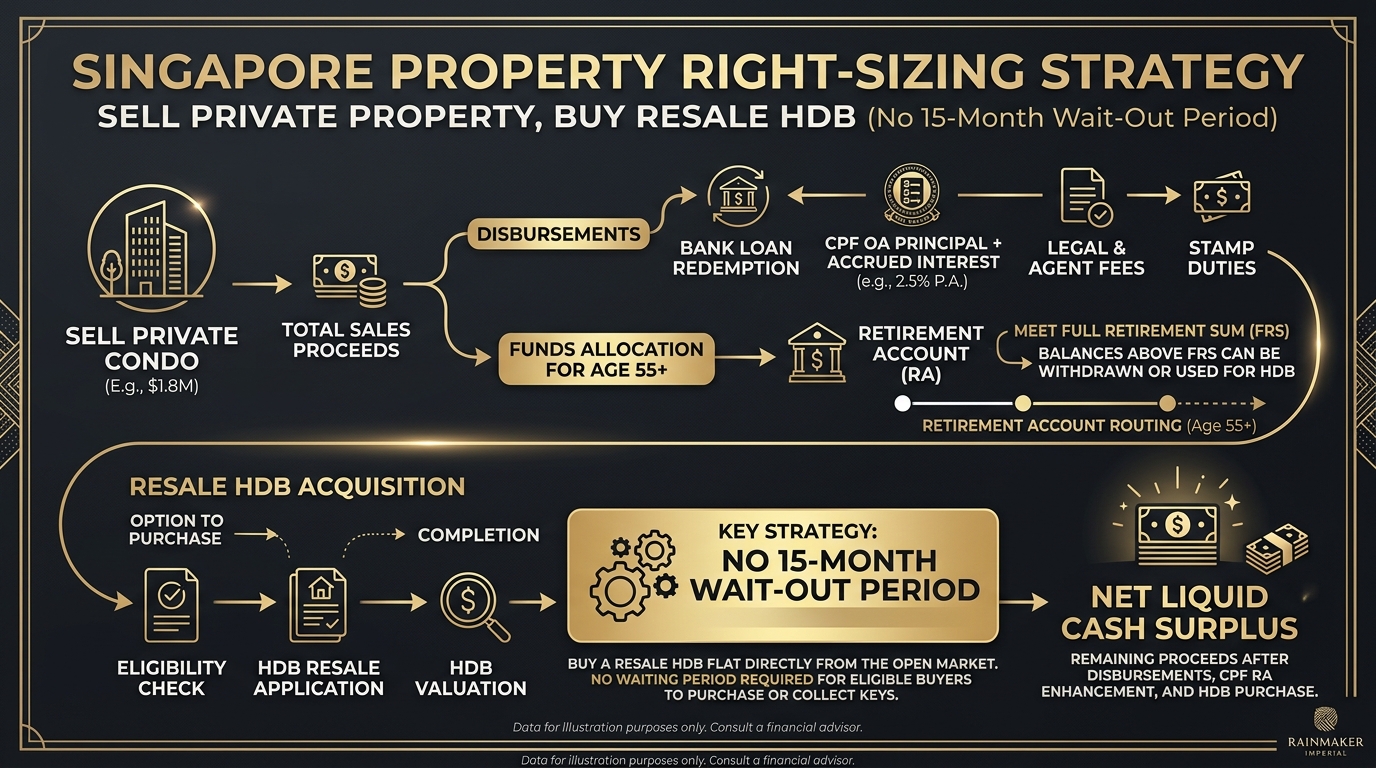
The removal of the 15-month wait-out period for private property owners buying HDB resale flats makes the move easier for a small group of right-sizing households, but analysts do not expect it to drive up resale prices (Channel NewsAsia, 2026).
Key takeaways
- The policy shortens the waiting time for eligible private homeowners who sell a private property and buy an HDB resale flat, but it does not create a new class of buyers.
- Analysts see limited price impact because the affected segment is small, price-sensitive and was already able to enter the market after the wait-out period.
- HDB resale prices in 2026-Q2 were at their previous peak of S$652 psf, suggesting limited headroom for another sharp upward move (PropAce Institutional Advisorydata, 2026).
- Private home prices remain below their earlier peak, and the still-large price gap between private and HDB homes acts as a natural market restraint (PropAce Institutional Advisorydata, 2026).
- The more immediate effect is likely to be on buyer timing and confidence, not on price levels.
The policy change and its rationale
What the 15-month rule did
The 15-month wait-out period was introduced as part of a broader set of property cooling measures to moderate demand for HDB resale flats (Channel NewsAsia, 2026). Under the rule, a private property owner who sold a private home was required to wait 15 months before buying a resale flat from the Housing and Development Board. The measure was aimed at a specific group: homeowners looking to move from a private home to a public housing resale flat, a segment that had been identified as adding pressure to resale prices.
For those affected, the rule effectively forced a pause in the middle of a housing transition. A household that sold its private home could not immediately complete a purchase of an HDB resale flat. In many cases, this meant renting in the interim, managing the cost and inconvenience of temporary accommodation, and timing the eventual purchase to the end of the waiting period.
What the removal changes
The removal of the wait-out period means that eligible private homeowners can now complete the sale of a private property and the purchase of an HDB resale flat without the built-in pause. This is significant for households that wish to right-size: empty-nesters, retirees, or owners looking to release equity while remaining in a home they own.
Analysts, however, describe the change as a refinement of the existing policy framework rather than a broad easing of cooling measures (Channel NewsAsia, 2026). The change does not relax loan limits, grants, or eligibility checks. It simply removes a timing constraint on a defined category of buyers.
Why the impact on resale prices is likely to be muted
A narrow buyer pool
Private homeowners moving into HDB resale flats are typically right-sizing, not scaling up. They are often motivated by lifestyle, family circumstance, or the desire to free up cash. As a group, they tend to be price-conscious and disciplined, especially when they are selling one asset and buying another at the same time.
That matters for price formation. A small group of motivated buyers, most of whom are looking for a sensible financial transition, is unlikely to bid aggressively across the resale market. The rule change may add a handful of additional inquiries at the top end of the HDB resale segment, but it does not transform demand.
The buyers were already in the market
Under the old rule, the same households could buy a resale flat after the 15-month period expired. In that sense, the removal does not generate new demand; it compresses the timeline and brings some purchases forward. Over a 12-month period, the total number of eligible buyers is unlikely to be materially different.
This is one reason analysts are cautious about predicting a price surge. A timing adjustment changes when a transaction takes place, not whether it takes place. The policy may cause a slight bunching of purchases in the months immediately after the change, but it does not increase the long-term purchasing power of the affected group.
Financing and eligibility rules remain unchanged
Buyers of HDB resale flats still have to meet eligibility conditions and work within the prevailing loan framework. Income ceilings, loan-to-value limits and the rules around grants remain intact. A private homeowner who cannot qualify for the necessary financing will not be able to buy simply because the wait-out rule has been lifted.
In addition, HDB flats continue to be owner-occupied housing. The change does not open the resale market to investors or expand the scope for speculative buying. For analysts, this reinforces the view that the policy is about smoothing transitions, not stimulating the market.
A market already at its peak
The price context also argues against a sharp spike. Data from URA caveats compiled by PropAce Institutional Advisoryshow that islandwide HDB prices averaged S$652 psf in 2026-Q2, unchanged from their previous peak of S$652 psf and 57.5% above the S$414 psf trough (PropAce Institutional Advisorydata, 2026). In other words, the HDB resale market has already recovered all of the ground lost in the previous downcycle.
When an asset class is trading at a record level, a modest demand-side change tends to have less price impact than when it is starting from a low base. Sellers may try to test the market, but buyers, especially right-sizers, are more likely to hold out for reasonable numbers.
Data: where prices stand
HDB resale prices have run far and now sit at their peak
PropAce Institutional Advisorydata from URA caveats shows islandwide HDB prices of S$652 psf in 2026-Q2. That is 0.0% above the S$652 psf peak and 57.5% above the S$414 psf trough (PropAce Institutional Advisorydata, 2026). These figures illustrate how much of the cyclical recovery has already occurred. A market sitting at its record is not usually the setting for an aggressive re-rating as a result of one policy tweak.
The figures also help explain why some analysts expect the resale market to move sideways or drift upward only slowly. Affordability is a real constraint at these levels, particularly for first-time buyers who do not have the cushion of a previous property sale.
Private prices remain below their earlier peak
The private residential market tells a different part of the story. Islandwide private prices averaged S$2,038 psf in 2026-Q2, 6.8% below their S$2,186 psf peak, yet still 33.3% above the S$1,529 psf trough (PropAce Institutional Advisorydata, 2026). Private prices have not reclaimed their previous peak, which tempers the wealth effect for private homeowners looking to move into HDB resale flats.
If private prices were pushing beyond old records, sellers might feel more confident about extracting maximum value from a sale before buying a cheaper HDB flat. But with private prices still below their peak, that upward pull is absent.
New-sale premium and location spreads
Caveat data also highlights the gap between new and resale homes in the private market. New-launch private homes averaged S$2,304 psf in 2026-Q2, against S$1,594 psf for resale private homes, a premium of around 45% (PropAce Institutional Advisorydata, 2026). That premium matters because it influences the decisions of private homeowners who are selling one home and buying another. Those who bought a new launch at a premium may be reluctant to accept resale prices that are significantly lower.
By location, prime-core (CCR) private homes averaged S$2,444 psf, city-fringe (RCR) S$2,078 psf and suburban (OCR) S$1,551 psf (PropAce Institutional Advisorydata, 2026). For a right-sizing household from the suburbs, the price step-down to an HDB resale flat remains substantial. The removal of the wait-out rule does nothing to change that gap.
Worked example: a right-sizing household
Consider a household that sells a 900 sq ft condominium in the suburban OCR segment at the 2026-Q2 average of S$1,551 psf. The sale proceeds would be roughly S$1.40 million (PropAce Institutional Advisorydata, 2026). If the same household buys a 1,000 sq ft HDB resale flat at the islandwide average of S$652 psf, the purchase price would be around S$652,000 (PropAce Institutional Advisorydata, 2026). That leaves a substantial amount of equity released, before accounting for any outstanding mortgage, transaction costs and resale levy.
The arithmetic illustrates why the wait-out rule mattered more for timing than for affordability. Under the old rules, this household would have had to plan for a 15-month rental period while waiting to buy the resale flat. That period would have involved renting costs and the added stress of a double move. With the rule removed, the household can sequence its sale and purchase more efficiently, potentially moving directly from one home to another.
But the same example also shows why a price surge is unlikely. A household in this position is not buying because it is being forced to. It is making a deliberate financial decision to move down the price ladder, release cash, and live in a more affordable home. Such buyers are not typically aggressive bidders. They want to buy the right flat at the right price, and they have the patience to walk away if the numbers do not work.
What the change means for buyers and sellers
For resale flat sellers
HDB resale sellers may see a slight increase in interest from private homeowners who no longer have to wait. But a bigger pool of eligible buyers does not necessarily mean deeper pockets. Buyers from the private market are often sophisticated about values, and they have a benchmark of what their own sale has fetched. Sellers who price too far above recent transactions may still struggle to close a deal.
The more likely outcome is a modest improvement in demand for well-located flats, particularly larger units that suit right-sizing households. Prices, however, are already supported by a market that has recovered to its previous peak. Additional upside from this single policy change is therefore expected to be limited.
For mainstream HDB buyers
First-time buyers and HDB upgraders are not directly affected by the removal of the 15-month rule. The policy was aimed at private homeowners, and it does not change the competition faced by first-time buyers for the most affordable resale flats.
There could be a marginal increase in interest at the higher end of the resale market, where private homeowners tend to focus. But analysts do not see this as a threat to overall affordability. The broader resale market remains driven by income growth, loan availability and genuine housing needs.
For the wider residential market
The policy change also has a psychological dimension. A move that removes friction from a property transition tends to support consumer confidence, even if it does not directly shift prices. Analysts have noted that policy refinements which make it easier for homeowners to adjust their housing choices can contribute to long-term market stability (Channel NewsAsia, 2026).
This framing is important. Singapore’s residential market is underpinned by owner-occupier demand, a disciplined supply pipeline and stable economic fundamentals. A targeted administrative change such as this is unlikely to alter that broader picture.
Outlook: policy fine-tuning, not a route back to aggressive growth
The removal of the 15-month wait-out period is best understood as a way to make the property ladder more workable, not as a stimulus measure. It removes a timing obstacle for a specific group of homeowners and gives them more control over their moves. It does not change the supply outlook, the financing framework or the fundamental affordability dynamics of the HDB resale market.
Going forward, the key drivers of HDB resale prices remain the pace of new flat supply, household income growth, interest rates and the state of the broader economy. The market enters the next phase with HDB resale prices at their previous peak and private prices below theirs. That combination, in the view of analysts, is more likely to produce stability than a renewed bout of rapid price growth.
For homeowners who have sold a private property and want to buy an HDB resale flat, the immediate effect is positive: they no longer need to wait out 15 months or make temporary housing arrangements. For the market as a whole, however, the change is modest. It makes an established group of buyers more flexible, but it does not give them more money to spend. That is why analysts say the removal of the 15-month rule is unlikely to drive up HDB resale prices (Channel NewsAsia, 2026).
FAQ
Why was the 15-month wait-out rule introduced?
The rule was introduced as part of the government’s cooling measures to moderate demand from private property owners in the HDB resale market. It required these buyers to wait 15 months after selling a private home before buying an HDB resale flat (Channel NewsAsia, 2026).
Statutory Source: Housing & Development Board (HDB) — Resale Flat Eligibility & Wait-Out Requirements
Who benefits most from the removal of the rule?
Existing private homeowners who want to right-size into an HDB resale flat benefit most. They can sell a private property and buy a resale flat without a 15-month rental detour, giving them more control over their timing and moving arrangements.
Statutory Source: Housing & Development Board (HDB) — Resale Flat Eligibility & Wait-Out Requirements
Why do analysts expect limited price impact?
Analysts point to the narrow pool of affected buyers, unchanged financing rules and the fact that HDB resale prices are already at a cyclical peak. With islandwide HDB prices at S$652 psf in 2026-Q2, there is limited room for a sharp price increase from a single policy tweak (PropAce Institutional Advisorydata, 2026).
Statutory Source: Housing & Development Board (HDB) — Resale Flat Eligibility & Wait-Out Requirements
Will the change affect first-time HDB buyers?
Not directly. The policy affects private homeowners moving into HDB resale flats, which is a separate segment from first-time buyers. Competition for lower-priced resale flats is therefore unlikely to change materially.
Statutory Source: Housing & Development Board (HDB) — Resale Flat Eligibility & Wait-Out Requirements
Should private homeowners move quickly to buy an HDB resale flat?
There is no indication that prices are about to surge, so urgency is not required. Buyers should base their decision on affordability, loan eligibility and their own housing needs rather than trying to time the market around this policy change.
Statutory Source: Housing & Development Board (HDB) — Resale Flat Eligibility & Wait-Out Requirements
By the numbers
``` HDB PSF momentum by district — QoQ %
D? +8.2% ██████████████████████████ D? +7.0% ██████████████████████ D? +2.9% █████████ D? +2.6% ████████ D? +2.4% ████████ D? +2.1% ███████ D? +1.5% █████ D? +1.5% █████ D? +1.3% ████ D? +0.7% ██ ```
| District | Median PSF | QoQ | YoY | Txns (3mo) |
|---|---|---|---|---|
| D? | $964 | ▲ 8.2% | ▲ 7.5% | 195 |
| D? | $829 | ▲ 7.0% | ▲ 7.2% | 228 |
| D? | $705 | ▲ 2.9% | ▲ 4.9% | 32 |
| D? | $597 | ▲ 2.6% | ▲ 1.2% | 215 |
| D? | $641 | ▲ 2.4% | ▲ 2.4% | 342 |
| D? | $822 | ▲ 2.1% | ▲ 1.0% | 214 |
| D? | $535 | ▲ 1.5% | ▲ 0.6% | 266 |
| D? | $665 | ▲ 1.5% | ▲ 0.3% | 105 |
| D? | $770 | ▲ 1.3% | ▲ 5.5% | 119 |
| D? | $691 | ▲ 0.7% | ▲ 1.0% | 455 |
_Data: PropAce Institutional Advisory analysis of URA/HDB transaction data — rolling 3-month average PSF, HDB, 2026-06..2026-08. Directional; confirm before acting._
Sources
- URA caveat data, compiled by PropAce Institutional Advisory— 2026-Q2.
- URA caveat data, compiled by PropAce Institutional Advisory.
References
- Channel NewsAsia (2026) Removal of 15-month rule unlikely to drive up HDB resale prices: Analysts.
Interactive Strategic Tools & Concierge
Simulate bridging loan carrying costs, 6-month disposal deadlines, and 100% IRAS ABSD refunds.
Launch Interactive Buy Before Sell Calculator
Frequently Asked Questions
Why was the 15-month wait-out rule introduced?
The rule was introduced as part of the government’s cooling measures to moderate demand from private property owners in the HDB resale market. It required these buyers to wait 15 months after selling a private home before buying an HDB resale flat (Channel NewsAsia, 2026). Statutory Source:** Housing & Development Board (HDB) — Resale Flat Eligibility & Wait-Out Requirements
Who benefits most from the removal of the rule?
Existing private homeowners who want to right-size into an HDB resale flat benefit most. They can sell a private property and buy a resale flat without a 15-month rental detour, giving them more control over their timing and moving arrangements. Statutory Source:** Housing & Development Board (HDB) — Resale Flat Eligibility & Wait-Out Requirements
Why do analysts expect limited price impact?
Analysts point to the narrow pool of affected buyers, unchanged financing rules and the fact that HDB resale prices are already at a cyclical peak. With islandwide HDB prices at S$652 psf in 2026-Q2, there is limited room for a sharp price increase from a single policy tweak (PropAce Institutional Advisorydata, 2026). Statutory Source:** [Housing & Development Board (HDB) — Resale Flat Eligibility & Wait-Out Requirements](https://www.hdb.gov.sg/cs/infoweb/residential/buying-a-flat/resale-flat/el
Will the change affect first-time HDB buyers?
Not directly. The policy affects private homeowners moving into HDB resale flats, which is a separate segment from first-time buyers. Competition for lower-priced resale flats is therefore unlikely to change materially. Statutory Source:** Housing & Development Board (HDB) — Resale Flat Eligibility & Wait-Out Requirements
Should private homeowners move quickly to buy an HDB resale flat?
There is no indication that prices are about to surge, so urgency is not required. Buyers should base their decision on affordability, loan eligibility and their own housing needs rather than trying to time the market around this policy change. Statutory Source:** Housing & Development Board (HDB) — Resale Flat Eligibility & Wait-Out Requirements
Statutory References & Citations
- Housing & Development Board (HDB) (2026). Housing and Development Act (Cap. 129). Singapore: Ministry of National Development.
Statutory Disclaimer: This guide is published for strategic, educational, and institutional planning purposes only and does not constitute formal legal, taxation, or financial advice. All property transactions, stamp duty remissions, and financing structures should be formally verified with qualified Singapore legal counsel and certified tax advisors.