 PropAce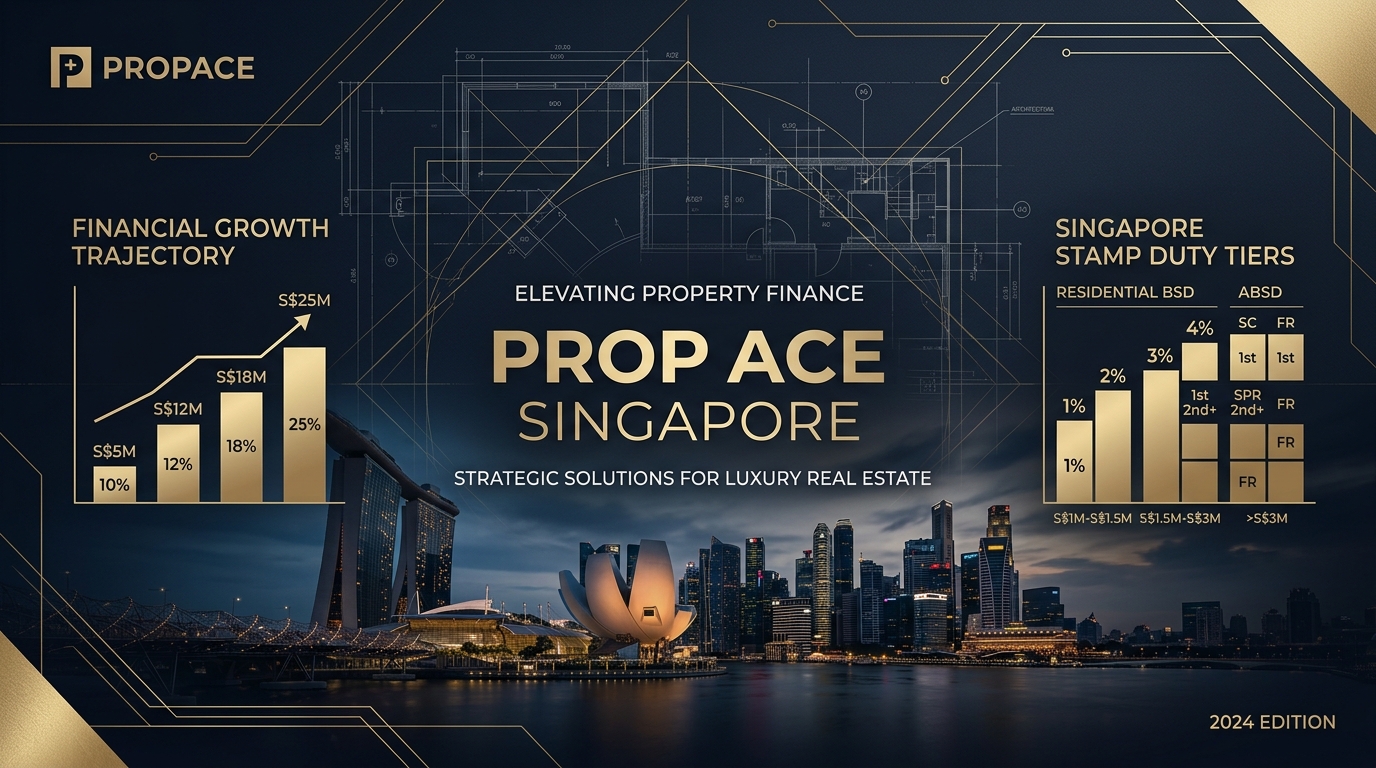
Acquiring private residential real estate in Singapore demands rigorous balance-sheet precision. Unlike public housing where initial outlays can frequently be absorbed entirely through Central Provident Fund (CPF) Ordinary Account balances and state grants, private condominiums enforce rigid statutory cash floors, progressive tax liabilities, and conservative debt ceilings governed by the Monetary Authority of Singapore (MAS).
Whether acquiring an uncompleted new launch under the Progressive Payment Scheme (Building-Under-Construction - BUC) or negotiating an established resale condominium in the Core Central Region (CCR), this guide outlines the exact liquid capital requirements governing Singapore property transactions in 2026.
Executive Summary & Statutory Capital Benchmarks
- Mandatory Pure Cash Floor: Under MAS Notice 632, every borrower taking their first housing loan must provide a minimum 5% pure cash downpayment that cannot be financed via CPF funds or personal loans.
- Statutory Maximum Loan-to-Value (LTV): First-time home loan borrowers qualify for a maximum 75% LTV, provided the loan tenure does not exceed 30 years and does not extend beyond the borrower's 65th year of age.
- Remaining Downpayment (20%): The balance of the 25% downpayment (20%) can be funded using CPF Ordinary Account (OA) savings, additional cash, or a hybrid combination.
- Progressive Buyer's Stamp Duty (BSD): Levied on all purchases up to 6% on purchase consideration exceeding S$3.0 million, payable to IRAS within 14 days of exercising the Option to Purchase (OTP).
- Additional Buyer's Stamp Duty (ABSD): Zero for Singapore Citizens purchasing their first home; 5% for Permanent Residents on their first home; 60% for foreigners (unless eligible for Free Trade Agreement remission).
The Capital Outlay Waterfall: Resale vs. New Launch (BUC)
The chronological sequence of capital disbursement differs fundamentally between completed resale condominiums and new developer launches:
`` [ STAGE 1: Option to Purchase (OTP) ] • Resale: 1% Cash Fee to secure OTP (14-day validity) • New Launch: 5% Cash Booking Fee (Receive Sale & Purchase Agreement within 2 weeks) │ ▼ [ STAGE 2: Exercise of Option / Execution of S&P ] • Resale: 4% Cash Exercise Fee (Completes the 5% cash floor) • New Launch: Sign S&P within 3 weeks of receipt │ ▼ [ STAGE 3: Stamp Duty Settlement (Within 14 Days) ] • Progressive BSD (Up to 6%) + Applicable ABSD (Up to 60%) • Funded via Cash or CPF e-payment withdrawal (subject to lawyer approval) │ ▼ [ STAGE 4: Balance Downpayment Completion (Within 8–10 Weeks) ] • Balance 20% downpayment satisfied via CPF OA balances or cash • Bank loan facility (75%) commences disbursement ``
Detailed Capital Outlay Matrix Across Purchase Tiers
The following table models the total liquid capital, CPF absorption, stamp duty liabilities, and incidental conveyancing expenses required across three benchmark price tiers for a Singapore Citizen (SC) purchasing their first residential property (0% ABSD):
| Transaction Milestone | S$1,500,000 (Entry RCR/OCR 2-Bedder) | S$2,500,000 (Prime RCR/CCR 3-Bedder) | S$4,000,000 (Luxury CCR Penthouse/4-Bedder) |
|---|---|---|---|
| 1. Minimum 5% Pure Cash Floor | S$75,000 | S$125,000 | S$200,000 |
| 2. Balance 20% Downpayment (CPF OA/Cash) | S$300,000 | S$500,000 | S$800,000 |
| 3. Buyer's Stamp Duty (BSD Progressive) | S$44,600 | S$94,600 | S$179,600 |
| 4. Maximum Bank Financing (75% LTV) | S$1,125,000 | S$1,875,000 | S$3,000,000 |
| 5. Estimated Conveyancing Legal Fees | ~S$2,800 | ~S$3,000 | ~S$3,500 |
| 6. Valuation & Mortgage Stamp Fees | ~S$1,000 | ~S$1,200 | ~S$1,500 |
| TOTAL INITIAL CAPITAL OUTLAY (Cash + CPF) | S$423,400 | S$723,800 | S$1,184,600 |
| — of which MINIMUM PURE CASH required | S$123,400 | S$223,800 | S$384,600 |
Formula for BSD on properties between S$1.5M and S$3.0M: $(\text{Purchase Price} \times 4\%) - \text{S}\$15,400$. On properties exceeding S$3.0M: $(\text{Purchase Price} \times 6\%) - \text{S}\$60,400$.
Additional Buyer's Stamp Duty (ABSD) Impact by Residency Profile
For buyers who are Permanent Residents or Foreign Nationals, ABSD dramatically shifts the upfront cash outlay:
`` [ RESIDENCY STATUS ] ─────────────────► [ 1ST PROPERTY ABSD ] ──────► [ 2ND PROPERTY ABSD ] Singapore Citizen (SC) 0% 20% Permanent Resident (SPR) 5% 30% Foreign National (Non-FTA) 60% 60% Corporate Entity / Trust 65% 65% ``
Free Trade Agreement (FTA) Remission Exception
Under prevailing international treaties, nationals and permanent residents of Iceland, Liechtenstein, Norway, Switzerland, and Nationals of the United States of America are accorded the same stamp duty treatment as Singapore Citizens. Eligible citizens from these jurisdictions pay 0% ABSD on their first residential purchase in Singapore.
Income Stress-Testing: The 55% TDSR Hurdle
Under MAS Notice 645, your monthly debt obligations across all financial institutions—including car loans, study loans, credit card balances, and your prospective property mortgage—cannot exceed 55% of your gross monthly income (Total Debt Servicing Ratio - TDSR).
MAS Interest Rate Stress-Test:
To protect against interest rate volatility, banks must evaluate your repayment capability using a standardized stress-test floor of 4.00% per annum (or the prevailing market rate plus a margin, whichever is higher).
- To support a S$1,875,000 bank loan (for a S$2.5M property) over a 25-year tenure at 4.00% stress interest, the monthly loan repayment assessed is approximately S$9,897.
- Applying the 55% TDSR ceiling, your household gross monthly income must be at least S$17,995 (assuming zero other outstanding debt).
Verify Your Financial Feasibility Before Committing
Do not risk forfeiting your 5% cash booking deposit. Calculate your exact borrowing quantum with our [Interactive Borrowing Power Calculator](https://PropAce Institutional Advisorys.com/how-much-can-i-borrow/) or connect with our [Private Client Capital Desk](https://PropAce Institutional Advisorys.com/stamp-duty-calculator/) to structure your OTP timeline securely.
FAQ
How are official Singapore private home and HDB resale price indices compiled?
URA compiles the Private Property Price Index (PPI) using lodged caveats and developer monthly transactions submitted under the Planning Act. HDB compiles the Resale Price Index (RPI) from registered resale transactions, providing verified arm's-length benchmarks.
Statutory Source: Urban Redevelopment Authority (URA) — Private Residential Property Transactions Portal
What key factors drive capital appreciation in Core Central Region (CCR) vs Rest of Central Region (RCR)?
CCR appreciation is anchored in freehold land scarcity, prime school districts, and institutional wealth preservation, while RCR performance is driven by infrastructure connectivity (Thomson-East Coast Line) and major urban transformation master plans.
Statutory Source: Urban Redevelopment Authority (URA) — Master Plan & Development Control Guidelines
Where can buyers verify true transacted prices instead of advertised asking prices?
Buyers should cross-examine official transacted caveat registries on URA's Private Residential Property Transaction portal and HDB's Resale Flat Prices e-service, which reflect actual legal contract amounts rather than speculative listing prices.
Statutory Source: Urban Redevelopment Authority (URA) — Private Residential Property Transactions Portal
Primary References & Statutory Authorities
- Monetary Authority of Singapore (MAS) (2026) MAS Notice 645: Computation of Total Debt Servicing Ratio (TDSR) for Property Loans. Singapore: Monetary Authority of Singapore. Available at: https://www.mas.gov.sg
- Monetary Authority of Singapore (MAS) (2026) MAS Notice 1115: Minimum Cash Downpayment and Loan-to-Value (LTV) Limits for Residential Mortgages. Singapore: Monetary Authority of Singapore.
- Association of Banks in Singapore (ABS) (2026) Singapore Overnight Rate Average (SORA): Key Principles and Transition Methodology. Singapore: ABS.
- Inland Revenue Authority of Singapore (IRAS) (2026) Stamp Duties Act 1929: Schedule of Buyer's Stamp Duty (BSD). Singapore: Singapore Statutes Online. Available at: https://sso.agc.gov.sg
Interactive Strategic Tools & Concierge
Instant calculation of tiered residential BSD (up to 6%) and profile-based ABSD (0% to 65%).
Calculate Exact Stamp Duties with ABSD/BSD Calculator
Frequently Asked Questions
How are official Singapore private home and HDB resale price indices compiled?
URA compiles the Private Property Price Index (PPI) using lodged caveats and developer monthly transactions submitted under the Planning Act. HDB compiles the Resale Price Index (RPI) from registered resale transactions, providing verified arm's-length benchmarks. Statutory Source:** Urban Redevelopment Authority (URA) — Private Residential Property Transactions Portal
What key factors drive capital appreciation in Core Central Region (CCR) vs Rest of Central Region (RCR)?
CCR appreciation is anchored in freehold land scarcity, prime school districts, and institutional wealth preservation, while RCR performance is driven by infrastructure connectivity (Thomson-East Coast Line) and major urban transformation master plans. Statutory Source:** Urban Redevelopment Authority (URA) — Master Plan & Development Control Guidelines
Where can buyers verify true transacted prices instead of advertised asking prices?
Buyers should cross-examine official transacted caveat registries on URA's Private Residential Property Transaction portal and HDB's Resale Flat Prices e-service, which reflect actual legal contract amounts rather than speculative listing prices. Statutory Source:** Urban Redevelopment Authority (URA) — Private Residential Property Transactions Portal
Statutory References & Citations
- Inland Revenue Authority of Singapore (IRAS) (2026). Stamp Duties Act 1929. Singapore: Government of Singapore.
- Monetary Authority of Singapore (MAS) (2026). Notice 645: Computation of Total Debt Servicing Ratio (TDSR) for Property Loans. Singapore: MAS.
- Central Provident Fund Board (CPF) (2026). Central Provident Fund (Approved Housing Schemes) Regulations. Singapore: CPF Board.
Statutory Disclaimer: This guide is published for strategic, educational, and institutional planning purposes only and does not constitute formal legal, taxation, or financial advice. All property transactions, stamp duty remissions, and financing structures should be formally verified with qualified Singapore legal counsel and certified tax advisors.