 PropAce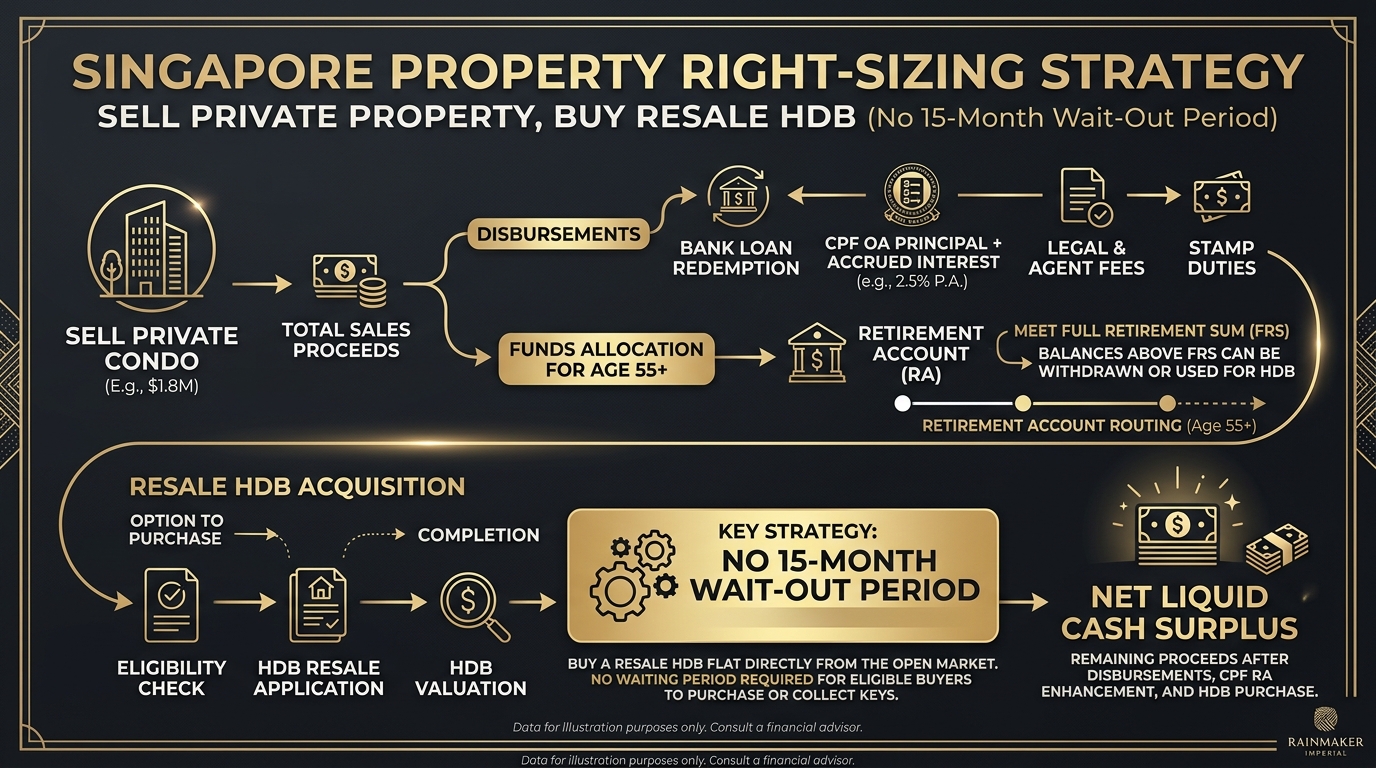
The removal of the 15-month wait-out period will widen the pool of eligible buyers for HDB resale flats, but it is unlikely to set off another broad price surge because HDB resale prices are already at their peak and the private-to-HDB switch is an expensive right-sizing trade, not a cheap arbitrage.
Key takeaways
- The 15-month wait-out has been removed for eligible private homeowners buying HDB resale flats, reopening a channel that had effectively required them to exit the private market well before entering the public housing market (The Star, 2026).
- HDB resale prices are already at their cycle peak: islandwide HDB prices hit S$652 psf in Q2 2026, exactly matching their previous high and sitting 57.5% above the S$414 psf trough (PropAce Institutional Advisorydata, 2026).
- Private prices are in a different phase, sitting 6.8% below the S$2,186 psf peak yet still 33.3% above the S$1,529 psf trough, so the two markets are not moving in lockstep (PropAce Institutional Advisorydata, 2026).
- New launches carry a roughly 45% premium over resale, which means the price gap between private housing and HDB resale remains a central consideration in any right-sizing decision (PropAce Institutional Advisorydata, 2026).
- Expect moderate and uneven pressure on HDB resale prices rather than another sharp rally; analysts have framed the move as supporting owner-occupier demand and long-term market stability (The Edge Singapore, 2026).
The policy reversal: What changed, and why it matters
A restriction aimed at slowing the HDB resale market
The 15-month wait-out period had required eligible private homeowners to wait before purchasing an HDB resale flat, effectively forcing them to sell their private home first and sit out of the market for more than a year if they wanted to move into public housing (The Star, 2026). The rule was designed to cool demand for HDB resale flats from buyers who had sold private property, and to keep the public housing market focused on first-timers and those without private housing interests.
The removal changes the sequence of events. A private homeowner can now sell and buy in the same transaction, or buy an HDB resale flat without first going through a prolonged period of uncertainty. That makes right-sizing more practical for owners who want to unlock equity, move closer to family, or reduce housing costs without the risk of navigating two transactions in completely different market windows.
A targeted loosening, not a broad easing
The change should not be read as a general relaxation of property cooling measures. It applies specifically to private homeowners buying HDB resale flats, not to other categories of buyers, and it does not affect the broader rules that govern private housing demand. Market observers have described the move as a support for consumer confidence and long-term market stability, particularly for owner-occupiers and right-sizers (The Edge Singapore, 2026).
That framing matters. The intent is to make it easier for private owners to move into HDB resale flats when they genuinely need to, not to inject speculative demand into the public housing market. The policy is therefore best understood as an efficiency improvement for a particular group of buyers, rather than a signal that the Government is reopening the door to investors.
Two markets at very different points in the cycle
The most useful way to assess the price impact is to separate the HDB resale market from the private market. The two are interlinked, but they are not in the same phase of the cycle.
Private prices: below the peak
PropAce Institutional Advisory’s compilation of URA caveat data puts islandwide private prices at S$2,038 psf in Q2 2026, 6.8% below the S$2,186 psf cycle peak. They remain 33.3% above the S$1,529 psf trough (PropAce Institutional Advisorydata, 2026). In other words, the private market has cooled from its high point, but it has not collapsed; the gains from earlier in the cycle are still firmly in place.
This is a mixed signal for a private homeowner considering a move to HDB resale. Selling today means accepting a price that is slightly below the cycle peak, but still well above the lows at which many owners bought. The financial incentive to right-size exists, but it is not the same as selling into the heat of a booming market.
HDB resale: already at the peak
The HDB picture is different. Islandwide HDB prices reached S$652 psf in Q2 2026, exactly matching their previous peak and confirming that the market has fully recovered any earlier dip (PropAce Institutional Advisorydata, 2026). The same data shows HDB prices remain 57.5% above the S$414 psf trough (PropAce Institutional Advisorydata, 2026).
This is critical context for the policy reversal. The new pool of eligible buyers is arriving at a market that has already repriced significantly, not one with obvious unused headroom. Any additional demand will be layered on top of a price level that is already stretching household budgets in many estates.
New launches versus resale: a significant premium
The gap between new and resale private homes is also wide. According to URA caveat data compiled by PropAce Institutional Advisory, new-launch private homes averaged S$2,303 psf while resale private homes averaged S$1,594 psf — a roughly 45% new-sale premium (PropAce Institutional Advisorydata, 2026). This premium is one reason the policy change is unlikely to trigger a flood of private owners into HDB resale flats; the price gap between a new launch and an HDB resale flat is substantially larger than the gap between private resale and HDB resale.
The segment averages underscore how uneven the private market is. Across the transaction record, prime-core (CCR) homes averaged S$2,444 psf, city-fringe (RCR) homes S$2,078 psf, and suburban (OCR) homes S$1,551 psf (PropAce Institutional Advisorydata, 2026). A right-sizer from the OCR is in a very different financial position from one in the CCR. The closer an owner is to the HDB price level to begin with, the smaller the financial release from selling, and the less compelling the down-trade.
Who benefits most: The right-sizer channel
The demand-side logic
The removal of the wait-out period increases demand for HDB resale flats because it removes a practical obstacle. Previously, a private owner who wanted to move into HDB resale had to coordinate the sale of their private home, wait 15 months, and then enter the HDB market. That meant finding temporary accommodation, managing two moves, and accepting the risk that prices could move against them during the waiting period.
With the wait removed, more owners in the later stages of their housing cycle can consider making the switch. The group most affected is usually described as right-sizers — older owners, or those simplifying their lives, who want to release capital from a larger private home and buy a smaller or more conveniently located HDB flat. They are not typically speculators; they are owner-occupiers moving between markets for lifestyle or financial reasons (The Edge Singapore, 2026).
The supply-side response
It is tempting to assume that every private owner who now buys an HDB resale flat will also sell their private home, adding to private resale supply. In practice, some will sell, while others may keep their private unit and rent it out or hold it for family use. The net effect on the private market is therefore uncertain.
There is at least a partial offset to consider: more private owners entering the HDB resale market could mean more private resale listings over time. That would put some downward pressure on private prices at a moment when the data already show private prices below their peak. The policy is therefore not simply a one-way bet on higher prices across both markets.
What the numbers mean for a would-be right-sizer
A worked example
Imagine a private homeowner in an OCR condominium. Based on the averages in PropAce Institutional Advisory’s URA caveat data, OCR private homes transacted at about S$1,551 psf, while islandwide HDB resale prices were about S$652 psf (PropAce Institutional Advisorydata, 2026). For a flat of roughly 1,000 sq ft, the private-to-HDB transition would be from around S$1.55 million to around S$652,000, releasing close to S$900,000 before transaction costs.
That is a substantial pool of equity for an owner who genuinely wants to reduce housing costs. But it is not the same for every seller. A homeowner who bought near the top of the cycle, or who lives in a prime-core location where private prices average S$2,444 psf, faces a much larger gap to cross before the numbers make sense. Even an owner who bought a new launch at S$2,303 psf would be making a far more radical financial switch than the typical right-sizer scenario suggests (PropAce Institutional Advisorydata, 2026).
The important caveat
Averages are not a market forecast. A resale HDB flat in a mature estate can transact well above the islandwide average, and an older OCR condo can trade well below its segment average. The purpose of the exercise is to show that the financial benefit of moving to HDB resale can be large in absolute terms, which is precisely why pent-up demand exists.
The same arithmetic also explains why the policy change could push up prices at the upper end of the HDB resale market, particularly for larger flats in sought-after locations where the gap between private and HDB prices is still wide enough to make the switch worthwhile.
Will prices rise again? The likely path
The case for upward pressure
The short-run supply of HDB resale flats is fixed. The number of flats available for sale in any quarter depends on owners who choose to list, and it cannot be expanded quickly by developers or builders. Adding a new group of eligible buyers — private homeowners who no longer have to wait — will raise competition for the segments those buyers want. All else equal, that should support, and probably nudge up, HDB resale prices.
The case against a sharp surge
But HDB prices are starting from their peak. At S$652 psf, with prices 57.5% above the trough, much of the affordability gain from earlier in the cycle has already been absorbed (PropAce Institutional Advisorydata, 2026). Buyers at these levels need larger loans, bigger cash outlays and higher monthly payments. Loan and income limits still apply, and the pool of buyers who can afford to pay significantly more is finite.
The gap between the private and HDB markets also cuts both ways. Private prices remain 6.8% below their peak, which means sellers who are not genuine right-sizers have little reason to exit unless they need the equity (PropAce Institutional Advisorydata, 2026). Without a steady supply of private owners choosing to sell, the demand boost from the policy change will be smaller than the headline numbers suggest.
Expect a segmented impact
The price impact is likely to be uneven. Larger HDB resale flats and units in mature estates with strong accessibility are the natural targets for right-sizing private owners. These segments may see firmer demand and faster price growth. Smaller flats, less desirable locations, and newer flats with longer remaining leases may see less pressure.
In the private market, the change could modestly increase resale listings as some owners act on their exit plans. The net effect on aggregate price indices may be a reshuffling of demand between segments rather than a uniform lift across the board.
What analysts are saying
Market observers have greeted the move with cautious optimism. The Edge Singapore reports that the policy refinement could support consumer confidence and long-term market stability, with the market expected to remain resilient through the rest of 2026 on the back of moderate price growth driven by genuine housing demand (The Edge Singapore, 2026). Stacked Homes, in its analysis, posed the same question directly, asking whether prices will rise again and tying the answer to the current cycle of both markets (Stacked Homes, 2026). The common thread is moderation, not acceleration.
Risks to watch
The wrong-sizer risk
The biggest risk for individual buyers is mistaking an average for a plan. A private owner who uses the removal of the wait-out period to buy the upper end of the HDB resale market — a large flat in a prime location — may find that the financial benefit of the switch is smaller than expected. Conversely, an owner who sells a private home below its peak and buys an HDB flat at a record price could be locking in a less efficient trade. The policy itself does not change the fundamental economics of the decision.
Policy risk
Cooling measures are not permanent. The 15-month wait-out period was introduced as a demand-side curb, and the same instrument could, in principle, be reinstated if prices accelerate sharply. Buyers who structure their finances around the assumption that the wait-out will remain removed indefinitely are taking a policy risk. This is not a prediction, but it is a reminder that the current setting is unusual: HDB prices are at a peak while private prices sit below one.
Valuation and financing risk
HDB resale transactions are subject to the same valuation and loan rules that apply to all buyers. If prices outpace appraisals, buyers will need larger cash down payments. The current data suggest there is no shortage of demand, but they also suggest there is no obvious trigger for a sustained new leg of rapid price gains.
The verdict
Removing the 15-month wait-out period is a meaningful, practical reform for private homeowners who want to right-size into HDB resale flats. It will create new demand, and some segments of the HDB resale market should see prices firm. But the move is arriving at a time when HDB resale prices are already at their peak, private prices are still below their own peak, and the premium for new launches over resale remains wide. The more likely outcome is a moderate, segmented adjustment — not a repeat of the market-wide surge that the wait-out was originally meant to dampen.
FAQ
What does the removal of the 15-month wait-out period mean for private homeowners?
It means eligible private owners no longer need to sit out for 15 months before buying an HDB resale flat, making it practical to sell a private home and move into public housing in a single market window. The change does not apply to new flat exercises such as BTO launches.
Statutory Source: Housing & Development Board (HDB) — Resale Flat Eligibility & Wait-Out Requirements
Could the removal cause HDB resale prices to rise sharply?
A sharp, market-wide surge is unlikely because islandwide HDB prices are already at S$652 psf, the same level as their previous peak (PropAce Institutional Advisorydata, 2026). More likely, demand will concentrate in larger flats and preferred locations, producing modest and uneven price firming.
Statutory Source: Housing & Development Board (HDB) — Resale Flat Eligibility & Wait-Out Requirements
Should private homeowners wait before making the switch?
There is no universal answer, because the trade is most attractive to genuine right-sizers with equity to release and a clear need for lower housing costs. The key is to compare the sale price of the private home with actual transacted prices of HDB resale flats in the target estate, rather than relying on islandwide averages.
Statutory Source: Housing & Development Board (HDB) — Resale Flat Eligibility & Wait-Out Requirements
Is the removal of the wait-out period the start of a broader easing of cooling measures?
The change is targeted at owner
Statutory Source: Housing & Development Board (HDB) — Resale Flat Eligibility & Wait-Out Requirements
By the numbers
``` Private PSF momentum by district — QoQ %
D11 +29.6% ██████████████████████████ D26 +12.6% ███████████ D25 +7.9% ███████ D12 +7.8% ███████ D02 +5.6% █████ D08 +4.8% ████ D20 +3.2% ███ D28 +1.5% █ D27 +0.1% █ D19 -0.2% ░ ```
| District | Median PSF | QoQ | YoY | Txns (3mo) |
|---|---|---|---|---|
| D11 | $2,882 | ▲ 29.6% | ▲ 29.8% | 320 |
| D26 | $2,297 | ▲ 12.6% | ▲ 6.9% | 247 |
| D25 | $1,352 | ▲ 7.9% | ▲ 6.6% | 57 |
| D12 | $1,984 | ▲ 7.8% | ▲ 7.1% | 85 |
| D02 | $2,596 | ▲ 5.6% | ▲ 26.9% | 28 |
| D08 | $2,002 | ▲ 4.8% | ▲ 16.6% | 35 |
| D20 | $2,041 | ▲ 3.2% | ▲ 4.1% | 122 |
| D28 | $1,670 | ▲ 1.5% | ▲ 7.5% | 99 |
| D27 | $1,425 | ▲ 0.1% | ▼ 12.9% | 115 |
| D19 | $1,758 | ▼ 0.2% | ▲ 5.3% | 440 |
_Data: PropAce Institutional Advisory analysis of URA/HDB transaction data — rolling 3-month average PSF, private residential, 2026-06..2026-08. Directional; confirm before acting._
Sources
- URA caveat data, compiled by PropAce Institutional Advisory— 2026-Q2.
- URA caveat data, compiled by PropAce Institutional Advisory.
References
- Stacked Homes (2026) Singapore Removes 15-Month Wait-Out Period For Private Homeowners Buying Resale HDB Flats: Will Prices Rise Again?.
- The Edge Singapore (2026) Analysts cheer removal of 15-month wait-out period for private home owners buying HDB resale flats.
- The Star (Malaysia) (2026) Singapore scraps 15-month wait for private homeowners buying HDB resale flats.
Interactive Strategic Tools & Concierge
Simulate bridging loan carrying costs, 6-month disposal deadlines, and 100% IRAS ABSD refunds.
Launch Interactive Buy Before Sell Calculator
Frequently Asked Questions
What does the removal of the 15-month wait-out period mean for private homeowners?
It means eligible private owners no longer need to sit out for 15 months before buying an HDB resale flat, making it practical to sell a private home and move into public housing in a single market window. The change does not apply to new flat exercises such as BTO launches. Statutory Source:** Housing & Development Board (HDB) — Resale Flat Eligibility & Wait-Out Requirements
Could the removal cause HDB resale prices to rise sharply?
A sharp, market-wide surge is unlikely because islandwide HDB prices are already at S$652 psf, the same level as their previous peak (PropAce Institutional Advisorydata, 2026). More likely, demand will concentrate in larger flats and preferred locations, producing modest and uneven price firming. Statutory Source:** Housing & Development Board (HDB) — Resale Flat Eligibility & Wait-Out Requirements
Should private homeowners wait before making the switch?
There is no universal answer, because the trade is most attractive to genuine right-sizers with equity to release and a clear need for lower housing costs. The key is to compare the sale price of the private home with actual transacted prices of HDB resale flats in the target estate, rather than relying on islandwide averages. Statutory Source:** [Housing & Development Board (HDB) — Resale Flat Eligibility & Wait-Out Requirements](https://www.hdb.gov.sg/cs/infoweb/residential/buying-a-flat/resal
Is the removal of the wait-out period the start of a broader easing of cooling measures?
The change is targeted at owner Statutory Source:** Housing & Development Board (HDB) — Resale Flat Eligibility & Wait-Out Requirements
Statutory References & Citations
- Housing & Development Board (HDB) (2026). Housing and Development Act (Cap. 129). Singapore: Ministry of National Development.
- Singapore Land Authority (SLA) (2026). Land Titles Act (Cap. 157) & Conveyancing Registration Framework. Singapore: SLA.
Statutory Disclaimer: This guide is published for strategic, educational, and institutional planning purposes only and does not constitute formal legal, taxation, or financial advice. All property transactions, stamp duty remissions, and financing structures should be formally verified with qualified Singapore legal counsel and certified tax advisors.