 PropAce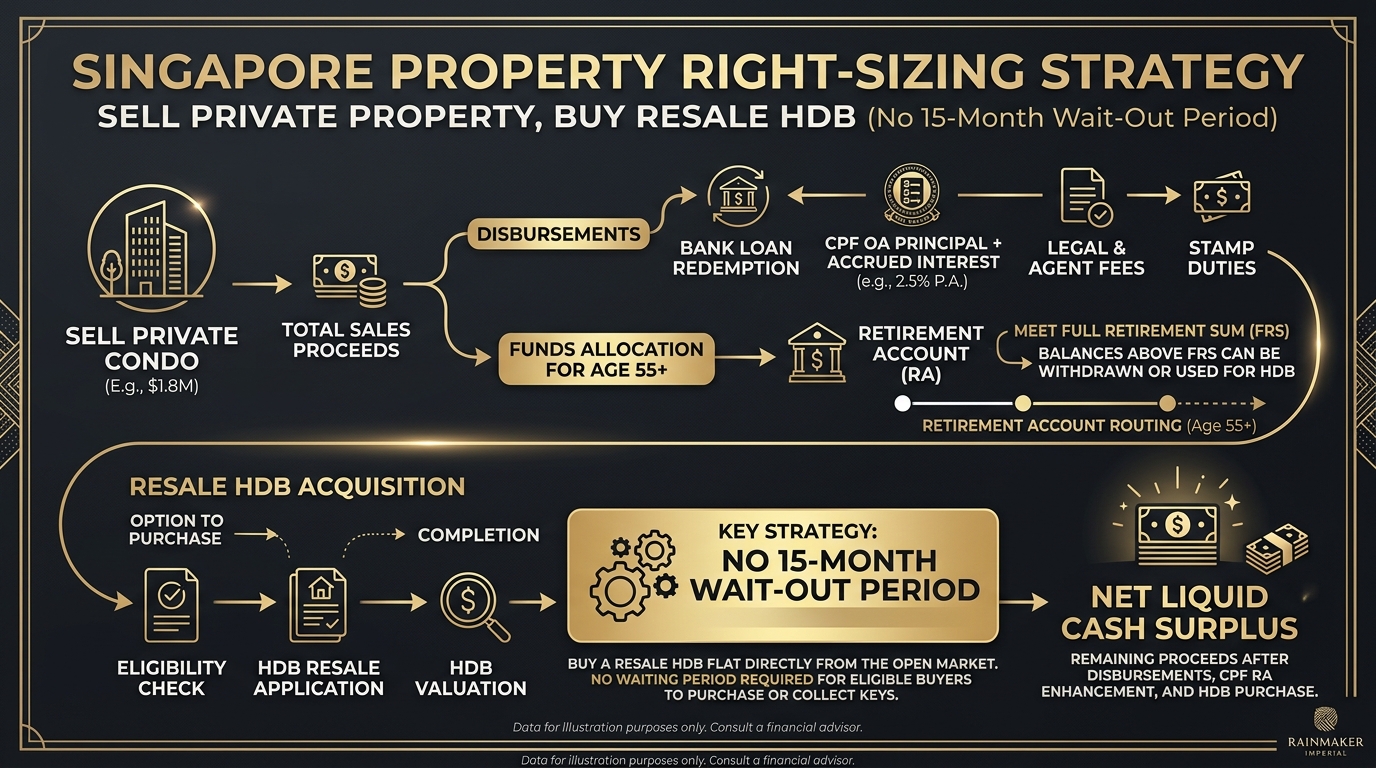
One online form now bundles two CPF applications — paying for your resale flat and paying for the Home Protection Scheme — but the form is the easy part; the real work is understanding how much of your CPF the rules will actually let you spend (Housing and Development Board, 2026).
This guide walks through the HDB e-service, the downpayment rules for HDB and bank loans, the grants that shrink your upfront cash, and the 2026 market data you are buying into. Some of it will save you money. Some of it is a warning.
Key takeaways
- HDB's e-service lets you apply to pay for a resale flat and the Home Protection Scheme with CPF in one place (Housing and Development Board, 2026).
- The HDB loan downpayment is 20% and can come entirely from CPF; a bank loan requires 25%, with at least 5% in cash (99.co, 2026).
- CPF Housing Grants, including the Enhanced CPF Housing Grant for households earning S$9,000 or less a month, can offset part of the downpayment (99.co, 2026).
- Islandwide HDB prices stood at S$652 psf in 2026-Q2 — equal to their peak and 57.5% above the trough (PropAce Institutional Advisorydata).
- The 15-month wait-out period for private owners buying five-room or larger resale flats is gone, as long as they skip the HDB loan (Stacked Homes, 2026).
What the e-service covers
The e-service is hosted on the HDB's services portal and carries the functional title "Apply to Pay for Resale Flat and Home Protection Scheme with CPF" (Housing and Development Board, 2026). Two things happen in that one application: you draw on your CPF to pay for the resale flat, and you draw on CPF to pay for the Home Protection Scheme.
The source material confirms the application route, not the scheme's mechanics. The coverage and premium structure of the Home Protection Scheme are not addressed in the reporting this guide draws on, so treat this article as a map of the payment rules, not the scheme's fine print. Likewise, the sources do not set out a step-by-step submission flow — the documents, the waiting time, the approval sequence — so the practical focus here is the rules that determine what you can pay.
HDB loan or bank loan: where your CPF goes
The downpayment is the first wall your CPF hits. On an HDB loan, you put down 20% of the purchase price, and the whole sum can come from CPF Ordinary Account (OA) savings or a combination of CPF and cash. On a bank loan, the downpayment rises to 25%, with at least 5% in cash and the remaining 20% from CPF and/or cash (99.co, 2026). That 5% cash clause is the one that catches buyers off guard — CPF cannot replace it.
Condo buyers face a similar structure. On a first property, the minimum downpayment is 25%, with at least 5% in cash (99.co, 2026).
Subject to CPF withdrawal limits, your OA savings can fund most, if not all, of an HDB downpayment (99.co, 2026). The withdrawal limits are the second wall. And remember the costs that sit outside the downpayment: stamp duties, legal fees and renovation costs (99.co, 2026). None of those can be folded into the loan.
The Staggered Downpayment Scheme
First-timers buying a BTO flat can split the downpayment into two instalments under the Staggered Downpayment Scheme — a cash-flow tool aimed squarely at young couples and first-time buyers (99.co, 2026). It does not reduce what you owe; it changes when you pay.
Grants that shrink the upfront cash
Before you worry about the downpayment, check the grants. CPF Housing Grants for eligible buyers can offset part of the downpayment, reducing your upfront cash outlay (99.co, 2026). The Enhanced CPF Housing Grant (EHG) is available to households earning S$9,000 or less per month (99.co, 2026).
Income ceilings decide who gets in the door at all. The current monthly ceiling is S$14,000 for couples and families buying BTO flats, S$16,000 for new executive condominiums, and S$14,000 for resale purchases of a "Plus" HDB flat (99.co, 2026). Along the way, you will also meet instruments such as the HDB Flat Eligibility (HFE) Letter and the HDB Loan Eligibility (HLE) Letter (99.co, 2026).
The market you are paying into
This is where a CPF application stops being paperwork and becomes a financial decision. Islandwide HDB prices averaged S$652 psf in 2026-Q2 — exactly 0.0% above the previous peak, and 57.5% above the S$414 psf trough (PropAce Institutional Advisorydata). You are, in other words, applying to spend CPF at the top of the HDB cycle.
Private property is in a different place. Islandwide private prices of S$2,038 psf in 2026-Q2 sit 6.8% below the S$2,186 psf peak, but they remain 33.3% above the S$1,529 psf trough (PropAce Institutional Advisorydata). The private market has cooled from its high; the HDB market has not.
The gap between new and resale private homes is stark. New-launch private homes averaged S$2,304 psf against S$1,595 psf for resale — a roughly 44% new-sale premium (PropAce Institutional Advisorydata). The regional splits show why upgraders keep gravitating to the city fringe: prime-core (CCR) homes have averaged S$2,443 psf, city-fringe (RCR) S$2,078 psf, and suburban (OCR) S$1,552 psf (PropAce Institutional Advisorydata).
Million-dollar flats: the government's warning
HDB has been generating headlines for million-dollar flats, and the government's advice is blunt: buyers should exercise caution, because those who buy at high prices may be more exposed if the market softens (Stacked Homes, 2026). The warning lands differently for a CPF-funded buyer. Your CPF money goes in at the valuation you agree to, and if prices correct, the exposure is not paper-only — it is retirement savings sitting in the asset.
The segment trends back that caution with one standout: city-fringe (RCR) condos have outperformed other segments, with a 6.5% price increase in 2024 and nearly 40% growth over the past five years, continuing to attract HDB upgraders who want affordability with proximity to the city (Stacked Homes, 2026).
The wait-out period is gone
One change has already reshaped demand. At the end of July, the government scrapped the 15-month wait-out period that had prevented private property owners from buying a five-room or larger HDB resale flat (Stacked Homes, 2026). The condition: you cannot be taking an HDB loan (Stacked Homes, 2026).
The timing is no coincidence. The removal of the wait-out period has likely contributed to the uptick in million-dollar resale transactions in recent days (Stacked Homes, 2026). Cash-rich downgraders can now move immediately, and some have — recent sales along Bedok South Road, with a premium location and MRT access, have moved quickly in the last four months (Stacked Homes, 2026).
A worked illustration: what one calculator run shows
To see how the rules bind together, consider what a public affordability calculator produces. The tool, which its publisher says runs on the latest MAS, HDB and CPF rules and current interest rates, generated a maximum bank loan of S$576,018 for an illustrative set of inputs, with a maximum loan-to-value ratio of 75%, a Total Debt Servicing Ratio (TDSR) cap of 55% of income that worked out to S$2,750 a month, and an income-weighted average age of 30 years (99.co, 2026). For HDB and EC purchases, the Mortgage Servicing Ratio (MSR) limit applies at 30% (99.co, 2026). The calculator also factors in CPF Housing Grants for eligible first-timers and applies the correct HDB loan downpayment rules (99.co, 2026).
That S$576,018 is an illustration, not a promise. The publisher itself advises confirming final figures with a bank or a licensed advisor (99.co, 2026). The structural lesson stands: your loan ceiling — and therefore the CPF draw you can service — is set by your income, your age and the loan type, not by the flat's asking price.
Who pays what else
Most foreigners purchasing residential property in Singapore face Additional Buyer's Stamp Duty (ABSD), currently 60% for a first purchase (99.co, 2026). There are exceptions. Under Free Trade Agreements, nationals and permanent residents of Liechtenstein, Iceland, Norway, Switzerland and the United States are exempt (99.co, 2026). Those eligible pay no ABSD on a first residential purchase, just like Singapore Citizens, but they remain limited to private residential properties such as condos, apartments and privatised executive condominiums (99.co, 2026).
FAQ
Can my CPF Ordinary Account cover the whole HDB downpayment?
Yes for most buyers. The 20% downpayment on an HDB loan can be paid entirely with CPF OA savings or a combination of CPF and cash (99.co, 2026). CPF OA can fund most, if not all, of the HDB downpayment, subject to CPF withdrawal limits (99.co, 2026).
Statutory Source: Central Provident Fund Board (CPF) — Housing Scheme & OA Withdrawal Rules
What is the difference between an HDB loan and a bank loan downpayment?
An HDB loan requires 20% of the purchase price, payable entirely by CPF or a CPF-cash mix (99.co, 2026). A bank loan requires 25%, with at least 5% in cash and the remaining 20% from CPF and/or cash (99.co, 2026).
Statutory Source: Housing & Development Board (HDB) — Official Housing Policies & Resale Guidelines
Is the 15-month wait-out period still in force for private property owners?
No. The government scrapped it at the end of July (Stacked Homes, 2026). Private property owners can now buy a five-room or larger HDB resale flat without waiting, as long as they are not taking an HDB loan (Stacked Homes, 2026).
Statutory Source: Housing & Development Board (HDB) — Resale Flat Eligibility & Wait-Out Requirements
Which foreigners are exempt from ABSD?
Under Free Trade Agreements, nationals and permanent residents of Liechtenstein, Iceland, Norway, Switzerland and the United States are exempt (99.co, 2026). They pay no ABSD on a first residential purchase, just like Singapore Citizens, but remain limited to private residential properties such as condos, apartments and privatised executive condominiums (99.co, 2026).
Statutory Source: Inland Revenue Authority of Singapore (IRAS) — ABSD Remissions Under Free Trade Agreements
What income ceilings and grant thresholds apply?
The monthly income ceiling is S$14,000 for BTO flats and S$16,000 for new executive condominiums (99.co, 2026). A S$14,000 ceiling also applies when buying a "Plus" HDB resale flat, and the Enhanced CPF Housing Grant is available to households earning S$9,000 or less a month (99.co, 2026).
Statutory Source: Housing & Development Board (HDB) — CPF Housing Grants Framework
By the numbers
``` HDB PSF momentum by town — QoQ %
Queenstown +7.5% ██████████████████████ Toa Payoh +7.5% ██████████████████████ Marine Parade +4.1% ████████████ Pasir Ris +2.9% █████████ Bedok +2.6% ████████ Bukit Merah +2.2% ██████ Serangoon +2.0% ██████ Choa Chu Kang +0.9% ███ Punggol +0.3% █ Clementi +0.1% █ ```
| Town | Median PSF | QoQ | YoY | Txns (3mo) |
|---|---|---|---|---|
| Queenstown | $958 | ▲ 7.5% | ▲ 6.8% | 218 |
| Toa Payoh | $833 | ▲ 7.5% | ▲ 7.8% | 252 |
| Marine Parade | $713 | ▲ 4.1% | ▲ 6.1% | 35 |
| Pasir Ris | $599 | ▲ 2.9% | ▲ 1.5% | 235 |
| Bedok | $642 | ▲ 2.6% | ▲ 2.6% | 375 |
| Bukit Merah | $823 | ▲ 2.2% | ▲ 1.1% | 234 |
| Serangoon | $668 | ▲ 2.0% | ▲ 0.8% | 115 |
| Choa Chu Kang | $532 | ▲ 0.9% | — 0.0% | 290 |
| Punggol | $688 | ▲ 0.3% | ▲ 0.6% | 505 |
| Clementi | $761 | ▲ 0.1% | ▲ 4.2% | 128 |
_Data: PropAce Institutional Advisory analysis of URA/HDB transaction data — rolling 3-month average PSF, HDB, 2026-06..2026-08. Directional; confirm before acting._
Sources
- URA caveat data, compiled by PropAce Institutional Advisory— 2026-Q2.
- URA caveat data, compiled by PropAce Institutional Advisory.
References
- Stacked Homes (2026) 'A Bedok 5-Room HDB Just Sold For A Record $1.45M — The Same Block Broke The Record 3 Months Ago'. Available at: https://stackedhomes.com/bedok-5-room-hdb-sold-record-1-45m-same-block-broke-record-3-months-ago/ (Accessed: 28 August 2026).
- Stacked Homes (2026) 'Could This Proposed Move Let Homeowners Sell Without Property Agents? It's Not That Simple'. Available at: https://stackedhomes.com/could-this-proposed-move-let-homeowners-sell-without-property-agents-its-not-that-simple/ (Accessed: 28 August 2026).
- Stacked Homes (2026) 'Here Are 5 Of The Cheapest 4-Bedroom Condos — From Under $2M'. Available at: https://stackedhomes.com/5-of-the-cheapest-4-bedroom-condos-from-under-2m/ (Accessed: 28 August 2026).
- Stacked Homes (2026) 'Here Are 5 Of The Cheapest Freehold 3-Bedroom Condos — From Under $1.7M'. Available at: https://stackedhomes.com/three-bedroom-freehold-condo-below-1-7-million/ (Accessed: 28 August 2026).
- Stacked Homes (2026) 'We Toured A 999-Year Landed Street In Serangoon Gardens Where Terrace Homes Have Sold From $4.8 Million'. Available at: https://stackedhomes.com/we-toured-999-year-landed-street-serangoon-gardens-terrace-homes-sold-from-4-8-million/ (Accessed: 28 August 2026).
- Stacked Homes (2026) 'Why Rental Prices In Singapore Are Still Climbing Despite More Homes Coming This Year'. Available at: https://stackedhomes.com/why-rental-prices-in-singapore-are-still-climbing-despite-more-homes-coming-this-year/ (Accessed: 28 August 2026).
Interactive Strategic Tools & Concierge
Simulate bridging loan carrying costs, 6-month disposal deadlines, and 100% IRAS ABSD refunds.
Launch Interactive Buy Before Sell Calculator
Frequently Asked Questions
Can my CPF Ordinary Account cover the whole HDB downpayment?
Yes for most buyers. The 20% downpayment on an HDB loan can be paid entirely with CPF OA savings or a combination of CPF and cash (99.co, 2026). CPF OA can fund most, if not all, of the HDB downpayment, subject to CPF withdrawal limits (99.co, 2026). Statutory Source:** Central Provident Fund Board (CPF) — Housing Scheme & OA Withdrawal Rules
What is the difference between an HDB loan and a bank loan downpayment?
An HDB loan requires 20% of the purchase price, payable entirely by CPF or a CPF-cash mix (99.co, 2026). A bank loan requires 25%, with at least 5% in cash and the remaining 20% from CPF and/or cash (99.co, 2026). Statutory Source:** Housing & Development Board (HDB) — Official Housing Policies & Resale Guidelines
Is the 15-month wait-out period still in force for private property owners?
No. The government scrapped it at the end of July (Stacked Homes, 2026). Private property owners can now buy a five-room or larger HDB resale flat without waiting, as long as they are not taking an HDB loan (Stacked Homes, 2026). Statutory Source:** Housing & Development Board (HDB) — Resale Flat Eligibility & Wait-Out Requirements
Which foreigners are exempt from ABSD?
Under Free Trade Agreements, nationals and permanent residents of Liechtenstein, Iceland, Norway, Switzerland and the United States are exempt (99.co, 2026). They pay no ABSD on a first residential purchase, just like Singapore Citizens, but remain limited to private residential properties such as condos, apartments and privatised executive condominiums (99.co, 2026). Statutory Source:** [Inland Revenue Authority of Singapore (IRAS) — ABSD Remissions Under Free Trade Agreements](https://www.iras
What income ceilings and grant thresholds apply?
The monthly income ceiling is S$14,000 for BTO flats and S$16,000 for new executive condominiums (99.co, 2026). A S$14,000 ceiling also applies when buying a "Plus" HDB resale flat, and the Enhanced CPF Housing Grant is available to households earning S$9,000 or less a month (99.co, 2026). Statutory Source:** [Housing & Development Board (HDB) — CPF Housing Grants Framework](https://www.hdb.gov.sg/cs/infoweb/residential/buying-a-flat/understanding-your-eligibility-and-housing-loan-options/housin
Statutory References & Citations
- Monetary Authority of Singapore (MAS) (2026). Notice 645: Computation of Total Debt Servicing Ratio (TDSR) for Property Loans. Singapore: MAS.
- Housing & Development Board (HDB) (2026). Housing and Development Act (Cap. 129). Singapore: Ministry of National Development.
- Singapore Land Authority (SLA) (2026). Land Titles Act (Cap. 157) & Conveyancing Registration Framework. Singapore: SLA.
- Central Provident Fund Board (CPF) (2026). Central Provident Fund (Approved Housing Schemes) Regulations. Singapore: CPF Board.
Statutory Disclaimer: This guide is published for strategic, educational, and institutional planning purposes only and does not constitute formal legal, taxation, or financial advice. All property transactions, stamp duty remissions, and financing structures should be formally verified with qualified Singapore legal counsel and certified tax advisors.